Solitaire Peg Solution: How to Solve Peg Solitaire
By Rajat Agarwal, Founder of Play Solitaire Gaming
Master the solitaire peg solution with step-by-step moves, strategies, and diagrams. Learn to solve English and French boards like a pro.
A standard central-start English board has a shortest possible solitaire peg solution of 18 moves, yet a random game ends with one peg in the center only about 1 time in 74 million. That contrast explains the puzzle perfectly: the rules are simple, but the winning decisions must be made long before the final jump.
You've probably seen the familiar scene. The board looks almost empty, your last few pegs seem close to the middle, and then one stranded peg makes the entire attempt impossible. The move that looked clever five turns earlier removed the only bridge you needed. Peg solitaire doesn't reward clearing pieces as quickly as possible. It rewards preserving future choices.
This guide treats a solitaire peg solution as a problem you can understand, not a sequence you must memorize. You'll learn how to read the English board, recognize legal jumps, plan backward from a finishing hole, and translate computer-solving ideas such as backtracking and pruning into practical habits at the board.
Table of Contents
- Why Peg Solitaire Feels Easy but Solves Hard
- How to Read a Peg Board and Make Legal Jumps
- Core Solitaire Peg Solution Strategies That Actually Work
- Step-by-Step English Board Solutions for Beginners
- French Board Solitaire Peg Solutions and Variant Differences
- How Many Solutions Exist and Why Planning Matters
- Final Checklist for Solving Any Peg Solitaire Board
Why Peg Solitaire Feels Easy but Solves Hard
The first few moves usually feel effortless. You see a peg beside another peg, notice an empty hole beyond it, and jump. The crossed peg disappears, so the board looks cleaner. That immediate progress creates a strong temptation to repeat the same decision: choose the jump that removes a peg and opens the most visible space.
A typical failed game follows that instinct. You clear a corner because it appears crowded, then open a line along the edge. A few moves later, the remaining pegs have separated into small groups. One group has no empty landing hole, another sits too far from the center, and the peg you expected to use as a bridge has already vanished. The board may look nearly solved, but no legal continuation remains.
Practical rule: A jump is valuable because of the options it preserves, not merely because it removes a peg.
That's why peg solitaire belongs closer to a planning puzzle than a speed game. Each jump changes three locations at once: the starting hole becomes empty, the middle peg disappears, and the landing hole becomes occupied. Those changes affect every later jump around them.
The mistake behind “good-looking” moves
Players often judge a move by its immediate appearance. A jump toward the center seems strong, while a jump toward an edge seems wasteful. Neither judgment is reliable on its own. A move toward the center can block a needed route, and an outer jump can prepare a chain that later feeds the center.
The better question is, “What will this move allow on the next few turns?” You don't need to calculate the whole game in your head. You do need to reject moves that isolate pegs, consume the only connector between clusters, or leave no useful landing holes.
The difference between luck and skill in solitaire becomes especially clear here. A lucky-looking finish may come from a favorable sequence, but repeatable solving comes from noticing structure before acting.
Think in clusters, not individual pegs
The board is easier to understand when you group nearby pegs into clusters. A cluster can supply jumpers, crossed pegs, and landing spaces. If you remove too many members too early, the cluster loses the relationships that make future jumps possible.
Your first objective isn't to make the board look empty. It's to keep enough connected material alive so that one region can help solve another. Once you adopt that view, a failed attempt becomes useful. You can ask which cluster lost its bridge and which earlier jump caused the separation.
How to Read a Peg Board and Make Legal Jumps
Start with the standard English board, which has 33 holes arranged as a cross. The central-start position has every hole occupied except the center. Before moving, assign coordinates so you can describe a jump precisely.
A simple notation labels rows from top to bottom and columns from left to right. The corner areas of the cross have no holes, so you only record actual holes. For a move written as D4-D2, the peg begins at D4, jumps over the adjacent peg at D3, and lands in the empty hole at D2. The middle peg is removed.
The English 33-hole layout
Use o for a hole and a blank space for a location that doesn't belong to the board.
    o o o
    o o o
o o o o o o o
o o o o o o o
o o o o o o o
    o o o
    o o o
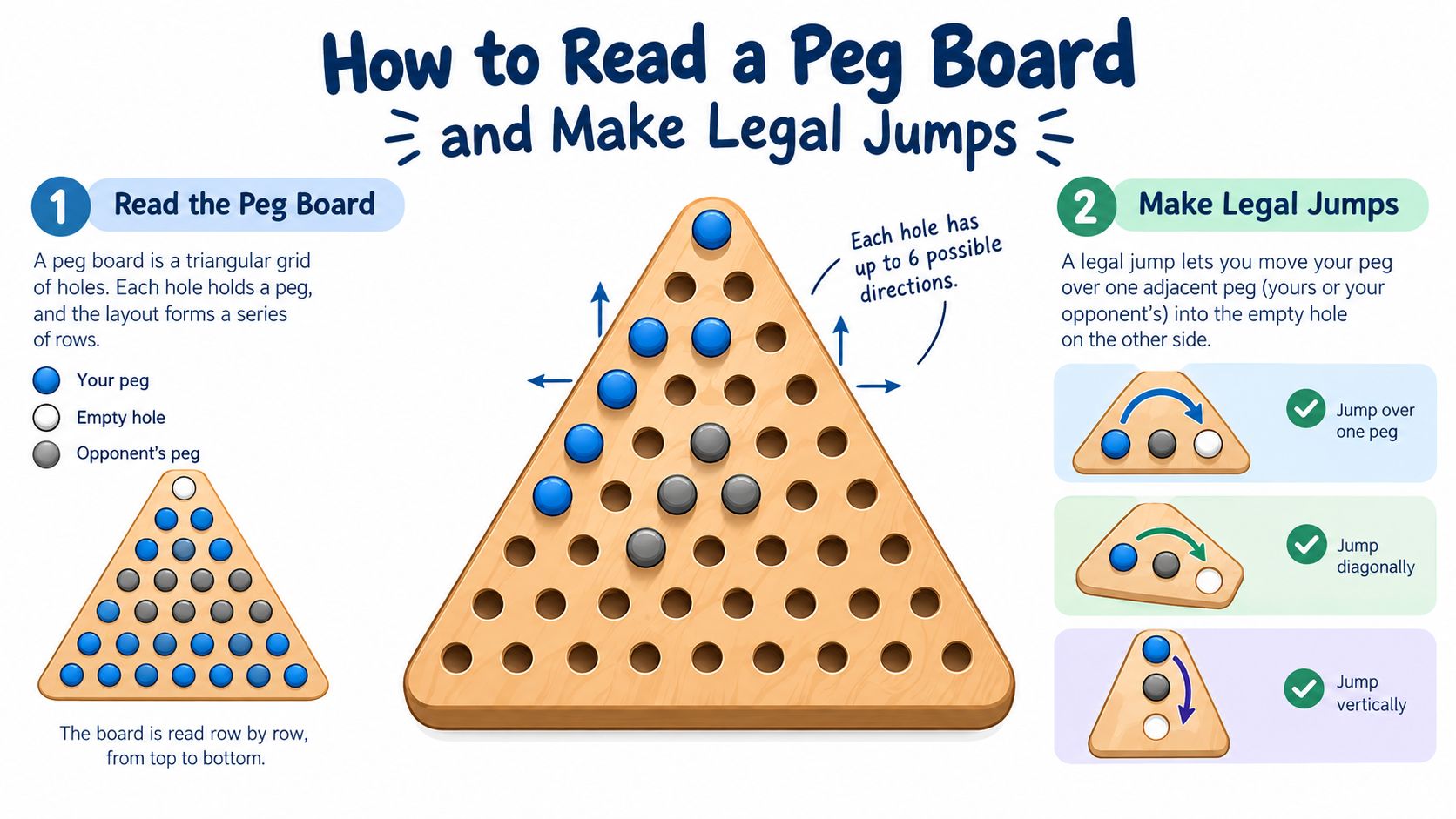
A legal jump always follows a straight horizontal or vertical line. Diagonal jumps aren't legal on the English board. The starting peg moves across one adjacent peg into the next hole, and that destination must be empty before the move.
A reliable move-checking routine
Before moving a peg, check these three conditions:
- The starting hole contains a peg.
- The adjacent hole contains a peg to jump over.
- The landing hole is empty and lies exactly one hole beyond the crossed peg.
If one condition fails, the move isn't legal. This sounds obvious, but mistakes often happen when players look at the board from an angle or mentally skip the middle position.
Record moves as you play. Coordinate notation makes it easier to identify the first divergence when a solution fails. It also turns a confusing board into a sequence you can review. If you prefer plain language, write “middle-left peg jumps right over its neighbor into the empty center” and convert to coordinates later.
Keep an eye on isolated pegs. A single peg near an edge may be safe if a landing route remains, but isolated pieces usually offer fewer future jumps than connected groups. Don't remove every outer peg automatically. Instead, ask whether the move leaves a route back toward the active part of the board.
Core Solitaire Peg Solution Strategies That Actually Work
Strong play combines local awareness with long-range pruning. You still choose one legal jump at a time, but you judge that jump by the branches it keeps alive. This is the human version of a search algorithm: explore promising paths, reject positions that can't support a finish, and return to the last meaningful choice when necessary.
Preserve connections
Connected pegs give you flexibility. If a region contains several pegs arranged along the same row or column, it may support multiple jump directions. Clearing that region too aggressively can leave the board visually tidy but strategically empty.
Edge clusters deserve special care. They're harder to re-enter once you remove their internal support, so avoid spending them merely to gain an early open space. Use an edge jump when it contributes to a larger route, such as feeding pegs toward the center or creating a needed landing hole.
Plan from the finish
Backward reasoning is one of the most useful habits for beginners. Choose the hole where you want the final peg to remain, then ask what the final jump must look like. The last move requires a peg, an adjacent peg, and an empty destination, so the position immediately before the finish has a very specific shape.
Work backward again. What move could create that pre-finish arrangement? You won't always reconstruct the complete solution, but this method prevents moves that make your intended ending impossible.
Use the sixth move as a warning point
The opening can hide mistakes because many legal jumps remain. By around the sixth move, you should stop judging progress by the number of pegs removed and start checking the board's shape. Look for stranded pieces, closed corridors, and clusters with no available landing hole.
If you're stuck, don't restart immediately. Undo to the last move that changed the relationship between two clusters. That move is often the main decision point, while the later dead end is only the visible symptom.
Search idea in plain language: Don't examine every possible move equally. Discard branches that isolate a region or make the chosen finishing hole unreachable.
The question of whether brain games make you smarter is separate from the practical benefit here. Peg solitaire gives you a clear setting for practicing attention, sequencing, and error analysis, because every failed line leaves a visible board state.
A solver can also use a computer search as a teacher rather than a crutch. The point isn't to copy a mysterious list of coordinates. It's to compare a successful branch with a failed branch and identify which connection the successful line protected.
Step-by-Step English Board Solutions for Beginners
The central-start English board is the clearest place to practice. Begin with the center empty and all other valid holes occupied. Your target is usually one peg in the center, although a different finishing hole can require a different move order.
The shortest known English-board solution uses 18 moves, a result associated with Ernest Bergholt in 1912 and later proven minimal by John Beasley in 1964, as documented in the history and solution overview of peg solitaire. A shortest solution is mathematically elegant, but it isn't always the easiest sequence for a first-time player to follow. Your immediate goal should be a stable, understandable line.
Start with a notation checkpoint
Use the coordinate layout from the rules section. If your board uses a different numbering system, translate the moves rather than forcing the labels to match.
A familiar opening pattern is to make a jump into the central vacancy, then use the newly created empty hole to support a second jump. The exact direction depends on the chosen solution line and board orientation. Rotate the board mentally if needed. A move that looks different may be equivalent after a quarter-turn or reflection.
At each checkpoint, pause and confirm three things:
- The center has changed purpose. It may begin empty, become occupied, then become empty again as a route rather than a permanent destination.
- Outer groups remain connected. You should still have at least one useful way to move pegs from an edge toward the interior.
- The intended finish remains possible. Don't fill or block the final destination without knowing how it will become the last occupied hole.
Follow phases instead of memorizing a wall of moves
A practical solution usually feels easier when divided into phases.
Outer-region preparation uses jumps that reduce crowded areas without cutting their access to the center. Don't treat every edge peg as disposable. The desired result is a smaller, still-connected group.
Central coordination brings several regions into contact. Here, a jump may appear to move a peg away from the finish, but it can create the empty landing hole needed for the next sequence. Watch the holes, not just the pegs. Empty spaces are working resources.
Final alignment leaves a compact arrangement that supports the last few jumps. Backward reasoning holds paramount importance at this stage. If the remaining pegs don't form a route toward the target, undo to the prior phase rather than trying random repairs.
What to do when your board differs
A single wrong move can produce a position that no longer matches your reference. Don't continue by guessing. Mark the first move where your board diverged, restore the position before it, and test the alternative legal jump.
If you've already made several moves, compare clusters rather than individual coordinates. Ask whether the same region was cleared, whether the center was used as a bridge, and whether the finishing route remains open. This lets you recover conceptually even when the notation looks unfamiliar.
For practice, you can use a digital board with undo and redo, or a solver that displays legal moves and explores alternatives. The most useful feedback is not merely “solved.” It's seeing where a branch becomes impossible and which earlier choice caused that restriction.
French Board Solitaire Peg Solutions and Variant Differences
The French board changes the problem before the first move. Its layout has extra corner holes compared with the English cross, so pegs can form relationships that don't exist on the standard board. A move sequence that works on the English board may be illegal, ineffective, or strategically misplaced on the French layout.
That difference matters because board shape controls access. On the English board, the narrow arms can make outer regions difficult to re-enter. On the French board, the added corners create more room but also more positions to manage. More apparent mobility doesn't guarantee an easier finish.
Adjust the target before choosing moves
First identify the starting vacancy and the intended finishing hole. Variant boards can have distinct finishing constraints, so “leave one peg in the middle” isn't a universal instruction. The board-variant reference from Jaap's Puzzle Page illustrates why board shape, starting hole, and ending position must be treated as one problem.
A useful French-board routine looks like this:
- Map the corners first. Note which corner clusters can jump inward and which can only interact locally.
- Protect re-entry routes. A corner may need a supporting peg nearby before it can contribute to the center.
- Test the finish backward. If the target hole requires a final horizontal jump, preserve the two preceding positions needed to create it.
Why greedy play fails early
Random-play analysis of the English board gives a vivid warning. Moves 1 through 5 have zero dead-end risk, but by move 6 there are already 32 possible dead-end paths. The number rises to 386,416 by move 14 and 81,723,294,080,159,936 by move 31, according to the University of Waterloo analysis of peg-solitaire backtracking.
Those figures don't mean every human move is equally dangerous. They show that the tree of possible play expands quickly, while many branches eventually fail. On a French board, the altered geometry changes which branches are useful, so copying an English pattern without checking legality is a poor strategy.
A good solver prunes by asking whether a move leaves every important region with a future role. If a corner becomes permanently isolated, reject that branch early. If the board still contains several connected routes, continue exploring it even if the move didn't reduce the most visible cluster.
How Many Solutions Exist and Why Planning Matters
The standard English board has far more possible play than its simple appearance suggests. One count reports 577,116,156,815,309,849,672 possible game sequences, while another count gives 40,861,647,040,079,968 total solutions when move order is counted. An independent analysis reports 23,475,688 reachable board positions from the central-vacancy start. These figures are collected in the English peg-solitaire counting analysis.
The counts differ because “solution” can mean different things. One method may distinguish every move order, while another may group paths that reach the same board position. That distinction is important for players: two games can look different step by step but arrive at the same strategic state.
What the numbers mean at the table
You don't need to calculate these sequences while playing. The practical lesson is that memorizing one line doesn't teach you how to handle a changed position. If you make a different opening move, rotate the board, or aim for another finishing hole, you need transferable principles.
At this juncture, pruning becomes a human skill. You can reduce the choices by ruling out moves that:
- leave a single peg with no nearby support,
- consume a bridge between two active clusters,
- block the target finishing route,
- or create a region that can't supply a future jumper or landing hole.
The mathematics of solitaire helps explain why a small board can still produce a huge search problem. Every legal jump changes the next set of legal jumps, so an apparently harmless decision can reshape the entire remaining game.
Computer solvers make this manageable with depth-first search, which follows one branch until it succeeds or fails, then backtracks. More advanced bidirectional BFIDA* methods search forward and backward so the frontiers meet, improving on earlier search times by up to two orders of magnitude in reported work on peg-solitaire instances, as described in the technical study of bidirectional peg-solitaire solving.
For a human, “search from both directions” means alternating between two questions: What can I do now, and what must be true just before the finish? The strongest moves satisfy both.
Final Checklist for Solving Any Peg Solitaire Board
Before your first jump, identify the board shape, the empty starting hole, and the finishing hole you want. Don't assume an English solution transfers to a French or triangular layout. The benefits of playing solitaire are easier to experience when you treat the game as focused practice rather than random repetition.
Use this compact routine during play:
- Confirm legality: Check the starting peg, crossed peg, straight direction, and empty landing hole.
- Protect clusters: Keep at least one route between important regions.
- Scan ahead: Consider the next few useful jumps, not only the current capture.
- Review after the opening: Once the early freedom narrows, look for isolated pegs and blocked corridors.
- Plan backward: Keep the final destination and its required pre-finish shape in mind.
- Undo intelligently: Return to the last structural decision, not merely the latest move.
- Change the target when needed: A different finishing hole may suit the position better than forcing a blocked central finish.
Peg solitaire becomes far less mysterious when every jump has a reason. You're not trying to guess the one magical move. You're managing connections, preserving options, and pruning weak branches until a complete route remains.
Play Solitaire Gaming offers browser-based solitaire games with touch-friendly controls, smart hints, and unlimited undo and redo, so you can practice deliberate planning without downloads or signups. Visit Play Solitaire Gaming to explore its classic solitaire variants and use the same patient, forward-thinking habits in a different kind of single-player puzzle.
Ready to play?