8 Benefits of Playing Solitaire for Mind and Mood
By Rajat Agarwal, Founder of Play Solitaire Gaming
Explore the benefits of playing solitaire, from sharper planning and focus to relaxation, emotional resilience, and practical ways to play with purpose.
Solitaire is more than a way to pass time. A quiet solo card game can ask you to plan several moves ahead, hold information in mind, stay with a task, accept setbacks, and change direction when a promising line fails. That doesn't make it a cure-all, and it shouldn't be sold as a guaranteed way to prevent illness or improve intelligence. The experience depends on the variant, how actively you play, and whether you keep healthy limits around screen time.
The strongest benefits of playing solitaire are practical and modest. FreeCell can turn card placement into a planning exercise. Klondike can make you track hidden information. Golf or TriPeaks can offer a calmer pause, while rotating through several variants can challenge your ability to switch strategies. Research also points to a more careful interpretation: card games may engage useful cognitive skills, and gameplay data may provide screening signals, but solitaire isn't a medical diagnosis.
The eight benefits below connect each possible advantage to specific mechanics and simple ways to play with more intention. They also show how Play Solitaire Gaming's ad-free browser access, daily challenges, hints, undo tools, and optional stats can support deliberate practice without turning entertainment into a health promise.
Table of Contents
- 1. Improved Problem-Solving and Strategic Planning
- 2. Enhanced Memory and Concentration
- 3. Stress Reduction and Relaxation
- 4. Development of Patience and Emotional Regulation
- 5. Sense of Accomplishment and Achievement Motivation
- 6. Behavioral Focus and Attention Control
- 7. Cognitive Flexibility and Adaptive Thinking
- 8. Sustained Motivation Through Habit Formation and Social Engagement
- Solitaire Benefits: 8-Point Comparison
- Turn Casual Games Into Intentional Practice
1. Improved Problem-Solving and Strategic Planning
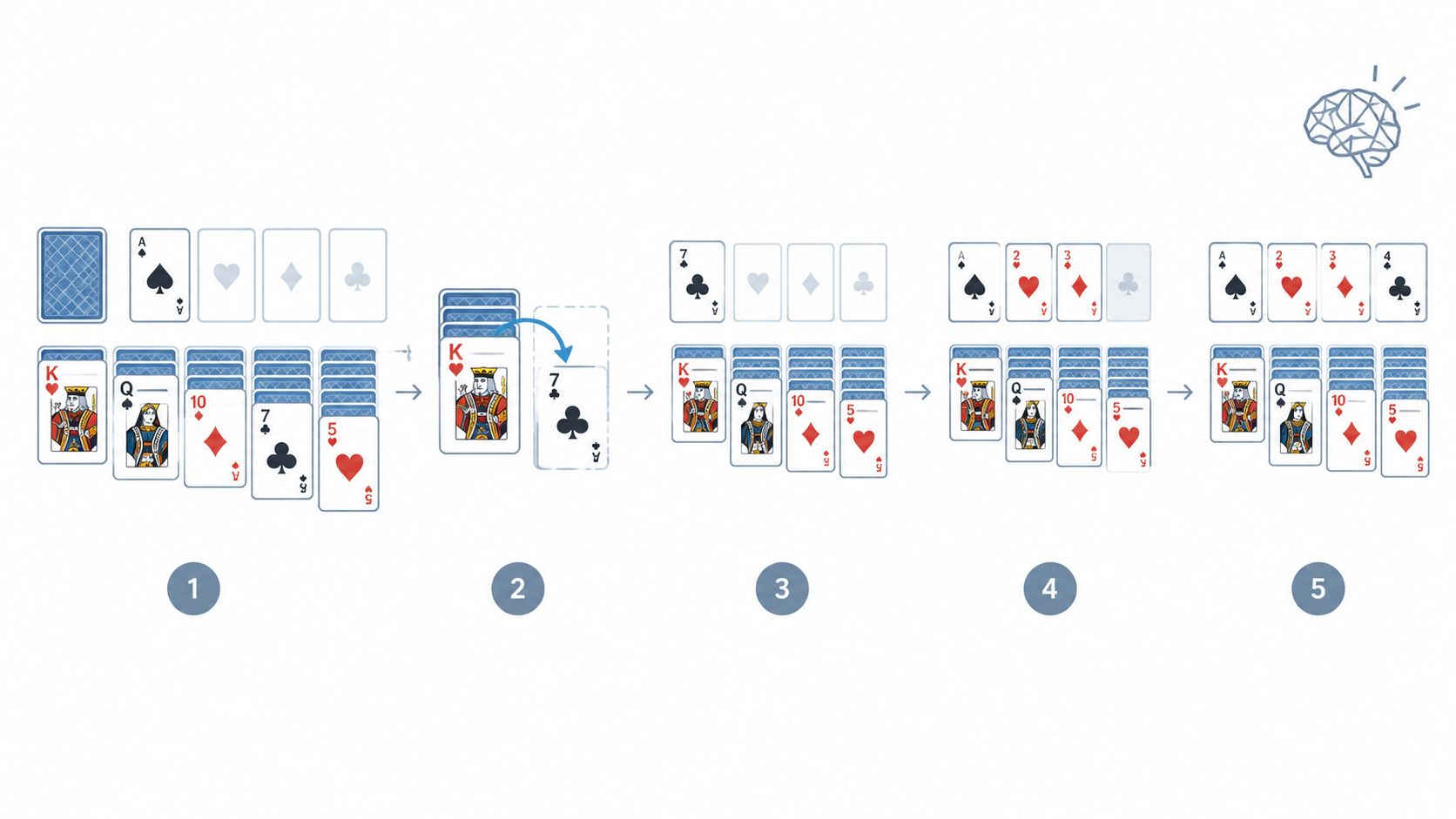
Solitaire does not reward speed alone. Each move changes the options that remain. Moving a card can reveal a hidden card, open a tableau column, block a sequence, or determine which cards become reachable next. The game therefore works like a small planning exercise: compare possible actions, predict consequences, and choose before committing.
FreeCell makes resource management easy to see. Its four free cells provide temporary storage, but filling them too quickly can leave insufficient space for moving longer sequences. Try reserving at least one cell for an unexpected blockage, then check whether a move improves access rather than merely clearing a card. Klondike requires a different judgment because some cards remain hidden. You weigh visible progress against the chance that a move will restrict later choices.
Match the variant to the planning challenge
Each variant emphasizes a different decision pattern:
- FreeCell: Treat the four free cells as limited resources, not convenient places to store every available card.
- Spider: Build and rearrange sequences across suits, watching how suit structure affects future moves.
- Pyramid: Find pairs totaling 13 while choosing the combination that opens the most useful part of the layout.
- Forty Thieves: Sequence moves carefully through a demanding structure, where patience matters more than quick clearing.
Play Solitaire Gaming's smart hint feature can identify a legal or potentially useful move while you learn. Before selecting it, predict what the move will reveal, then compare your reasoning with the hint. Daily challenges and optional stats can make practice more deliberate. Leaderboards may add pressure, but personal improvement is a clearer measure than rank.
A card-game training program for older adults improved executive control on untrained measures, while results did not extend broadly to reasoning or delayed episodic memory in the study's report. The careful conclusion is limited: card play can engage planning and control, not guarantee improvement in every mental ability.
2. Enhanced Memory and Concentration
Solitaire keeps information active while you make decisions. In Klondike, you may remember that a needed card was buried in a tableau pile, notice which cards have appeared in the waste pile, and hold several possible sequences in mind while you search for a legal move. The game doesn't ask you to memorize a list separately. It places memory inside an immediate task.
FreeCell makes more information visible, but that doesn't make it effortless. You still track which cards are available, which free cells are occupied, and how moving one sequence affects later access. In hidden-card variants, the uncertainty adds another layer because you must remember partial information without seeing the entire layout.
Build attention through active play
Try these adjustments rather than playing on autopilot:
- Use hidden-card games: Klondike and Pyramid make you recall positions and possible combinations.
- Reduce automatic correction: Play a deal without immediately using undo, then review the position afterward.
- Change the difficulty gradually: Start with a visible-information game such as FreeCell, then return to Klondike when you want more memory demands.
- Notice the board aloud: Naming a useful card location can reinforce attention, especially when you're learning.
The mental health and brain benefits of solitaire are best understood as skills practice, not guaranteed cognitive enhancement. A 2024 KU Leuven study found that Solitaire gameplay data could assess attention, executive function, object recognition, abstraction, and memory, and clinicians described possible value for non-intrusive, longitudinal screening without practice effects in the study materials. That distinction matters. Remembering card positions may exercise attention during play, while gameplay patterns may also offer information about cognition over time. Neither point makes the game a diagnostic test.
3. Stress Reduction and Relaxation
Solitaire can create a contained pause because its rules are stable and its consequences stay inside the game. You draw, inspect, choose, and continue. For some players, that predictable rhythm helps redirect attention away from a busy day without introducing the rapid competition or social pressure found in other games.
Choose the variant according to your state. Golf uses a simple remove-the-next-higher-or-lower-card rhythm, so it can suit a short break when you don't want a dense planning task. TriPeaks offers quick visual feedback as cards disappear from the peaks. Klondike may feel comforting because its familiar structure supports habitual, low-pressure play.
Keep relaxation separate from competition
A leaderboard can motivate you, but it can also change a restful game into a performance test. Turn away from rankings when you're anxious, set a stopping point before you begin, and choose Golf or TriPeaks instead of FreeCell if complex decisions feel tiring. Play Solitaire Gaming's ad-free environment removes the interruption of advertisements, which can make a short browser session easier to keep calm and contained.
Choose the gentlest useful challenge: If your thoughts are racing, don't force yourself into the hardest variant. A simple, bounded game may serve the purpose better.
Evidence about solitude adds context without proving that solitaire itself reduces stress. A 2023 NIH-hosted study found that on days when people spent more time alone, they reported less stress and greater satisfaction of autonomy, and solitude was also associated with greater day satisfaction and lower stress overall in the study's findings. That doesn't establish a universal effect from solo card play. It does support a reasonable possibility that chosen, quiet time can feel restorative for some people. For more context on using solitaire as a low-pressure pause, see solitaire for adults.
4. Development of Patience and Emotional Regulation
Solitaire gives frustration a clear boundary. A deal can stall because a needed card is unavailable, a sequence is blocked, or an earlier move closed off an option. You can't control every card arrangement, so the useful response is to pause, reassess, and decide whether to continue, undo, or start again.
Spider makes patience especially noticeable. Managing sequences across multiple suits can require you to delay a satisfying move because using a space too early may reduce your options. In a daily challenge, a loss can feel more personal because other players may be completing the same puzzle, but it still offers practice in separating one result from your overall ability.
Turn losses into information
After a difficult game, ask a narrow question rather than judging yourself:
- Review the turning point: Which move reduced your future choices?
- Test one alternative: Use unlimited undo to compare a different sequence.
- Separate luck from choice: Some deals won't resolve through skill alone.
- Track the pattern: Look for better decisions over time, not perfection in every game.
The aim isn't to become emotionally unaffected. It's to notice frustration before it controls the next move. Daily challenges can expose you to varied outcomes, while stats can help you focus on longer-term patterns instead of a single loss. Use them as feedback, not as a scorecard for personal worth.
Research on card games also suggests that context matters. A controlled study summarized in an open-access thesis found that card-playing alone produced little cognitive change, while card play combined with socialization produced the most significant improvements on cognitive tests in the summarized findings. That result doesn't mean solo solitaire has no value. It does caution against treating every form of card play as identical, and it suggests that discussing a game, teaching a relative, or comparing strategies with a friend may add a social dimension.
5. Sense of Accomplishment and Achievement Motivation
Solitaire turns progress into something you can see. A cleared tableau, an organized foundation, or a completed deal gives the session a definite endpoint, which can feel satisfying beside unfinished work and daily interruptions. The accomplishment comes from making legal choices and adapting to the layout, not from needing elaborate rewards.
The kind of challenge changes the feeling of success. Klondike can support momentum through repeated wins, while FreeCell makes completion feel more deliberate because its visible layout invites careful planning. Golf offers a quicker target; Spider and Forty Thieves ask for more sustained sequencing. Trying these variants lets you match difficulty to your current aim.
Make progress useful
Achievement features work best as feedback rather than judgment:
- Choose a suitable starting point: Use Klondike or Golf for shorter, approachable sessions, then test Spider or Forty Thieves as your planning improves.
- Compare your own results: A changing win rate, completion record, or streak can show development more clearly than a leaderboard position.
- Treat a daily challenge as an invitation: A recurring target can give play structure. Missing it does not measure your ability or commitment.
- Review the process: After a win, identify the decision that preserved options or exposed a useful card. That observation is practice, not just praise.
A finished game does not prove a dopamine-based health effect, and the available information here does not establish a particular chemical response from solitaire. A narrower behavioral claim is more defensible: clear goals and visible feedback can encourage people to return to a task and notice gradual improvement. Play Solitaire Gaming's ad-free access can reduce interruptions, while cloud-synced stats can help you review results across devices. For a structured recurring target, try the solitaire daily challenge, then decide whether the routine supports your attention or creates unnecessary pressure.
6. Behavioral Focus and Attention Control
A solitaire game gives attention a narrow track to follow. You inspect the layout, remember the objective, reject illegal or weak moves, and return to the position after a mistake. In Klondike, that may mean checking whether moving one sequence will expose a hidden card. In FreeCell, it can mean holding several possible moves in mind before using an open cell. These actions provide practice in directing attention, though they are not the same as meditation or formal attention treatment.
The value comes from deliberate engagement, not screen time alone. An ad-free browser setting can reduce interruptions, and leaving notifications unanswered while completing a deal adds a small real-world test of impulse control. A short session may therefore work like a rehearsal: keep one task in view, resist switching, and finish at a chosen stopping point.
Try this focus block:
- Silence or limit notifications.
- Select one familiar deal in Klondike, FreeCell, or another variant.
- Keep the game open rather than moving between apps.
- Stop at a preselected point, then begin one work, reading, or household task.
Play Solitaire Gaming's daily challenges can provide a recurring cue for this routine. Its cloud-synced stats may show whether you return consistently, but they cannot prove that attention has improved beyond the game. If you play in public, keep the session short and monitor your surroundings.
Use the result as a transfer test. Close unrelated tabs, complete one small task, and notice whether the same single-task habit feels easier to apply.
A twenty-minute session is a personal experiment, not an established threshold for better focus. Research supports associations between solitaire gameplay variables and abilities such as working memory, processing speed, and visual short-term memory, as summarized by CRESST. It does not show that a particular session length produces a specific improvement in everyday attention.
7. Cognitive Flexibility and Adaptive Thinking
Solitaire rewards different kinds of decisions depending on the variant. Klondike asks you to build alternating-color sequences and send cards to foundations in order. FreeCell gives you visible information but limits temporary storage. Spider centers on suit sequencing, while Pyramid requires pairs that total 13. Yukon, Golf, TriPeaks, and Forty Thieves each change the priorities again.
The practical skill is strategy adjustment. A move that opens a column in Klondike may have little value in Pyramid, while clearing cards too quickly can weaken a Spider position. Switching games therefore works like changing the rules of a puzzle: you must identify what matters before choosing your next move.
It also encourages metacognition, or noticing how you make decisions. After a loss, ask whether you missed information, committed too early, or continued using a strategy suited to another variant. That review is more useful than treating every outcome as proof of ability.
Practise deliberate strategy changes
Choose one familiar game, then move to a variant that changes a single major feature:
- Klondike to FreeCell: Compare hidden information with deliberate free-cell management.
- Klondike to Spider: Replace foundation-focused progress with multi-suit sequencing.
- Sequence games to Pyramid: Replace rank ordering with value-based pairing.
- Complex games to Golf: Adapt to a faster, simpler decision loop.
Play Solitaire Gaming's how-to-play guides can clarify the rules before you start. Smart hints can identify legal options while you learn, and daily challenges can prompt you to practise a less familiar variant. Stats may help you review patterns such as repeated losses or changing win rates, but they do not prove broader cognitive improvement. Choose a different game occasionally, then explain why your first plan no longer fits.
Research supports a cautious interpretation. One intervention found improvements in executive control, while reasoning and delayed episodic memory did not show the same gains in the reported results. Flexible thinking is a reasonable practice target, not evidence that rotating solitaire games produces broad cognitive improvement for everyone.
8. Sustained Motivation Through Habit Formation and Social Engagement
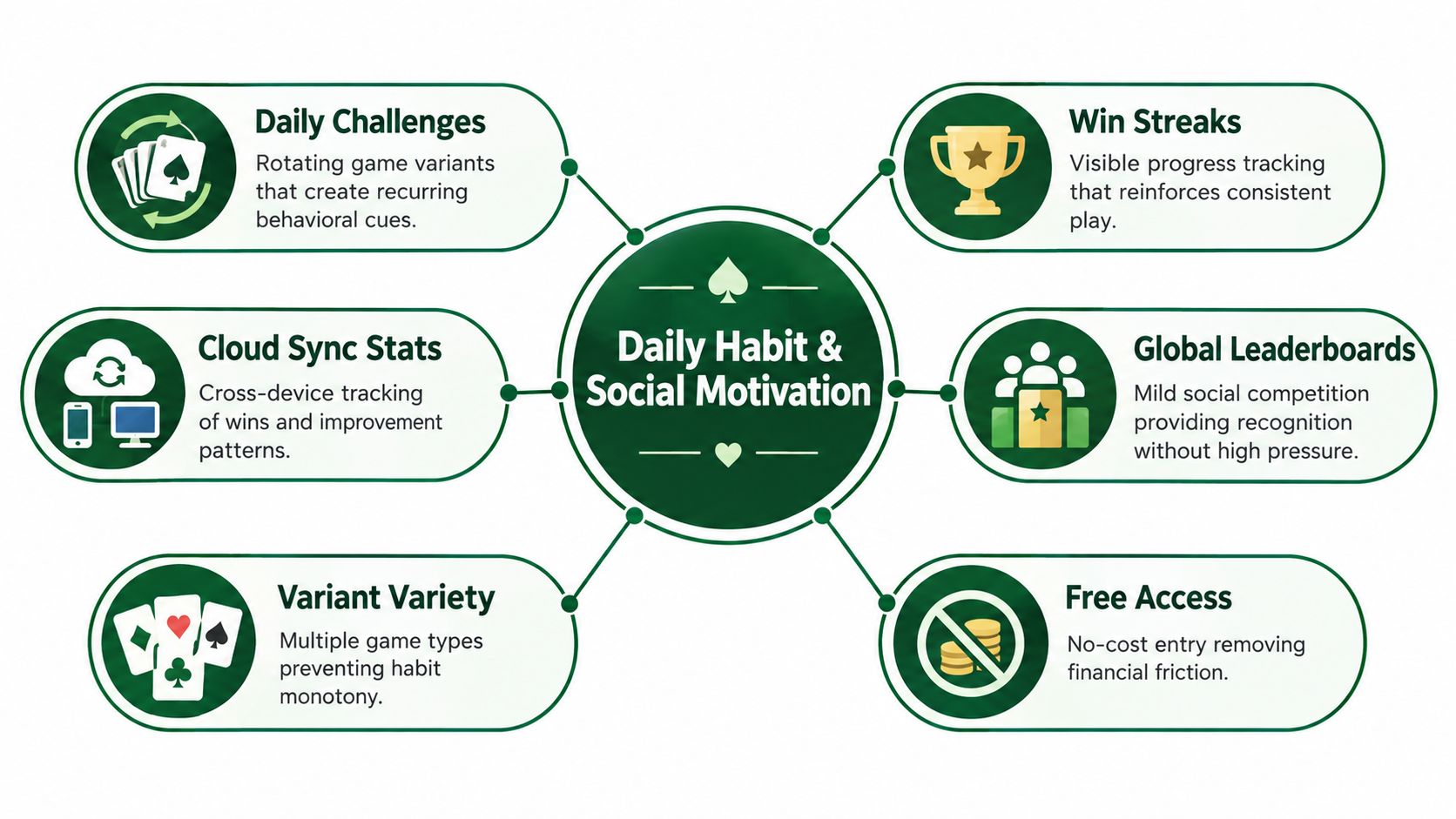
A sustainable solitaire habit has three parts: a cue, a manageable action, and a reason to return. A daily challenge supplies the cue, finishing a deal creates immediate closure, and personal stats make patterns visible. Optional leaderboards add social comparison without requiring a live multiplayer contest.
Choose a routine that fits the time and attention you have. Play Klondike during a quiet break, select Golf for a shorter decision loop, or reserve FreeCell for a longer planning session. Play Solitaire Gaming's ad-free access reduces interruptions, while optional Google or Apple sign-in can sync win rates, streaks, and detailed stats across a phone, tablet, and desktop.
Make the routine sustainable
- Begin with a small commitment: Try one daily challenge each week before increasing frequency.
- Set a clear boundary: Decide when the session ends before starting.
- Use progress privately: Let your win rate guide practice instead of making leaderboard rank the goal.
- Add social reinforcement: Share a strategy or milestone with a friend, even when you continue playing alone.
- Keep access friction low: Browser play lets you start without a download or signup.
A practical daily solitaire habit routine might pair the same cue with a specific variant. For example, play Klondike after a morning coffee, attempt the daily challenge, and record one decision that worked or failed. The goal is consistency, not a long session. If the routine begins to feel like an obligation, shorten it or change the cue.
Social engagement can make repetition easier, but research should be interpreted carefully. A large prospective cohort study of 12,423 Chinese adults aged 65 and older found that people who played cards or mahjong almost every day had a 37% lower risk of incident dementia than people who rarely or never played, after multivariable adjustment, with a hazard ratio of 0.63 and a 95% confidence interval of 0.42 to 0.95 in the 2022 study. This observational association involved card and mahjong play. It does not show that solo digital solitaire prevents dementia. It does support regular, mentally engaging activities when expectations remain realistic.
Solitaire Benefits: 8-Point Comparison
| Benefit | 🔄 Implementation complexity | ⚡ Resource requirements | 📊 Expected outcomes | 💡 Ideal use cases | ⭐ Key advantages |
|---|---|---|---|---|---|
| Improved Problem-Solving and Strategic Planning | Moderate, learn variant strategies and forward-planning | Low tech, moderate practice time and cognitive effort | Improves planning, sequencing, and decision-making over time | Skill-development sessions, analytic training, brain exercise | Transferable strategic skills, varied difficulty levels |
| Enhanced Memory and Concentration | Moderate, use hidden-card variants for greater challenge | Low tech, requires sustained sessions for gains | Strengthens working memory and sustained attention | Memory training, study-focus practice, cognitive rehab | Non-stressful memory workout with immediate feedback |
| Stress Reduction and Relaxation | Low, simple rules, quick to start | Minimal time per session; ad-free/distraction-free recommended | Lowers stress, promotes relaxation and short-term calm | Short work breaks, anxiety management, mindful downtime | Rapid calming effect, accessible and low-pressure |
| Development of Patience and Emotional Regulation | Low–Moderate, repeated exposure to uncertainty | Low tech, requires long-term consistent play | Improves frustration tolerance and emotional resilience | Practicing acceptance, gradual exposure to loss, therapy adjunct | Safe environment to practice regulation and persistence |
| Sense of Accomplishment and Achievement Motivation | Low, instant feedback; optional social features | Low time per win; cloud sync/leaderboards optional | Boosts motivation, self-efficacy via wins, streaks, stats | Habit building, confidence boosting, gamified goals | Regular measurable achievements and progress tracking |
| Behavioral Focus and Attention Control | Moderate, intentional distraction-free practice needed | Low tech; dedicated uninterrupted time blocks | Strengthens sustained attention and single-tasking ability | Focus training for work/study, cultivating flow states | Builds attentional habits; ad-free UI supports focus |
| Cognitive Flexibility and Adaptive Thinking | High, learn multiple variants and switch strategies | Low tech but requires deliberate variant-switching and time | Enhances task-switching, adaptive reasoning across contexts | Cross-training mental agility, preventing cognitive rigidity | Broad mental agility from multi-variant practice |
| Sustained Motivation Through Habit Formation and Social Engagement | Moderate, set up daily cues, use social features | Low tech; requires sign-in/cloud sync and regular commitment | Establishes consistent play habits and mild social motivation | Long-term engagement, habit formation, light competition | Encourages consistency via streaks, daily challenges, leaderboards |
Turn Casual Games Into Intentional Practice
The best way to use the benefits of playing solitaire is to choose one purpose instead of expecting every game to do everything. If you want deliberate planning, begin with FreeCell and treat each free cell as a resource. If you want to practice remembering hidden information, choose Klondike or another hidden-card game and pause before using hints or undo. For a calmer break, Golf or TriPeaks offers a simpler rhythm. For flexible thinking, rotate between Klondike, Spider, FreeCell, Pyramid, Yukon, Golf, TriPeaks, and Forty Thieves so you have to adjust your decision rules.
Keep sessions bounded and active. Decide whether you're playing to relax, learn a pattern, complete a Daily challenge, or review your choices. Use hints and unlimited undo or redo as learning tools, not as evidence that you should keep playing indefinitely. Stats, streaks, and leaderboards can show how your play is changing, but they aren't proof of improved health, prevented dementia, or a diagnosis of any cognitive condition.
The research supports measured language. Card games have been associated with lower dementia risk in a large older-adult cohort, and intervention studies have found specific gains in executive control or verbal fluency. Gameplay data from Solitaire may also help assess cognitive abilities and monitor change over time. Those findings make solitaire a promising form of structured engagement and a possible low-friction screening signal, not a substitute for clinical evaluation. If you or someone close to you notices concerning memory or thinking changes, speak with a qualified healthcare professional rather than relying on game performance.
Play Solitaire Gaming gives you a straightforward way to test these approaches. It offers eight browser-based variants, including Klondike, Spider, FreeCell, Pyramid, Yukon, Golf, TriPeaks, and Forty Thieves, with drag-and-drop controls, smart hints, and unlimited undo and redo. You can play without downloading an app or creating an account, use Daily challenges and global leaderboards if motivation helps, and enable optional private cloud sync through Google or Apple sign-in when you want stats and streaks across devices.
A useful starting plan is simple. Pick one variant that matches your goal, play with full attention for a bounded period, and record one observation afterward, such as whether you planned ahead, remembered a card location, or felt calmer. Repeat that approach consistently, then change the variant only when you have a reason. Solitaire works best as an enjoyable activity with clear limits, not as a medical promise disguised as a game.
Visit Play Solitaire Gaming to try ad-free Klondike, Spider, FreeCell, and five other solitaire variants instantly in your browser. Use smart hints, unlimited undo and redo, Daily challenges, and optional synced stats to make your play more intentional, whether you're practicing planning, taking a calm break, or building a sustainable routine.
Ready to play?