Do Brain Games Make You Smarter? What the Evidence Shows
By Rajat Agarwal, Founder of Play Solitaire Gaming
Do brain games make you smarter? Explore what research and meta-analyses really say about brain training, transfer, and who benefits most.
Most advice about brain games starts with the wrong promise. A few minutes of matching shapes, remembering cards, or solving patterns may leave you feeling sharper, but that feeling doesn't answer the important question: do brain games make you smarter outside the game?
The evidence points to a more useful answer than either hype or dismissal. Brain games can improve the tasks you practise, and some forms of cognitive training help particular groups with particular abilities. But becoming faster at a memory grid isn't the same as remembering names at a party, reasoning through a complicated decision, or raising general intelligence.
Table of Contents
- The Big Question About Brain Games
- What Brain Games Actually Are
- Where Brain Games Clearly Help
- Why Brain Games Do Not Raise Your IQ
- Who Actually Sees the Biggest Benefits
- How to Get Real Cognitive Value From Practice
- Solitaire as a Focus and Brain Exercise
- The Honest Bottom Line on Brain Games
The Big Question About Brain Games
A higher score in a memory game does not automatically mean a stronger memory in daily life. Players can learn recurring patterns, recognise visual cues faster, and develop strategies suited to an app's rules. Those gains are genuine, but they may remain tied to the task being practised.
Researchers call the broader issue transfer. Improvement on a second sequence task could show useful carryover because it places similar demands on memory. Remembering a stranger's name, retaining what you read, or recalling why you entered a room depends on different cues and retrieval processes. Success in one setting therefore offers no guarantee of success in another.
A large meta-analytic review found that working-memory training reliably improves trained tasks and closely related skills. Under stronger treated-control designs, however, it found no convincing evidence of lasting gains in nonverbal ability, verbal ability, word reading, or arithmetic. The findings support a skill-specific account of training, rather than a broad expansion of cognitive capacity. Read the meta-analytic review on working-memory training and transfer.
The useful question isn't “Did my score rise?” It's “What can I do better away from the game?”
That question reflects how cognitive researchers test genuine change. They compare people who receive training with suitable control groups, assess abilities beyond the original exercise, and check whether improvements persist. Without these comparisons, a higher app score could reflect familiarity, a learned strategy, or recognition of repeated formats instead of a general mental improvement.
The answer is conditional. Brain games can make you better at brain-game tasks. Broader benefits depend on what “smarter” means, which group is being studied, and whether the trained skill carries over to an unpractised ability. The gap between practice and transfer is the point, and it is where claims about brain games should be judged.
What Brain Games Actually Are
Think of brain training as a library analogy. Doing crossword puzzles is to brain games what reading romance novels is to a literature degree. The activities are related, and both involve language or attention, but one doesn't provide the breadth, analysis, and structured practice of the other.
Commercial apps usually package short exercises around functions such as working memory, selective attention, processing speed, planning, or reaction time. A laboratory task may isolate one of these abilities under controlled conditions. An app turns similar ideas into levels, scores, adaptive difficulty, reminders, and rewards.
Three terms make the research easier to understand:
- Near transfer means improving at the trained task or a very similar task. Someone who practises a particular sequence game may perform better on another sequence involving similar demands.
- Far transfer means carrying the improvement to a substantially different ability, such as general reasoning, everyday memory, or fluid intelligence.
- Process-based training means repeated drills aimed at a mental process rather than a body of knowledge. A working-memory exercise trains the temporary holding and manipulation of information, not history, vocabulary, or mathematical concepts.
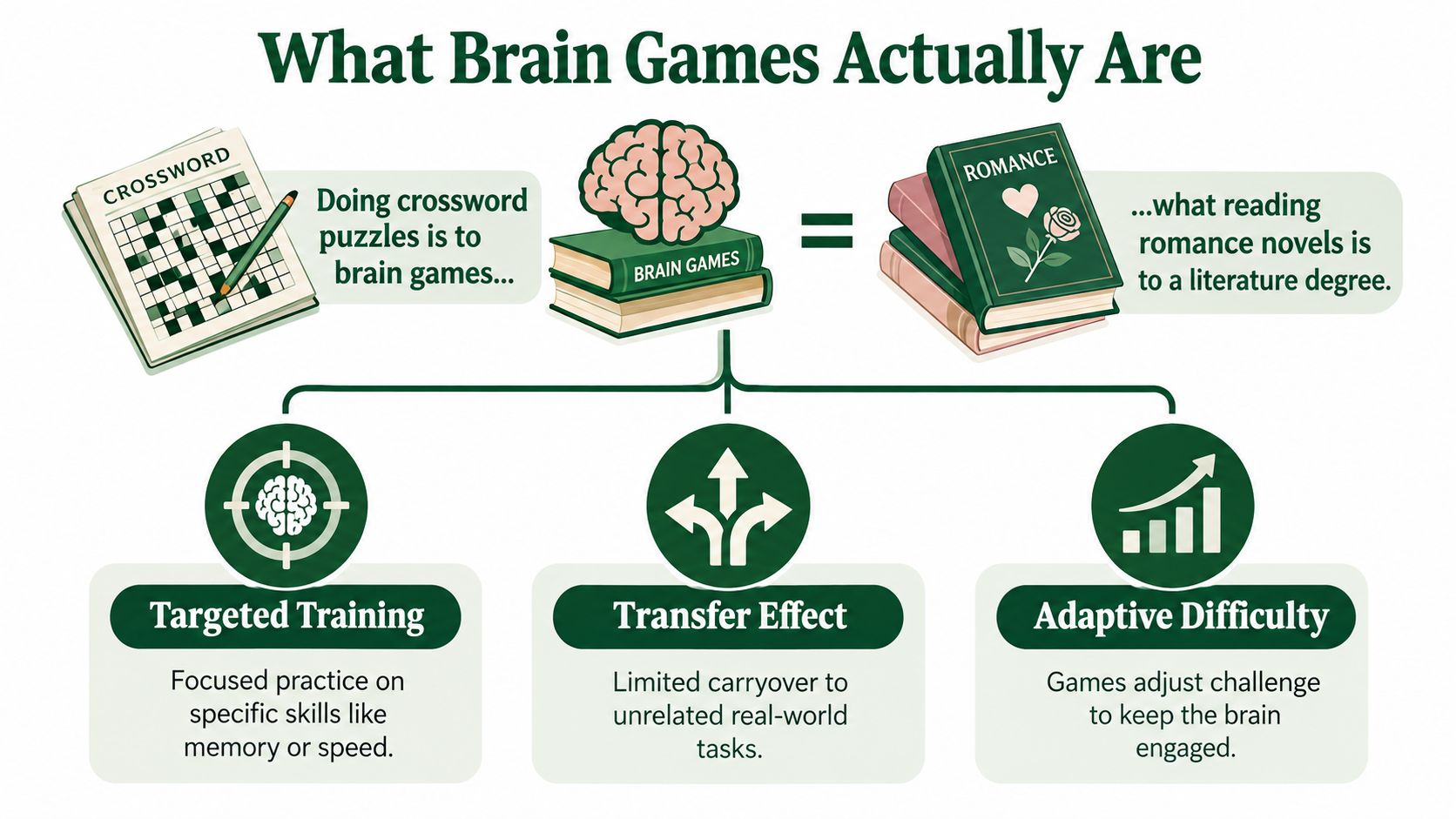
Even a familiar game such as Solitaire creates measurable mental demands. You may need to hold card locations in mind, decide which move preserves future options, scan for available sequences, and resist an attractive move that blocks the layout. Those demands make Solitaire a form of targeted practice, but they don't automatically turn it into general intelligence training. You can explore how different formats change those demands in this guide to types of Solitaire games.
The distinction between an app and a scientific training programme also matters. A commercial product may combine several exercises and adjust difficulty to keep you engaged, while a study may test one carefully defined task. Results from one shouldn't automatically be applied to every game marketed as “brain training.”
Where Brain Games Clearly Help
The clearest benefit of brain games is also the most limited: practice improves performance on the skill being practised. Repeating a demanding working-memory task can make you faster and more accurate with its rules, stimuli, timing, and strategies. That improvement may carry over to tasks that place closely related demands on the mind.
One review found near-transfer effects ranging from g = 0.37 to 0.72 immediately after training, with follow-up effects ranging from g = 0.22 to 0.78. Far-transfer effects were much smaller, at g = 0.14 for nonverbal ability and g = 0.16 for verbal ability, and they were not sustained. The comparison explains why researchers separate improvement on a trained skill from a broad rise in intelligence. See the review of working-memory training and transfer effects.
| Study or meta-analysis | Trained task | Effect size (Cohen's d) |
|---|---|---|
| Working-memory training review | Trained and closely related tasks | Effects were stronger for near transfer than far transfer |
| Brain-training literature review | Practised game or similar cognitive task | Gains generally stayed close to the trained task |
| Action-game research example | Certain visual-attention demands | Improvement was limited to related visual skills |
The same pattern appears across different exercises. Dual N-back practice can improve dual N-back performance. Tetris has been studied in relation to intrusive trauma memories, while action video games have been examined for particular aspects of visual attention. These examples show that practice effects are real, though they do not establish that every commercial app produces the same outcome.
The wider evidence points in the same direction. Training effects commonly appear on the game itself or on very similar tasks. Transfer to different abilities or everyday functioning is inconsistent and often absent. Review the evidence on brain games and far transfer.
A person who wants to practise visual scanning, sequencing, or sustained attention can reasonably choose an activity that repeatedly demands those skills. The useful result is specific: better performance on related mental tasks. A near-transfer gain is evidence of targeted practice, not proof of a general IQ increase.
Why Brain Games Do Not Raise Your IQ
A better score in a brain-game app can create the impression of a stronger mind overall. The evidence supports a narrower conclusion. People often improve at the activity they practise, while improvement becomes smaller or disappears when researchers test a different ability.
A 2014 consensus statement signed by 75 international scientists reported that claims about brain games were frequently exaggerated. It found no compelling scientific evidence that computer-based brain games reverse or reduce cognitive decline. Read the consensus discussion covered by BrainFacts.
A large online study of more than 1,000 self-identified brain trainers found no association between brain-training use and measures of cognitive functioning. The result did not change with age, training programme, or expectations about effectiveness. See the large online study of brain-training users.
Consider a person who repeatedly sorts coloured shapes. With practice, that person may sort them faster and recognise the recurring patterns more easily. An IQ test could instead ask for a rule in unfamiliar material, a verbal relationship, or a solution to a new problem. All involve mental effort, but success in one does not automatically provide the learned routines needed for the others.
That distinction explains why a higher game score can be genuine without representing broader cognitive growth. Familiarity with the interface, knowledge of its recurring formats, and better timing can all raise performance. A score improvement therefore answers one question, “Has this person become better at this task?” It does not by itself answer the larger question, “Has general reasoning ability increased?”
Researchers also separate a short-lived performance change from durable cognitive change. A stimulating session may leave someone feeling alert, and immediate performance may improve, but neither result establishes a lasting increase in reasoning capacity. The strongest test is whether gains appear later on unfamiliar measures that were not practised directly.
Brain games can still be enjoyable and may serve as a brief mental warm-up. Their limits matter because targeted practice should not be presented as a general IQ intervention. As noted earlier, the most defensible benefit is usually specific to the trained task or closely related skills, rather than a broad change in how a person thinks.
Who Actually Sees the Biggest Benefits
The evidence becomes more encouraging when the question changes from “Will this make everyone smarter?” to “Which ability, in which population, responds to which training?”
Older adults are one important group. In a meta-analysis of 15 trials involving 759 community-dwelling older adults, game-based brain training improved processing speed with g = 0.23, selective attention with g = 0.40, and short-term memory with g = 0.35 compared with control conditions. The authors described the intervention as supplementary, not as proof of a broad intelligence gain. Review the meta-analysis of game-based training in older adults.
People with mild cognitive impairment may also respond differently from healthy young adults. A 2025 meta-analysis found that tablet or computer cognitive training improved global cognition in older adults with mild cognitive impairment, with Hedges' g = 0.57. Higher gamification showed a trend toward larger effects, while the evidence for virtual-reality games was low certainty. Read the meta-analysis of cognitive training and gamification in mild cognitive impairment.
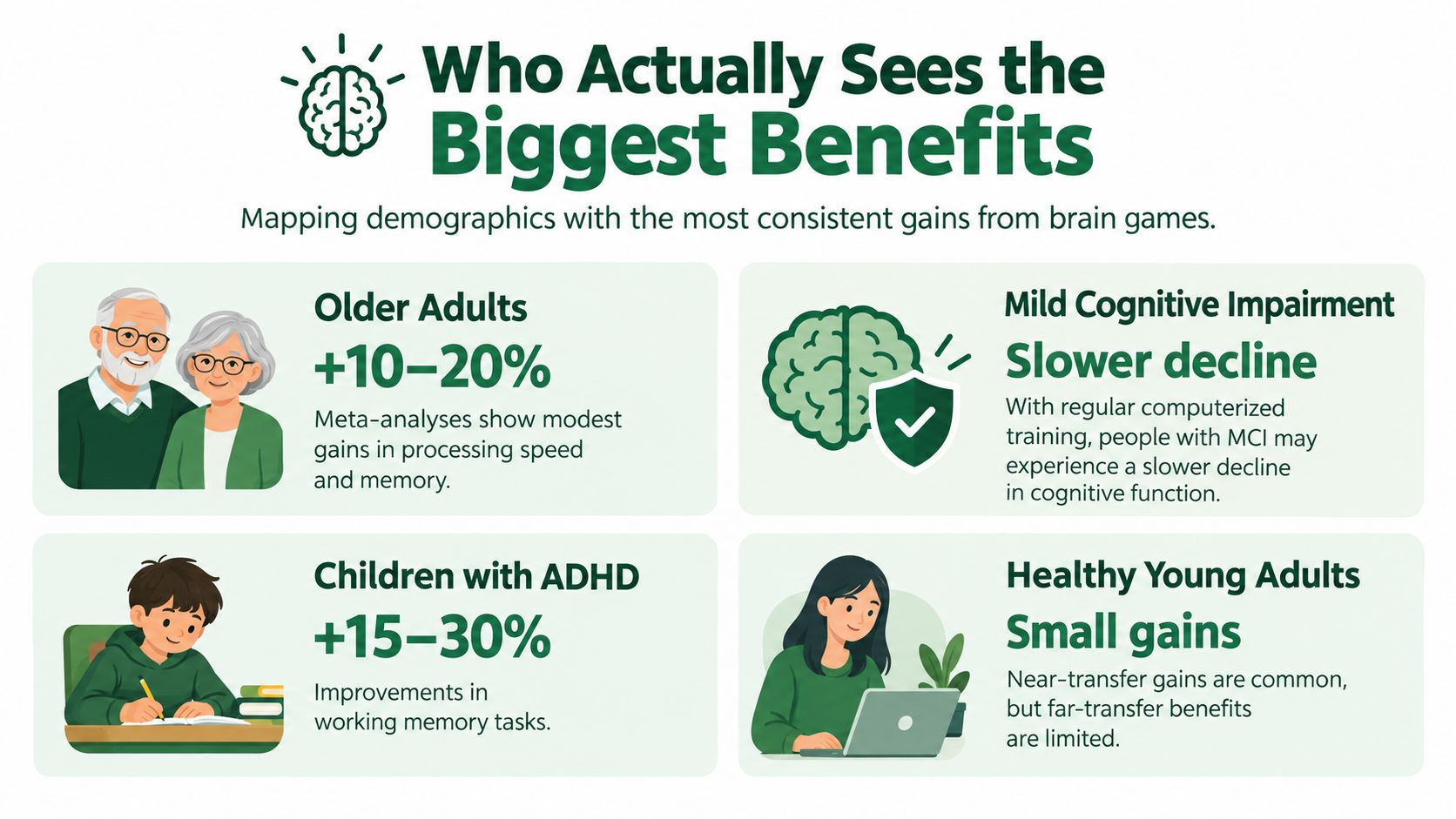
These findings don't justify promises of universal protection or recovery. They suggest that targeted training may have more noticeable value when a specific cognitive weakness or clinical need is present. The task, the participant, and the outcome all matter.
A 2025 review of brain-training games found 16 studies with statistically significant improvements from baseline, mainly involving functions such as processing speed and working memory rather than global intelligence. Read the review of brain-training games and cognitive outcomes.
For casual players, the safest expectation is narrower. A game may provide practice in attention, pattern recognition, or sequencing, and it may offer a pleasant reason to stay mentally active. It shouldn't be presented as a substitute for clinical rehabilitation, professional assessment, or broader learning. Older players who enjoy calm, accessible activities can also consider easy card games for seniors as one low-pressure option.
How to Get Real Cognitive Value From Practice
A brain game works best when you give it a defined job. “Get smarter” is too vague to guide practice or evaluate results. “Improve my ability to hold short instructions in mind” or “stay focused through a full planning task” is more useful.
Match practice to the target
Choose exercises that resemble the ability you care about. A memory task may help you practise remembering sequences, while a planning game may require you to compare options before acting. Expect the clearest improvement in that neighbourhood, not across every mental activity.
Then make the challenge progressive. If the same level feels effortless, it may no longer demand much deliberate control. A useful session asks you to manage information, notice errors, and adjust your strategy rather than tap through familiar patterns automatically.
Use regular, varied sessions
Short, repeated practice is easier to sustain than occasional marathon play. Spacing sessions across the week gives you repeated retrieval opportunities and makes it easier to notice whether a skill remains available after a break.
Variation helps prevent the exercise from becoming a memorised routine. Rotate between related tasks, such as visual scanning, sequencing, and planning, while keeping a clear record of what each session targets. That approach won't guarantee far transfer, but it gives you a better test of whether a skill survives a change in format.
Practical rule: Train the skill, then use that skill somewhere outside the app.
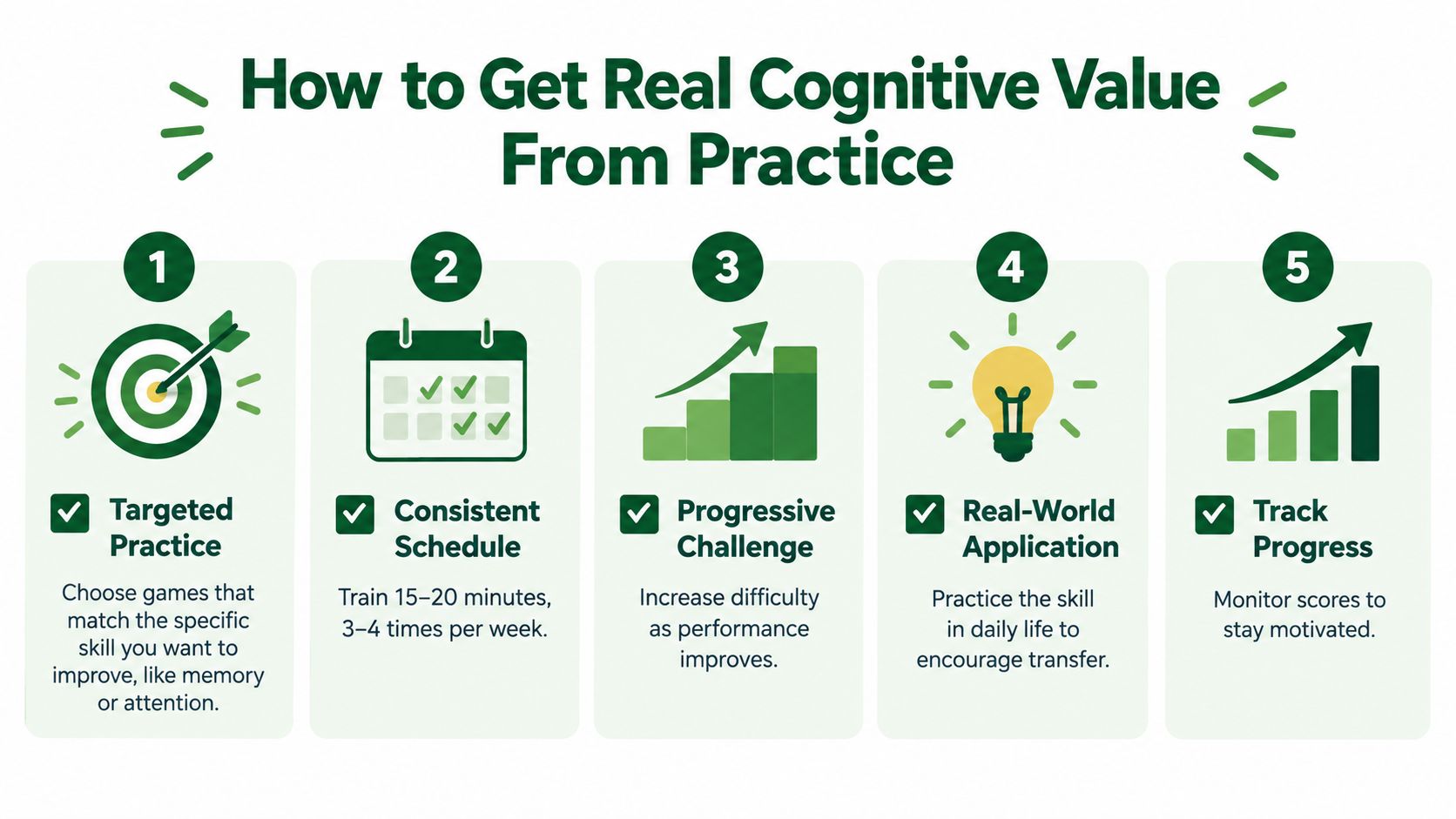
A simple weekly routine can look like this:
- Set a boundary: Use a timer for a brief session so the game remains deliberate rather than endless.
- Record the target: Write down whether you trained memory, attention, speed, or planning.
- Change the context: Try a related task with different rules or materials during another session.
- Apply the skill: Use a real-world version, such as recalling a short shopping list without checking it.
- Review critically: Ask whether your improvement appears only in the score or also in the untrained activity.
Sleep, movement, nutrition, stress management, and social interaction remain the foundation of cognitive wellbeing. A game can fit into that foundation, but it can't repair a routine that leaves you exhausted, inactive, and constantly distracted. For a repeatable, low-pressure schedule, you can use this daily Solitaire habit routine as a practical model.
Solitaire as a Focus and Brain Exercise
Solitaire isn't a miracle IQ booster. It is a legitimate specific cognitive exercise that can ask you to sustain attention, hold card locations in working memory, recognise patterns, and plan several moves ahead.
The game also has a useful emotional profile. Its rules are predictable, the stakes are low, and a player can stop after a short round or continue through a longer session. That makes it different from a frantic reaction challenge that constantly pushes speed and reward. Calm conditions can make it easier to practise focus without turning the activity into another source of pressure.
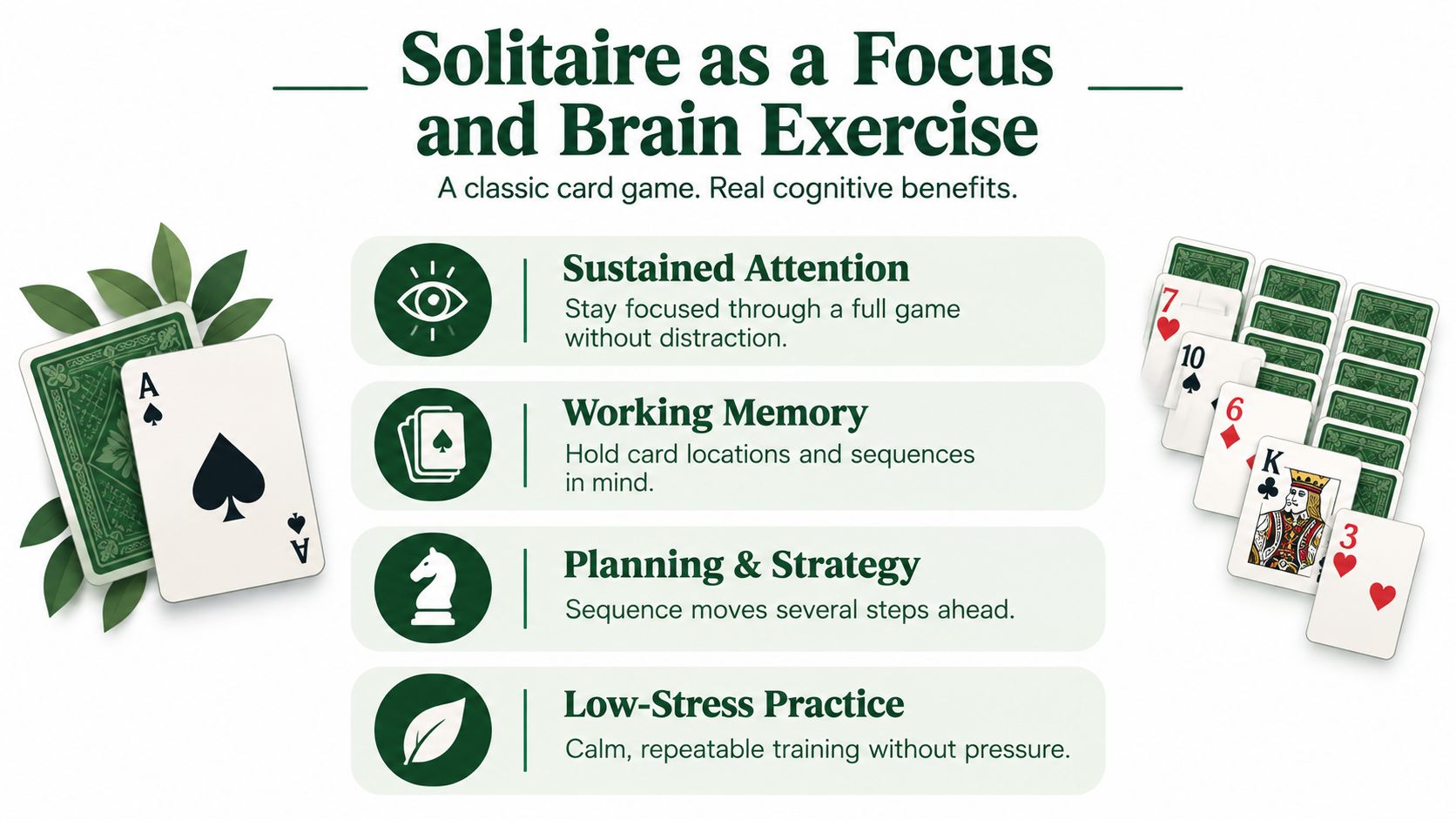
A thoughtful Solitaire session might involve several kinds of mental work:
- You scan the layout and identify available moves, which engages selective attention.
- You remember which cards are hidden, exposed, or likely to become available, which places demands on working memory.
- You compare immediate gains with future options, which encourages planning.
- You recognise sequences and suits quickly, which supports pattern processing.
You can make that practice more deliberate without making it joyless. Play without hints when you want to exercise planning, time a round when you want feedback on sustained attention, and finish one game before opening another tab to reduce task switching. Keep the objective specific, such as completing a full game without checking a phone notification.
Research on game-based training supports improvements in selected abilities, especially in studied populations, but it doesn't show that Solitaire alone produces broad intelligence gains. The sensible role is modest and useful: a repeatable activity that keeps attention engaged and gives you a structured break. Explore the cognitive and wellbeing benefits discussed in this Solitaire guide.
Solitaire can't replace sleep, aerobic movement, learning, or social connection. It earns a place in a brain-healthy routine when you use it mindfully, understand what it practises, and avoid confusing a better game score with a better mind in every situation.
The Honest Bottom Line on Brain Games
Brain games reliably make people better at the tasks they train. That result is meaningful, but it isn't the same as a general increase in intelligence. The strongest evidence concerns near transfer, while broad transfer to everyday reasoning, memory, fluid intelligence, or general cognitive functioning remains weak, inconsistent, or absent.
The most promising findings are specific rather than universal. Older adults may improve processing speed, selective attention, and short-term memory through game-based training. People with mild cognitive impairment may show broader cognitive improvement from computerised training, although the evidence varies by format and certainty. Targeted rehabilitation can also have a different purpose from a consumer app, because clinicians select exercises around a person's assessed needs.
A useful mental model is piano practice. Scales can improve finger control and piano playing, but they don't automatically create general musicianship, knowledge of music history, or skill on every instrument. Brain games work similarly. They can provide structured repetitions for attention, sequencing, speed, or planning, but they don't automatically build knowledge or flexible reasoning across life.
Treat a brain game as skill practice, not a shortcut to genius.
Match the activity to a concrete goal, test whether the skill appears outside the game, and protect the wider habits that support cognition. Used that way, brain games can be enjoyable, low-stress mental engagement. Used as a promise of a higher IQ, they ask the evidence to deliver more than it can.
Play Solitaire Gaming offers free, browser-based access to eight classic Solitaire variants, including Klondike, Spider, FreeCell, Pyramid, Yukon, Golf, TriPeaks, and Forty Thieves, with optional daily challenges and no required signup. Visit Play Solitaire Gaming to choose a calm, structured game and use it as one mindful part of your focus routine.
Ready to play?