Solitaire for Adults Relax Focus and Play Smarter
By Rajat Agarwal, Founder of Play Solitaire Gaming
Discover solitaire for adults as focus, relaxation and friendly competition. Explore variants, tips and how to play instantly ad-free on any device.
You've got a few quiet minutes between meetings, chores, or messages. You want something more engaging than scrolling, but you don't want another demanding task. A short game of solitaire can give that pause a clear shape: look, choose, move, and begin again.
Solitaire for adults works because it combines independence with gentle structure. You can play at your own pace, stop without coordinating with anyone, and choose a version that matches your energy. It can be a quick reset, a thoughtful puzzle, or a low-pressure way to build a repeatable personal routine.
Table of Contents
- Why Solitaire Fits Adult Life Right Now
- How Solitaire Supports Focus Relaxation and Light Competition
- Popular Solitaire Variants and What Adults Enjoy Most About Each
- Practical Tips to Play Better and Enjoy Every Game More
- Comfort Privacy and Accessibility for Adult Players
- How to Start Playing Instantly on Play Solitaire Gaming
- Build Your Personal Solitaire Routine and Keep Improving
Why Solitaire Fits Adult Life Right Now
After a demanding day, an adult may want a quiet activity that starts immediately, works without a partner, and ends whenever attention or time runs out. Solitaire fits that routine because its rules provide structure while the player controls the pace. A digital version can fill a five-minute break, offer low-stress brain training, or create a private reset between larger tasks.
Solo leisure also fits changes in daily life. In the United States, one-person households rose from 7.7% in 1940 to 27.6% in 2020, according to the U.S. Census Bureau's household analysis. Canada had 4.4 million people living alone in 2021, representing 15% of adults aged 15 and older, as reported in the same verified data set. These figures do not explain every leisure choice, but they help show why activities designed for one person can fit ordinary routines.
Research has also described a broader rise in solitary leisure among working-age adults in the United States between 1965 and 2018, with average time reaching almost two hours per day. Among heavier solo-leisure users, nearly 13% reported at least five hours per day by 2018. That trend places solitaire within a wider preference for quiet, independent downtime, without treating the household analysis as the original time-use study.
A game with built-in control
Consider two adults at the end of a long day. One wants calm entertainment without conversation or setup. The other wants a puzzle that rewards careful choices but allows an immediate stop before an appointment. Solitaire serves both needs because the player controls the pace, difficulty, and session length.
Its appeal extends beyond nostalgia. A 2023 YouGov survey found that 83% of U.S. adults had played Solitaire, making it the most-played card game in that sample. Microsoft Solitaire had surpassed 500 million players since its 1990 launch and had 35 million monthly active users in 2020, according to the YouGov survey. Klondike Solitaire has also been identified as a popular card game among older adults, with one tracked study noting that 9% of participants played Solitaire most consistently, as reported in the same source.
Practical rule: Choose the game that matches your mental energy, not the game you think you should be good at.
Start by asking what the moment requires: recovery, focus, or challenge. A comfortable interface, private play, and a suitable variant can turn a casual game into a routine that lasts. For more low-pressure options, see this guide to easy card games for adults.
How Solitaire Supports Focus Relaxation and Light Competition
After a demanding meeting, a commute, or a long evening of chores, an adult may want a short activity with clear boundaries. Solitaire provides that structure. You scan the cards, remember what has been revealed, compare possible moves, and choose one. The process works like clearing a crowded desk: each useful move creates space for the next decision.
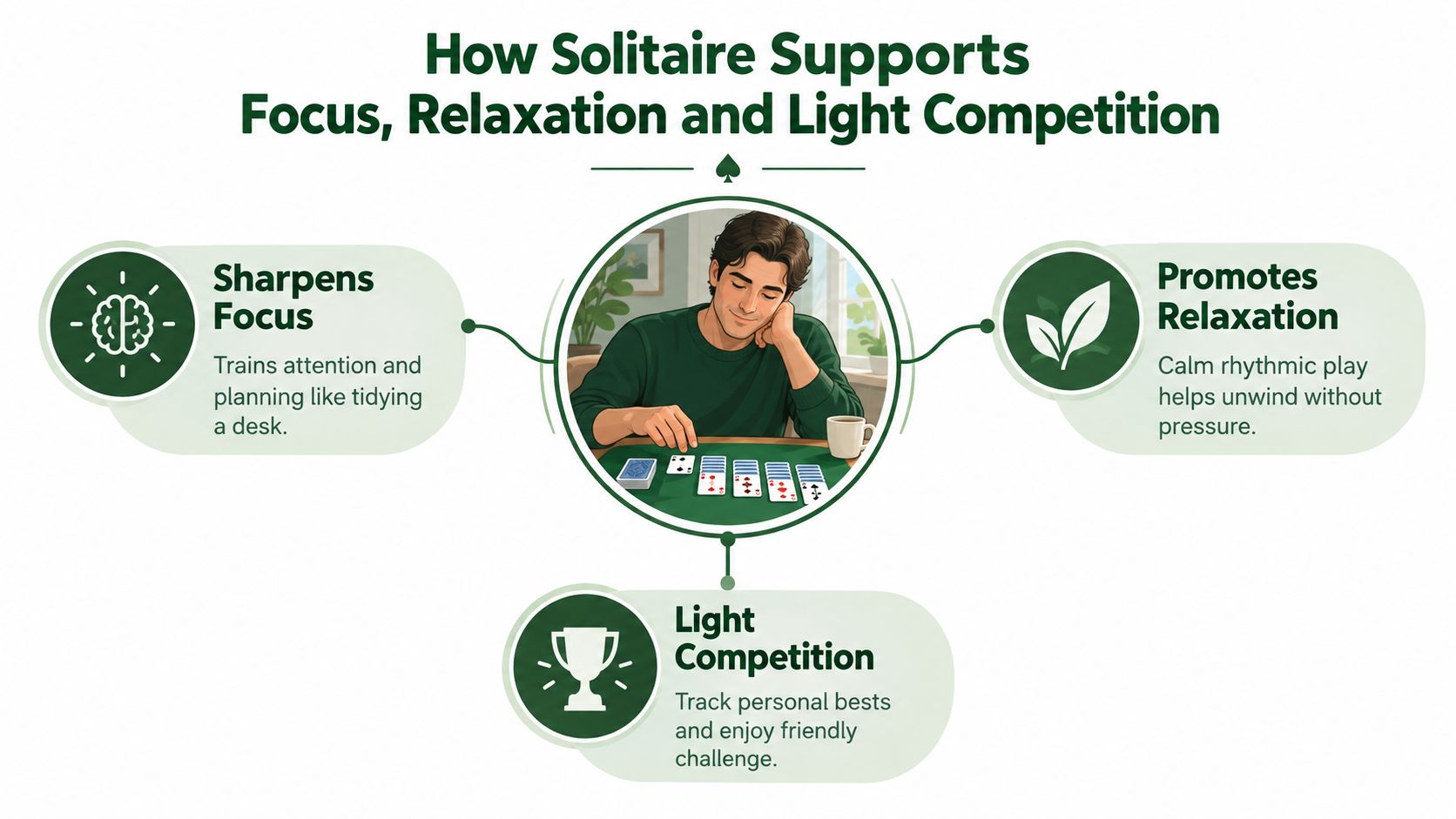
A 2021 Klondike Solitaire study examined gameplay from 23 healthy older adults and 23 older adults living with mild cognitive impairment. Machine-learning models distinguished the groups' gameplay traces by examining move timing, hint use, and pauses before planning. The study in the National Library of Medicine shows that ordinary play can contain measurable information about attention and executive control. It does not establish solitaire as a diagnostic tool. It does show how deliberate choices can make a player's approach to a task visible.
Focus without overload
Each move gives a clear result. You may expose a hidden card, open a space, or protect a useful sequence. That immediate feedback keeps attention on one manageable decision instead of letting it scatter across notifications and unfinished tasks.
A separate randomized study of healthy older adults tested modern board and card games. The pilot included 14 participants, and the main trial included 35 participants. The published study reported significant improvement in semantic verbal fluency in the pilot, while both interventions significantly improved phonemic verbal fluency in the main trial. Because these findings concern board and card games rather than every solitaire session, the practical conclusion should stay measured: repeated strategic play may offer cognitive stimulation, but it is not a medical treatment.
Relaxation and challenge can coexist
Relaxation can include gentle problem-solving. Familiar rules create a steady rhythm, while each layout supplies a small task that holds attention without demanding constant social interaction. For a five-minute reset, choose a forgiving variant, silence alerts, and stop after one game if you feel calmer.
Competition adds direction. A personal best, streak, or daily challenge can give a session a clear purpose without making it high pressure. Ignore a leaderboard if it creates tension. Use it as a light prompt if it gives you a reason to return.
The most restorative session is the one that leaves your attention steadier than you found it.
For adults seeking low-friction mental practice, Klondike gameplay has also been mapped to attention, executive function, object recognition, abstraction, and memory. The KU Leuven-related analysis mapped 22 player actions to 10 cognitive functions through review by three health professionals. This supports using solitaire as a structured activity with modest, practical goals, such as settling your attention during a break.
For a broader explanation of card play, attention, and mental well-being, read this guide to solitaire brain benefits and mental health.
Popular Solitaire Variants and What Adults Enjoy Most About Each
After a crowded morning, you may have only a few quiet minutes before the next task. The best variant depends on how you want to use that pause. Klondike offers familiar structure, FreeCell rewards careful planning, and Golf keeps decisions moving when time is limited. Other versions add more visual searching, flexible movement, or multi-suit difficulty.
| Variant | Pace and Complexity | Best For Adults Who Want |
|---|---|---|
| Klondike | Familiar pace with a mix of planning and chance | A classic reset with recognizable rules |
| Spider | More demanding, especially with multiple suits | A longer strategic challenge |
| FreeCell | Methodical and planning-heavy | Open information and careful sequencing |
| Pyramid | Quick decisions with matching and removal | A compact puzzle between tasks |
| Yukon | Flexible but less predictable tableau play | Variety and improvisation |
| Golf | Fast, flowing, and easy to start | A short relaxation session |
| TriPeaks | Rhythmic clearing across peaks | Momentum and simple visual progress |
| Forty Thieves | Deliberate, complex, and demanding | A serious test of patience |
Match the mood to the rules
Klondike works well as a default choice. You build descending sequences in alternating colors, move cards to the foundations, and reveal hidden cards. Chance affects the layout, so a loss does not automatically show poor decision-making. Choose it when you want recognizable rules and a moderate blend of planning and uncertainty.
Spider feels like sorting several tangled files at once. Descending runs matter, but suit management becomes increasingly important as the game grows more complex. It suits an adult who has time for a longer session and enjoys turning a disorderly layout into a clean sequence.
FreeCell places more information in view from the beginning, so planning carries greater weight. Its temporary cells function like a small workbench. Before moving a sequence, decide where the cards can go afterward. This variant fits focused play when you want each decision to have a visible reason.
Pyramid turns the board into a compact matching puzzle. Pair cards whose values reach the target total, then remove them to expose more of the layout. Its quick visual decisions make it practical between tasks, especially when you want a clear finish rather than a long strategic build.
Yukon permits more flexible tableau movement, which gives improvisation a larger role. It suits players who enjoy adapting to an uneven position instead of following a fixed plan.
Golf is easy to start and keeps the action flowing. TriPeaks offers a similar sense of momentum, with cards cleared from three peaks in a steady visual rhythm. Both can fit a short, low-pressure pause.
Forty Thieves asks for patience over a longer session. Its multi-suit structure and restricted movement leave less room for casual play, making it a better match for a dedicated challenge than a hurried break.
For a fuller comparison of rules and formats, explore these types of solitaire games. On Play Solitaire Gaming, smooth drag-and-drop controls, hints, and unlimited undo can reduce the learning curve, letting you test an unfamiliar variant without needing to master every rule first.
Practical Tips to Play Better and Enjoy Every Game More
A five-minute break can become more satisfying when you treat each move as a small decision, not a race. Better solitaire play begins with observation, then turns that observation into a simple plan.
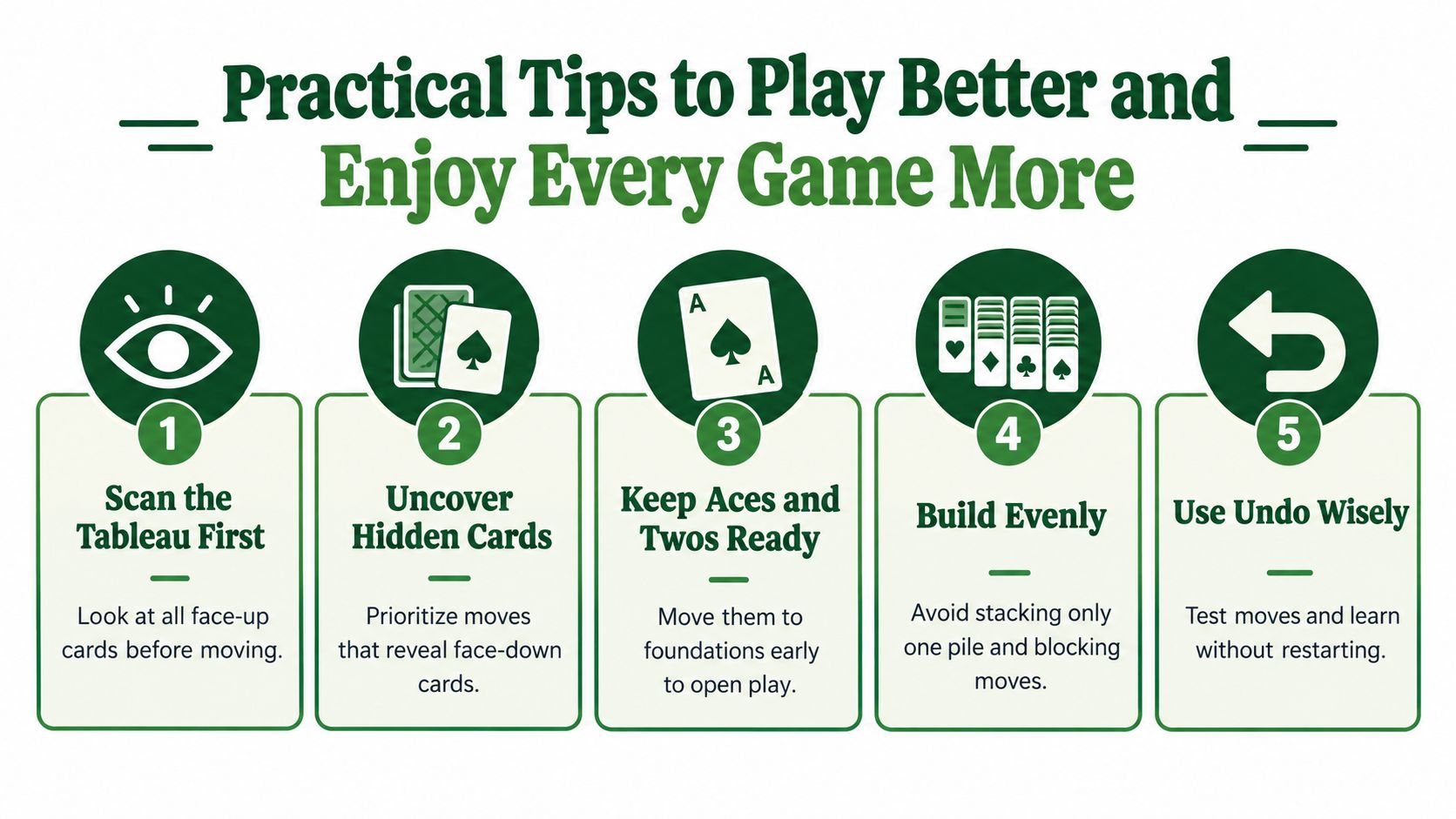
Begin with the whole tableau
Scan every face-up card before moving anything. Note exposed Aces, low cards, empty columns, and moves that might uncover face-down cards. This quick check works like reading a map before setting out. It helps you avoid spending a useful card on a move that looks appealing but leaves the board harder to work through.
Give priority to revealing hidden information. If one move exposes a face-down card while another only rearranges visible cards, the reveal often gives you more choices. New information can open several routes, while a rearrangement may move the same obstacle.
Manage space deliberately
An empty column is valuable in Klondike because it can hold a King or a movable sequence. Create one only when you can see how that space will help. In FreeCell, open cells work like temporary parking spaces. Before filling one, check whether a future sequence may need it.
Spider requires attention to suit-building. A descending run may look complete, yet a mixed-suit stack might not move as one unit. Build with the eventual clean sequence in mind rather than treating every temporary stack as progress.
Use undo as a notebook. Reverse a move, inspect what changed, and remember the pattern before trying a different line.
Hints can show which moves are available, but they should remain a teaching aid. Scan first and choose independently. If you reach a genuine dead end, use a hint, then undo the suggested move and ask why it helps. This turns assistance into pattern recognition instead of making every decision for you.
A gameplay study of older adults connected solitaire behavior with cognitive testing and identified 23 candidate digital biomarkers from actions such as timing, moves, hints, and undos. The research record supports treating these actions as meaningful parts of play, not merely interface details. Your pauses and reversals can therefore show how you approach problems, helping you refine a calm, deliberate routine.
Comfort Privacy and Accessibility for Adult Players
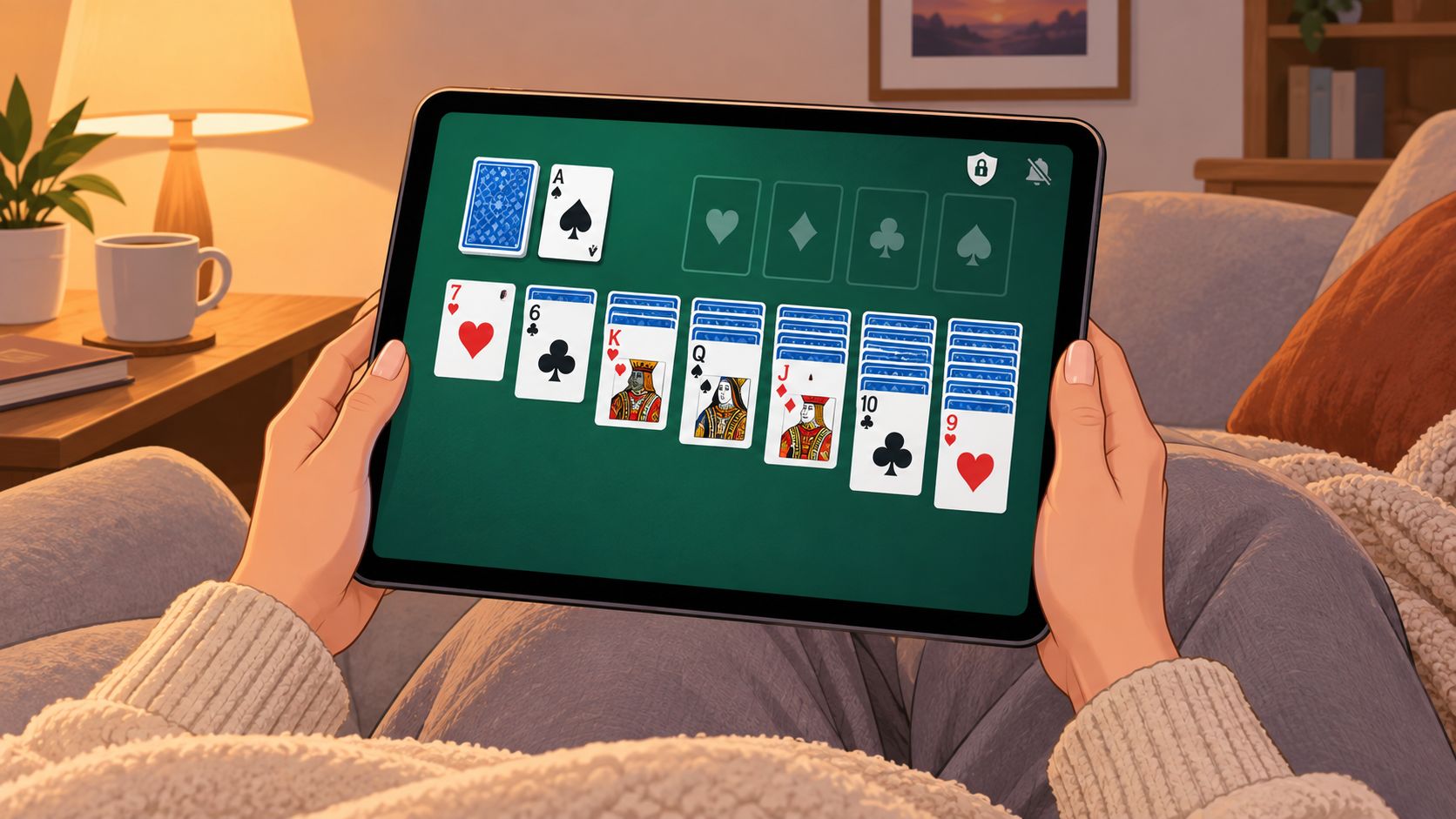
A five-minute break works best when the game starts quickly and stays out of the way. Adults may choose a phone for a short reset, then switch to a tablet or desktop when they want a larger view. The right setup makes solitaire feel like a quiet routine rather than another demanding task.
Begin with visual comfort. Choose clear card symbols, distinct piles, readable backgrounds, and limited animation. Touch-friendly drag-and-drop controls also matter. A card that moves predictably keeps attention on the decision instead of the interface.
Sound and feedback should match personal preference. A 2025 user study of older adults found strong interest in card games that reduce visual load, with 73.6% saying haptic support could reduce reliance on visual information, according to the National Library of Medicine study. Haptic feedback may help some players, while others may prefer silence, so both options should remain available.
Use a low-friction checklist
- Reduce interruptions: Avoid pop-ups, auto-playing audio, and layouts that pull attention away from the cards.
- Protect privacy: Check whether play works without an account and whether optional sync is separate from basic access.
- Fit the device: Test the controls on the phone, tablet, or desktop you plan to use.
- Control the pace: Choose undo, redo, and hints that you can call on without pressure.
- Lower visual strain: Prefer readable cards, uncluttered backgrounds, and settings that limit movement or sound.
Privacy can shape the whole experience. No-download, no-signup play suits a five-minute reset because setup does not consume the break. Optional cloud sync helps when you change devices, while private casual play can remain account-free. For a distraction-conscious option, explore solitaire without advertisements.
These choices also support gentle brain training. A calm interface lets you focus on planning, while adjustable feedback helps you keep playing when your energy is low.
How to Start Playing Instantly on Play Solitaire Gaming
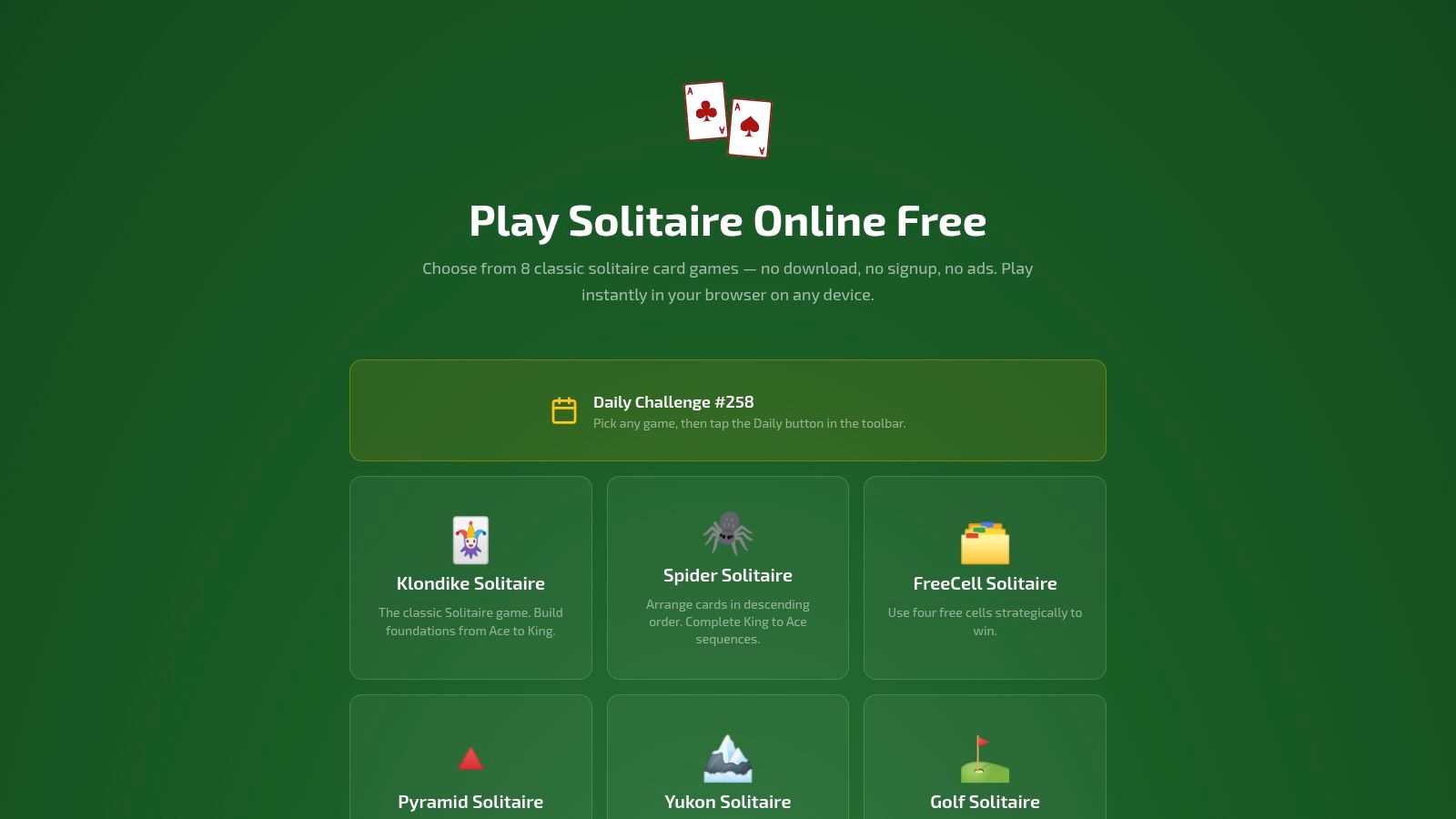
You have five quiet minutes before a meeting, or a longer break after dinner. Play Solitaire Gaming lets you use that time without installing software or creating an account. Open the browser, choose from Klondike, Spider, FreeCell, Pyramid, Yukon, Golf, TriPeaks, and Forty Thieves, and begin with drag-and-drop controls.
Choose a game that fits the moment
Use Klondike for a familiar structure, Golf for a quick, flowing reset, or FreeCell when you want more information visible before making a move. These choices work like selecting the right exercise: one supports an easy start, another gives you more room to plan.
The interface includes drag-and-drop controls, smart hints, and unlimited undo and redo. You can test a move, review the result, and try again instead of treating every mistake as a restart. That makes the first game approachable while still leaving room to improve your decisions.
For a small dose of competition, tap Daily. The rotating challenge and global leaderboards let you compare results, but participation remains optional. You can treat the layout as a short appointment with yourself, especially when a focused break feels better than scrolling.
Decide whether to use an account
Start without signing up. If you want win rates, streaks, and detailed stats available across your phone, tablet, and desktop, optional Google or Apple sign-in provides private cloud sync. Skip sign-in when a local, no-account session better suits your privacy preference.
How-to-play guides and blog articles are available when you want context before choosing a variant. Start immediately for a brief reset, or spend more time learning the logic behind a game when you are ready for a deeper challenge.
Build Your Personal Solitaire Routine and Keep Improving
A useful solitaire routine begins with the moment you want to support. For a five-minute reset, choose Golf or TriPeaks, where progress is easy to see. Klondike suits a familiar evening wind-down, FreeCell rewards deliberate planning, and Spider or Forty Thieves fit times when you can give a demanding puzzle your full attention.
Keep the plan small and specific. Play one quick game after lunch, choose a focused layout before reading, or use a Daily challenge during a quiet morning. The aim is not to fill every spare moment. It is to give selected moments a calmer alternative to fragmented scrolling.
Track progress without adding pressure
Stats and streaks can reveal how your choices change over time, but they should not become another obligation. Notice practical signals instead. Do you pause before moving? Do useful patterns become easier to recognize? Do you finish feeling refreshed rather than depleted?
A stale routine often needs a change of pace. Someone who usually plays Klondike may find that FreeCell develops patience, while Golf keeps a short break within its limits. Use undo to study a decision, hints to identify an unfamiliar pattern, and the Daily challenge when a little structure would help you return.
Research based on online solitaire gameplay with more than 4,000 players found that measures including time per move, number of moves, and hint or undo use helped predict performance on tests of processing speed, working memory, and visual memory, according to this solitaire cognition evaluation. Personal statistics are not a health assessment. They can still offer a useful mirror of attention habits.
Let the routine serve your day. A completed game is optional. A calmer pause is what matters.
Use the same device when convenience matters, or switch screens when comfort matters. Keep competition optional. With a suitable variant and comfortable interface, solitaire can support a short break, a quiet evening, or a low-stress daily reset.
Play Solitaire Gaming provides eight classic solitaire variants in a browser, along with drag-and-drop controls, hints, unlimited undo and redo, Daily challenges, and optional synced stats. Ready to practice? Choose a variant that matches your energy, then visit Play Solitaire Gaming for an immediate, low-pressure session without downloading or signing up.
Ready to play?