8 Easy Card Games for Adults to Play Anytime
By Rajat Agarwal, Founder of Play Solitaire Gaming
Discover 8 easy card games for adults, from quick solitaire rounds to deeper challenges, with playtimes, tips, variations, and accessibility advice.
You've got a few quiet minutes between responsibilities, but you don't want to learn a complicated rulebook or commit to a long multiplayer session. Maybe you want a relaxing break that feels more focused than scrolling, or a sharper mental puzzle that rewards careful planning. The right solitaire variant can fit either mood.
This guide compares eight easy card games for adults, all designed for one player, across practical factors: how each game works, the time and attention it typically demands, its balance of luck and strategy, accessibility adjustments, and useful variations. Some, such as Golf, Pyramid, and TriPeaks, offer quick rounds and immediate decisions. Others, including Spider and Forty Thieves, give you a deeper puzzle when you have more time.
If you want to start without downloading an app or setting up a physical deck, Play Solitaire Gaming provides browser-based access to these eight variants with ad-free play. You can choose a game, adjust the challenge where available, and begin instantly on a phone, tablet, or desktop.
Table of Contents
- 1. Klondike
- 2. Spider
- 3. FreeCell
- 4. Pyramid
- 5. Yukon
- 6. Golf
- 7. TriPeaks
- 8. Forty Thieves
- Quick Comparison: 8 Easy Card Games for Adults
- Choose Your Next Round With Confidence
1. Klondike
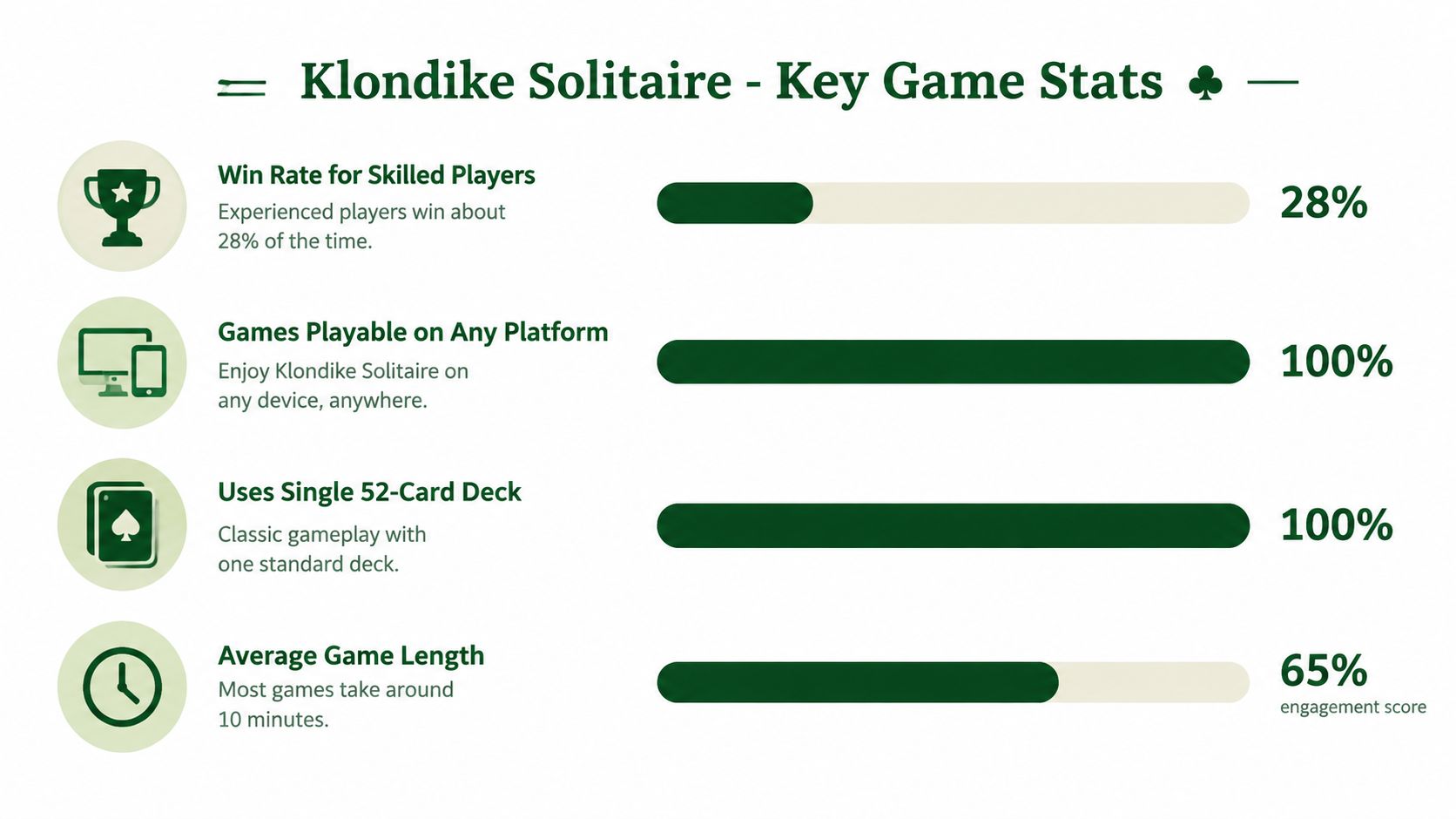
Klondike is the game many people mean when they say “Solitaire.” It uses a standard 52-card deck. Your aim is to move every card to four foundation piles, building each suit upward from Ace through King, while reorganizing seven tableau columns.
At the beginning, several tableau cards are face down, so your first decisions should create access to them. You build tableau sequences downward in alternating colors, such as placing a black 9 on a red 10. Only exposed cards can move, and an empty tableau column can generally receive a King or a sequence led by one.
You'll draw from the stock pile, either one card or three cards at a time depending on the setting. One-card draw is the gentler starting point because it gives you more usable information and fewer blocked choices. Three-card draw demands more planning because the order of the stock matters.
Make flexibility your priority
Expose face-down tableau cards before rushing cards into the foundations. Moving a low card to a foundation can be correct, but it may also remove the only card that could support a useful tableau sequence. Empty columns are valuable because they let you move Kings and open space for rearrangement.
Practical rule: Before drawing again, check whether a tableau move can expose a hidden card or create an empty column.
Klondike works well for adults who want familiar rules with a moderate blend of luck and judgment. It's approachable for a first session, but the draw setting and layout still create a meaningful challenge for experienced players. For a clear walkthrough, use this Klondike Solitaire how-to guide.
2. Spider
Spider uses two standard decks, creating 104 cards arranged across ten tableau columns. Unlike Klondike, you build descending sequences by rank without needing alternating colors. A complete sequence from King down to Ace in one suit can then be removed to a foundation.
The central challenge is keeping sequences useful while exposing hidden cards. You can move a connected run as a unit when the cards share a suit, but mixed-suit descending runs are less flexible. That distinction becomes increasingly important as the layout grows more crowded.
Spider offers a natural difficulty ladder. One-suit Spider is the most accessible because every descending sequence is compatible. Two-suit play introduces restrictions without overwhelming you with all suits at once. Four-suit Spider creates the deepest planning challenge and punishes careless stacking.
Use the empty columns carefully
An empty column is more than open space. It acts as a temporary work area, allowing you to separate cards, build a same-suit run, and reach face-down cards. Try to create one early, but don't fill it immediately unless the move improves your overall position.
Start with one suit if you're learning the game. Move to two suits once you're comfortable reading the tableau, then try four suits when you want a demanding strategic puzzle. Spider suits adults who enjoy pattern recognition, multi-step planning, and a challenge that can stretch beyond a quick break.
3. FreeCell
FreeCell removes much of Klondike's hidden information. All cards are dealt face up across eight tableau columns, so you can inspect the entire position before making your first move. Four free cells provide temporary storage, while four foundations receive cards by suit from Ace through King.
Tableau sequences descend in alternating colors. You can move individual cards or connected sequences, but the number of cards you can shift depends on your available empty free cells and tableau columns. A move that looks harmless can consume the space you need several turns later.
Because the cards are visible, FreeCell feels less like a gamble and more like a logic problem. The plan notes for this guide identify the game as theoretically winnable through skill alone, with a stated 99.9% solvability rate. That figure is part of the supplied game description, rather than a claim about every digital implementation or every deal.
Protect your storage spaces
Don't place a card in a free cell because the space is available. Each occupied cell reduces your ability to move blocked sequences. First look for cards that can be placed directly onto a tableau sequence or moved to a foundation.
- Scan before acting: Identify which low cards can reach the foundations and which columns block them.
- Preserve empty cells: Keep storage available for awkward cards that may become unavoidable.
- Watch long sequences: Breaking a useful run can create more work than it solves.
- Use learning aids: Hints and undo functions can help you recognize recurring patterns while you practice.
FreeCell is a strong choice when you want transparent information, deliberate decisions, and less dependence on the next stock card. This FreeCell versus Solitaire comparison can help clarify how its open layout changes the experience.
4. Pyramid
Pyramid changes the basic solitaire question from “Where can I place this card?” to “Which exposed cards can I combine?” The tableau forms a pyramid with rows of 1, 2, 3, 4, 5, 6, and 7 cards. You remove pairs that add up to 13, either from the exposed pyramid or by pairing an available pyramid card with the stock or waste card.
Kings are worth 13 and can be removed alone. Queens count as 12, Jacks as 11, and the remaining ranks follow their usual values down to Ace. A Queen therefore needs an Ace, while a Jack needs a 2.
The visual layout makes each decision easy to understand, but the order still matters. Removing one card may expose two others, creating a chain of opportunities. Removing a pair that looks available can also leave a more important blocker in place.
Look for the next opening
When a King appears and doesn't block a better immediate sequence, removing it can free the cards beneath. Prioritize moves that reveal buried cards and preserve potential pairings in the stock. You don't need to calculate every possible deal, but it helps to notice whether a useful rank is still unavailable or likely to appear later.
Pyramid suits adults who want a short, tactile-feeling puzzle with simple rules and a clear visual goal. Luck influences which cards appear, while your main skill lies in choosing the order of removals. It's a good fit for a brief reset when you want decisions without a heavy planning burden.
5. Yukon
Yukon offers a more open-ended tableau than Klondike. The layout uses two standard decks, or 104 cards, across seven columns. The first column receives one card, and each following column receives six more, with only the top card initially exposed.
You build descending sequences in alternating colors, but Yukon's defining feature is how you move those sequences. A group can be moved even when some cards within it remain hidden. That freedom creates opportunities to expose cards quickly, but it also makes careless moves harder to evaluate.
Suppose a red Queen sits above a hidden card and a black Jack is available elsewhere. Moving the Queen and its attached cards may reveal new information, even if the sequence isn't perfectly organized. You're constantly weighing immediate access against the risk of placing an important card in an awkward column.
Concentrate your work
Methodical play helps. Work from one or two columns at a time rather than shifting cards across the entire layout without a clear purpose. Look beneath every sequence before moving it, because hidden cards affect what you may uncover and what you may block.
- Expose hidden cards: Move eligible sequences when the result opens meaningful information.
- Build useful runs: Longer alternating-color sequences give you more control.
- Create open columns: Empty spaces increase your ability to manipulate the tableau.
- Avoid passive blocking: Don't park a card where it prevents access to a valuable lower rank.
Yukon sits between familiar and demanding. It has the approachable building rules of classic solitaire, but the ability to move partially hidden groups adds a layer of tactical judgment. Watch this Yukon solitaire gameplay demonstration to see how sequence movement changes the rhythm.
6. Golf
Golf is built for speed. A single 52-card deck is arranged in seven columns of five cards, with one card placed on the waste pile. You remove a tableau card when it ranks one higher or one lower than the current waste card, then place the removed card on top of the waste pile.
For example, if the waste card is a 7, you can play a 6 or an 8. That new card becomes the active waste card and may open another move. When no eligible tableau card remains, draw from the talon, the remaining deck, and continue from the new waste card.
The objective is to clear the tableau with as few draws as practical. The name references golf scoring, so many players treat each new talon card as a cost and try to build long removal runs.
Read the whole layout first
Golf rewards quick scanning more than elaborate calculation. Before taking an obvious match, look across all columns for a card that could start a longer chain. A low-value move may be better if it exposes a card that connects to several others.
Save Kings and Aces when they're the only options in a trapped area, but don't delay every move in pursuit of perfect play. Golf includes luck, and the best approach is usually to keep the sequence moving while watching for cascades.
Adults who want a fast, low-setup round will find Golf easy to enter and easy to stop. It works especially well during a short break because each decision is immediate and the rules don't require memorizing elaborate sequences. Track your own best scores if you want a small competitive element without needing another player.
7. TriPeaks
TriPeaks combines the matching logic of Pyramid with a more direct layout. The tableau contains three overlapping pyramid formations, with 28 cards arranged across the three peaks. You remove exposed cards that rank one above or below the current waste card, creating chains that uncover cards at the bases of the peaks.
The exact accessibility of a card depends on what remains underneath it. A card at the base of a peak may be available now, while cards higher up stay blocked until their supporting cards disappear. That structure gives you a clear visual target and makes each successful run feel connected to the next.
Unlike Pyramid's sum-to-13 pairing system, TriPeaks usually uses adjacent-rank play against the waste pile. A 9 can follow an 8 or a 10, and the newly played card becomes the next connection point. The result is quick, readable, and more immediately responsive than a heavily hidden tableau.
Build a removal chain
Prioritize cards that reveal the bases of the peaks. Before playing from the waste pile, scan for a move that removes a blocker and creates another available match. Kings can be removed when the rules allow a single-card King move, but use that opportunity thoughtfully if it opens several cards.
TriPeaks fits adults who want a visual puzzle with light planning and a quick pace. You can focus on the next obvious match when you're tired, or look ahead through the waste sequence when you want more control. For more detail on its layout and play, use this TriPeaks game guide.
8. Forty Thieves
Forty Thieves is the most demanding option in this group. It uses two complete 52-card decks, or 104 cards, arranged in ten tableau columns of four cards each. Cards are dealt face up with face-down cards beneath, creating a large position that combines open information with significant hidden information.
In the tableau, you build descending sequences in the same suit. Foundations are built upward by suit from Ace to King, and the larger layout gives you more cards to manage than a compact single-deck variant. Because same-suit sequences are required, a move that seems productive can still leave the next card inaccessible.
The game rewards patience. Study the available layout before committing to a foundation move, and consider whether that move will remove a useful tableau card or reduce your ability to build a long run. Empty columns are valuable because they create room for reorganization, but filling one too quickly can close off future options.
Treat every move as a commitment
Forty Thieves suits adults who want a longer, more demanding focus session rather than a quick break. Hidden cards, large stacks, and same-suit building make mistakes expensive, so hints and undo tools are useful while you're learning. Try to expose hidden cards strategically, maintain tableau flexibility, and complete suit sequences when doing so won't strand other cards.
For targeted guidance, read this Forty Thieves Solitaire strategy guide.
Quick Comparison: 8 Easy Card Games for Adults
| Variant | Complexity 🔄 | Resources ⚡ | Expected outcomes 📊 | Ideal use cases 💡 | Key advantages ⭐ |
|---|---|---|---|---|---|
| Klondike | Moderate, hidden cards, stock draw options; approachable learning curve | Single 52-card deck, 7-tableau setup, stock (1/3 draw) | 5–15 min; win rate ~25–30% (skilled) | Beginners, short mental breaks, ubiquitous casual play | Instantly recognizable, fast rounds, balanced luck & skill |
| Spider | High, deep planning, long sequences, scalable difficulty levels | Two 52-card decks (104), 10 tableau, stock | 10–30 min; win rate: Easy ~30–40%, Hard ~10–15% | Strategic long sessions, pattern-recognition practice | High strategic depth; difficulty scales with skill |
| FreeCell | Moderate–High, full information, heavy planning, deterministic | Single 52-card deck, 8 tableau, 4 free cells (all cards face-up) | 5–20 min; ~99.9% solvable (skill-driven) | Logical puzzles, skill training, improvement tracking | Nearly always winnable; pure strategy, clear learning feedback |
| Pyramid | Low, simple matching mechanic (sum to 13), quick decisions | Single 52-card deck, 28-card pyramid, 24-card stock | 3–10 min; win rate ~20–25% | Quick casual rounds, novelty matching variant | Unique matching play, fast to learn and play |
| Yukon | Moderate, move partially-hidden sequences, tactical planning | Two 52-card decks (104), 7 tableau (staggered), no free cells | 8–20 min; win rate ~30–40% (skilled) | Intermediate players, variety between Klondike and FreeCell | Move-sequence flexibility increases tactical options |
| Golf | Very low, minimal rules, fast-paced, luck-heavy | Single 52-card deck, 7 columns ×5, waste/talon | 2–8 min; variable win rate; score-based replayability | Micro-breaks, mobile casual play, score-chasing | Fastest tempo, extremely easy to learn, repeatable scoring |
| TriPeaks | Low, matching to 13 with clearer options than Pyramid | Single 52-card deck, three-peak tableau (28), waste pile | 3–8 min; win rate ~30–40% | Casual mobile sessions, streaks, short engagement | Faster and more accessible than Pyramid; clear visual play |
| Forty Thieves | Very high, same-suit sequences, many hidden cards, long planning | Two 52-card decks (104), 10 tableau, 8 foundations | 15–45 min; win rate ~10–20% (skilled) | Advanced players seeking deep, lengthy challenges | Maximum strategic depth; highly rewarding wins for experts |
Choose Your Next Round With Confidence
The best game depends less on a universal difficulty ranking than on what you want from the next few minutes. If you need the shortest and easiest session, start with Golf, Pyramid, or TriPeaks. Golf gives you rapid one-card decisions, Pyramid asks you to find pairs that total 13, and TriPeaks turns exposed-card matching into a visual clearing puzzle.
Choose Klondike when familiarity matters. Its foundation and tableau structure provide a natural introduction to solitaire, and one-card draw gives beginners a forgiving way to learn. Once the basic rhythm feels comfortable, three-card draw adds more pressure without changing the core rules.
FreeCell is the strongest fit for transparent, logic-led play. Since the tableau is face up, you can inspect the position rather than waiting for hidden cards or stock draws to reveal possibilities. Use hints and undo or redo while learning, not as a substitute for thinking, but as a way to understand why a sequence worked or failed.
Yukon makes a good middle-ground choice. It has familiar descending, alternating-color sequences, yet its flexible movement rules create more tactical possibilities. Choose it when Klondike feels too predictable but Forty Thieves seems too demanding.
For adjustable depth, try Spider. One-suit play keeps the rules approachable, two-suit play introduces more planning, and four-suit play demands careful sequencing. This lets you keep the same broad game while changing the mental workload to suit your energy and experience.
Select Forty Thieves when you want a longer, concentrated puzzle. Its two-deck layout, same-suit tableau building, and hidden information require more patience than the faster variants. It's better suited to an uninterrupted focus session than a rushed break.
Play Solitaire Gaming includes all eight variants in a browser, with hints and unlimited undo and redo available as learning aids. You can use one-suit Spider, one-card Klondike draw, and those recovery tools to build confidence before increasing the challenge. If you want added structure, the Daily button provides rotating challenges, while optional sign-in can support cloud-synced progress across devices.
Adults have strong reasons to keep simple card play in their routines. A 2023 YouGov survey summarized by JMIR found that 83% of Americans had ever played Solitaire, while 40% said they played card games online or in person very or somewhat often. The same survey found that 20% loved card games and 56% liked them, suggesting that the appeal extends beyond competitive players.
Accessibility matters, too. A 2025 JMIR study of older adults reported that 58.8% said they would be willing to try mobile card games. That makes adjustable text, clear controls, touch-friendly layouts, hints, and undo especially useful for readers who want low-friction play.
Choose according to today's constraint. Pick Golf, Pyramid, or TriPeaks when you have a short window, Klondike or Yukon for a familiar moderate challenge, FreeCell when you want visible logic, Spider when you want adjustable strategy, and Forty Thieves when you're ready to settle into a deeper puzzle. Start the game that matches your available time and attention now, then keep a personal note of which variant leaves you feeling focused rather than frustrated.
Play Solitaire Gaming offers instant, ad-free browser play for Klondike, Spider, FreeCell, Pyramid, Yukon, Golf, TriPeaks, and Forty Thieves, with no download or signup required. Visit Play Solitaire Gaming, choose the variant that matches your time and challenge level today, and start your next round.
Ready to play?