Is Solitaire Good for Your Brain? the Evidence
By Rajat Agarwal, Founder of Play Solitaire Gaming
Is solitaire good for your brain? Explore the science behind card games, cognitive benefits, stress relief, and how different variants train specific skills.
Can a game that looks like simple card sorting really exercise your brain, or is “brain game” just clever marketing? The most accurate answer is more useful than either extreme. Solitaire can engage attention, planning, working memory, and decision-making, but casual play isn't the same as a proven treatment for cognitive decline or a guaranteed way to become smarter.
The key distinction is between mental engagement and targeted cognitive training. A thoughtful game asks you to notice patterns, weigh alternatives, and adapt to changing information. Those demands matter, especially when the activity is enjoyable enough to repeat. Yet research also shows that benefits can stay limited to the skills a game practices. So, is solitaire good for your brain? It may be a worthwhile part of a varied brain-health routine, provided you keep its benefits and limits in view.
Table of Contents
- What Peer-Reviewed Research Says About Card Play and Cognition
- How Card Games Exercise Executive Function and Memory
- Matching Solitaire Variants to Specific Cognitive Skills
- Brain Training Versus Brain Health in Casual Play
- The Hidden Mental Health Benefits of a Quiet Game
- Building a Cognitively Engaging Solitaire Routine
- Making the Most of Your Daily Card Game Practice
What Peer-Reviewed Research Says About Card Play and Cognition
Commercial “brain training” often promises broad improvements from narrow tasks. Peer-reviewed research offers a narrower conclusion. Card play can involve meaningful cognitive work, but evidence that one casual game prevents dementia or improves every aspect of thinking remains limited.
One useful concept is cognitive reserve, the brain's ability to maintain function despite age-related changes. Mentally stimulating activities may contribute to that reserve by repeatedly challenging attention, memory, planning, and flexible decision-making. Solitaire fits this pattern because it is accessible, inexpensive, repeatable, and playable alone. Direct research on solitaire itself, however, remains limited.
What the strongest evidence shows
A 2022 prospective cohort study of Chinese adults aged 65 and older found that people who played cards or mahjong almost every day had a 37% lower risk of incident dementia than people who rarely or never played, after multivariable adjustment. The reported hazard ratio was 0.63, with a 95% confidence interval of 0.42 to 0.95. This was an important association, not proof that solitaire prevents dementia.
The finding is relevant because solitaire shares several mental demands with card play more broadly, including attention, planning, memory, and rule-based decision-making. The study connects frequent card-based activity with measurable brain-related benefits in older adults. It does not show that a particular solitaire variant produces the same outcome.
A 2018 paper on card-game-based cognitive training described structured card play as practice for attention, control, memory, and complex problem-solving. The authors argued that repeated challenges to these processes can support executive control. A later clinical trial protocol also described chess-and-cards leisure activity as a brain-stimulating intervention, drawing on systematic-review evidence that links frequent mental stimulation with cognitive reserve and dementia risk.
Scientific bottom line: Solitaire is best viewed as a mentally engaging pastime, not a medical intervention.
That distinction prevents two errors. Dismissing solitaire as meaningless overlooks the mental operations required to play well. Calling it a guaranteed dementia-prevention tool goes beyond the evidence. Regular, attentive play may complement broader habits such as physical activity, social connection, sleep, and continued learning. Its likely value lies in the specific skills each game repeatedly asks you to use, rather than in a general promise to strengthen the whole brain.
How Card Games Exercise Executive Function and Memory
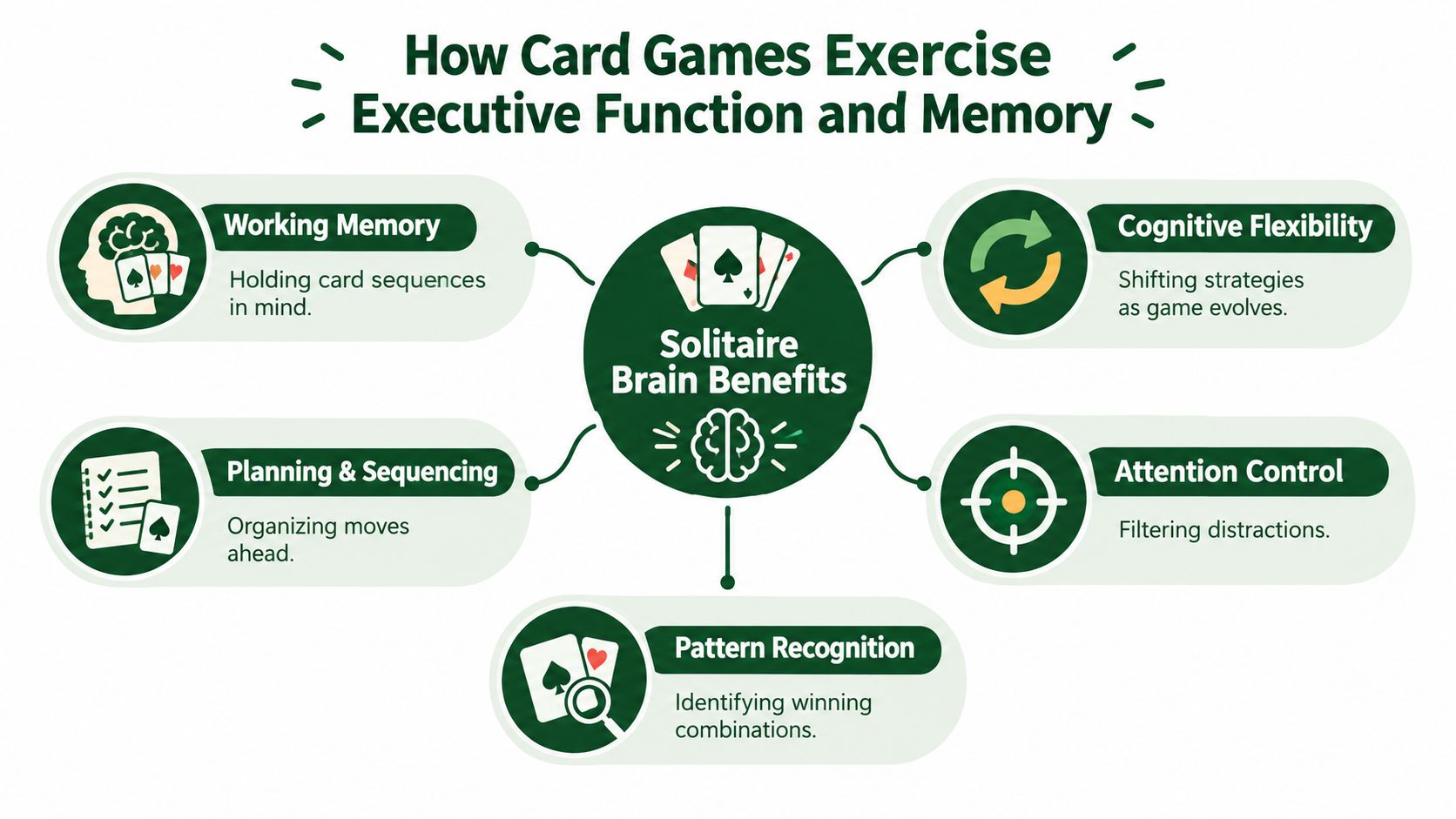
During a solitaire game, your brain isn't merely recognizing suits and moving cards. You're managing a changing problem with incomplete information, competing options, and consequences that may appear several moves later.
The tableau as a mental scratchpad
Think of the tableau as an external version of a mental scratchpad. You can see some information on the table, but you still need to hold intentions in mind: which column you want to open, which card might become available, and whether a move helps now while damaging a later sequence.
That is working memory, the ability to keep information active while using it. In Klondike, you may remember that a red six is needed under a black seven, while also tracking whether moving another card will expose a hidden card. In FreeCell, the open layout invites even more deliberate forecasting because many consequences follow directly from your choices.
A 2018 card-game cognitive-training paper identified attention, control, memory, and complex problem-solving as processes that structured card play can practice. Solitaire doesn't automatically train all of them equally. The challenge depends on the variant, your strategy, and whether you're thinking actively rather than clicking through familiar moves.
Executive control in everyday play
Executive function helps you choose a goal, organize actions, suppress impulses, and change course when conditions shift. Solitaire uses each of these abilities in a small, self-contained setting.
- Planning: You arrange moves in an order that may reveal hidden cards or preserve useful spaces.
- Inhibitory control: You resist an attractive move when waiting creates a stronger position.
- Cognitive flexibility: You abandon an intended sequence after a new card changes the available options.
- Selective attention: You focus on relevant ranks, colors, suits, and empty spaces while ignoring distractions.
- Self-monitoring: You check whether your current approach is working and adjust before the game becomes unwinnable.
A randomized intervention using modern board and card games found measurable gains in executive-control-related skills. Participants improved in verbal-fluency tasks, and the authors concluded that game training can help maintain some cognitive functions, particularly abilities related to verbal fluency and inhibition control. The result supports a mechanism, not a promise that every solitaire session will transfer to daily life.
Memory also has boundaries here. A multi-component card-game training study in older adults found transfer effects on untrained executive-control tests, but no transfer to reasoning or delayed episodic memory. That pattern matters. Card play may strengthen or maintain particular processes without producing a broad boost to every cognitive domain.
Matching Solitaire Variants to Specific Cognitive Skills
Different solitaire variants create different problems. Klondike mixes visible decisions with uncertainty from the stock. FreeCell exposes much more information, so planning becomes central. Spider asks you to coordinate longer sequences and manage suit-based constraints.
The table below describes likely cognitive demands based on game mechanics. These are practical interpretations, not proof that one variant improves a particular ability outside the game.
Cognitive demands by solitaire variant
| Variant | Primary Cognitive Skill | Secondary Benefit |
|---|---|---|
| Klondike | Attention and decision-making under uncertainty | Pattern recognition and patience |
| FreeCell | Strategic planning and working memory | Sequencing and consequence tracking |
| Spider | Cognitive flexibility and multi-step forecasting | Pattern recognition and problem-solving |
Klondike is familiar because it balances opportunity and uncertainty. You decide whether to move a card immediately, draw from the stock, or preserve a sequence for later. That makes it a useful choice for practicing quick evaluation, visual scanning, and delayed gratification. A move can look helpful while blocking a more valuable reveal, so attentive players learn to compare immediate gains with future options.
FreeCell functions more like an open-information puzzle. The visible cards reduce the need to remember hidden locations, but they increase the demand for sequential planning. You must decide which cards to place in temporary cells, when to clear a column, and how one move affects the next available sequence. The mental challenge resembles solving a route through a map, where every shortcut can close another path.
Spider Solitaire raises the complexity by requiring you to build and manage longer runs, often across suits. That makes it especially suitable for pattern recognition, categorization, and flexible strategy selection. You may begin with one plan, then revise it when a new arrangement creates a better chance to complete a sequence.
Choose the variant by the skill you want to emphasize, not by claims that one game is universally superior.
This comparison also explains why variety can help. Repeating one familiar layout may turn decision-making into habit. Rotating among Klondike, FreeCell, and Spider changes the rules you must monitor, the information you must prioritize, and the kinds of mistakes you need to detect.
Brain Training Versus Brain Health in Casual Play
A structured cognitive-training program usually targets a defined ability, adjusts difficulty, and measures performance with specific tests. Casual solitaire is broader and less controlled. You choose the pace, repeat familiar patterns, and may use hints or undo whenever a decision becomes uncomfortable.
That doesn't make solitaire worthless. It means the likely benefit is domain-specific engagement, not a guaranteed upgrade to general intelligence. A game can exercise planning during play without making you better at unrelated tasks such as remembering appointments or solving unfamiliar reasoning problems.
Why transfer is the difficult part
Researchers distinguish between improving at a trained task and transferring that improvement elsewhere. If you become better at spotting a legal card move, that proves you've learned something about that game. It doesn't automatically prove that your general memory, reasoning, or everyday decision-making has improved.
A randomized controlled trial of modern board-and-card-game training found improvements in semantic verbal fluency and response inhibition after five weeks of gameplay. The study also reported gains across tasks involving distributed spatial attention, spatial working memory, and color-direction conflict. Those outcomes were task-specific, which is stronger than relying on a player's feeling that their mind is sharper.
A large cross-sectional investigation found no cognitive advantages for commercially available brain-training regimes, while regular computer, board, and card-game activity was associated with better performance. Its reported positive effect sizes were 0.27 standard deviations for video games and 0.39 standard deviations for puzzles. Because the investigation was cross-sectional, it can't establish that playing caused the difference.
For a broader discussion of the distinction, see whether brain games make you smarter. The practical interpretation is straightforward: solitaire can provide consistent mental engagement, but adaptive clinical training may create stronger challenges in a narrowly defined skill.
What solitaire can and can't promise
Solitaire can offer a low-friction reason to focus, plan, and monitor decisions. It may also support a routine that keeps mentally stimulating activity present in daily life. It can't replace medical care, diagnose cognitive problems, or guarantee protection against dementia.
That balanced view is more useful than a sales pitch. If you enjoy the game, its repeatability is an advantage. The activity you return to thoughtfully may be more valuable than a theoretically powerful exercise you quickly abandon.
The Hidden Mental Health Benefits of a Quiet Game
After a noisy day, solitaire can create a small environment with clear rules and limited consequences. You deal the cards, identify the available choices, and work on one problem at a pace you control. The outside world hasn't disappeared, but your attention has a narrower place to rest.
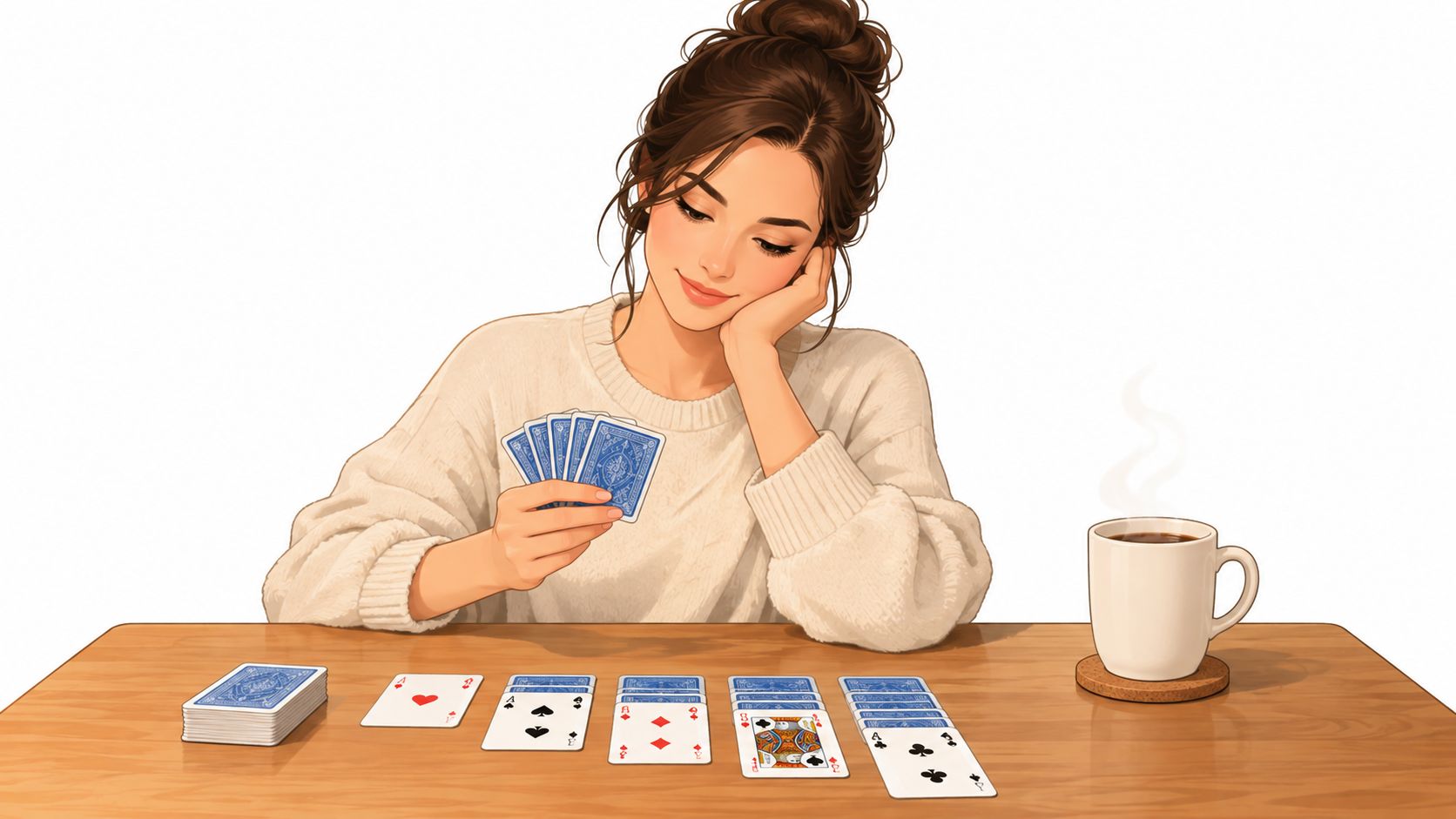
This structure can feel calming because the task is predictable without being completely automatic. You know the rules, yet you still need to notice changes and choose a response. That combination often supports a flow-like state, where attention settles on the activity and self-conscious worry becomes less prominent.
The effect isn't guaranteed, and solitaire isn't a treatment for anxiety or depression. Still, a low-stakes activity can help some people shift attention away from repetitive worries. Its value may come less from “relaxation” as a promised outcome and more from giving the mind a manageable task with immediate feedback.
Focus without social pressure
Single-player play removes the need to perform for an opponent. You can pause, reconsider, and start again without explaining a decision. That independence can make the game feel safer than competitive activities, especially when your goal is decompression rather than achievement.
A practical guide to the benefits of playing solitaire can be useful for readers who want to connect focus, patience, and relaxation with everyday play. Keep the claims proportionate, though. Feeling calmer after a quiet game is a personal experience, not evidence that solitaire changes the nervous system in a clinically established way.
You can make the session more mindful by noticing the physical details of play: the rhythm of turning cards, the visual order of the tableau, and the moment you choose one move over another. Put the phone on silent, remove unrelated tabs, and let the game be one activity rather than background noise.
The following video can serve as a simple visual companion for a quiet, focused session.
The mental-health case for solitaire is therefore modest but meaningful. It can create a short pause, reduce competing demands on attention, and give you a sense of order. Those qualities support a healthy routine, even though they shouldn't be confused with a medical claim.
Building a Cognitively Engaging Solitaire Routine
Solitaire becomes less mentally demanding when you play entirely on autopilot. If you make the same opening moves without checking alternatives, accept every hint immediately, and undo each uncomfortable choice, you reduce the need to plan and monitor.
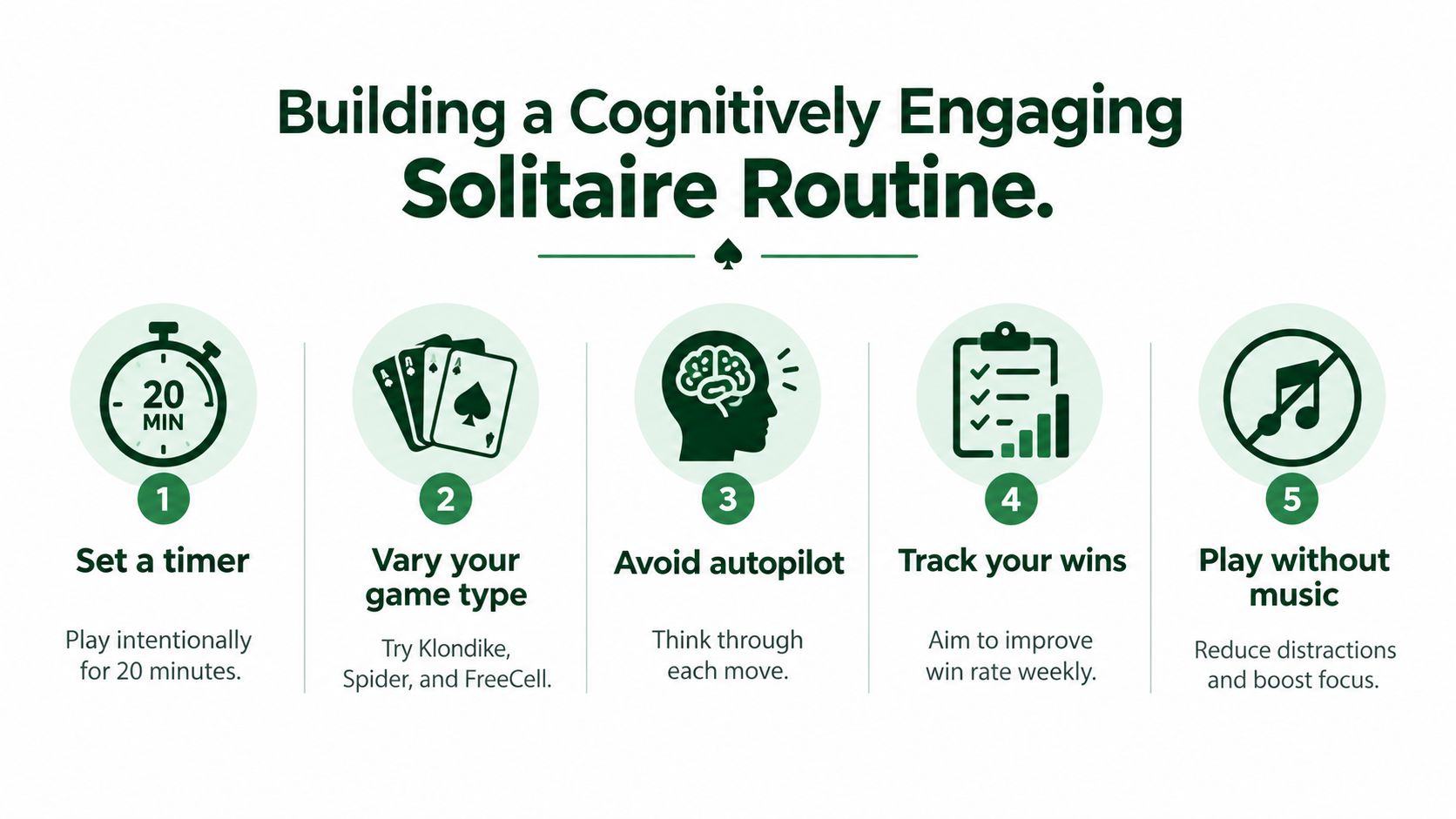
A better routine adds desirable difficulty, meaning enough challenge to require active thought without making the game frustrating. The aim isn't to make every session punishing. It's to keep your attention involved.
Five ways to increase useful challenge
-
Pause before the first move. Scan the tableau and identify more than one possible direction. This turns the opening from a reflex into a planning exercise.
-
Limit hints and undo. Use them when learning rules or recovering from a genuine mistake, but don't make them the default. Without instant correction, you have to compare consequences and learn from your own choices.
-
Rotate variants. Play Klondike for uncertainty, FreeCell for open-information planning, and Spider for sequence management. Changing mechanics prevents one familiar pattern from carrying the entire session.
-
Explain a move to yourself. A quiet sentence such as “I'm moving this card to expose the hidden card” makes your goal explicit. Self-explanation encourages monitoring instead of random experimentation.
-
Review the ending. If you lose, identify the first decision that narrowed your options. If you win, ask which move created the turning point. This reflection is more cognitively useful than focusing only on the result.
Use tools to support learning, not to remove every decision.
You don't need a strict performance target to benefit from deliberate play. Track a simple observation, such as whether you considered alternatives or noticed a recurring mistake. A win rate can be interesting, but it isn't a direct measure of brain health, and a higher score may reflect familiarity with the game rather than broad cognitive improvement.
For ideas on making a regular habit sustainable, explore this daily solitaire routine guide. Keep sessions comfortable, stop when concentration drops, and combine card play with other forms of mental and physical activity.
Making the Most of Your Daily Card Game Practice
The answer to “is solitaire good for your brain” depends on what you expect it to do. If you want a relaxing activity that asks you to focus, remember short sequences, plan ahead, and adapt to new information, solitaire is a reasonable choice. If you want a proven way to prevent dementia or produce broad intellectual gains, the evidence doesn't justify that promise.
The strongest interpretation combines two roles. First, solitaire offers specific executive-function practice, especially when you deliberately weigh moves and manage changing game states. Second, it can support a calm routine by giving your attention a contained task. Those benefits are complementary, but neither makes the game a substitute for sleep, movement, social contact, medical advice, or varied learning.
Turn a pastime into intentional practice
Choose a variant that matches your mood and goal. Use FreeCell when you want visible information and deeper planning, Spider when you want sequence and pattern challenges, or Klondike when you prefer a lighter mix of probability, attention, and decision-making.
Play with enough focus to make decisions consciously, then stop before the activity becomes tiring or compulsive. The most sustainable routine is one that remains enjoyable while still asking you to think.
Play Solitaire Gaming offers browser-based Klondike, Spider, FreeCell, Pyramid, Yukon, Golf, TriPeaks, and Forty Thieves, with drag-and-drop controls, hints, undo and redo, daily challenges, and optional account-based cloud sync. It can be used as one distraction-free option for applying a more deliberate approach to card play.
Try your next session with one clear goal, such as planning two moves ahead, using fewer hints, or switching to a different variant. Visit Play Solitaire Gaming to choose a browser-based solitaire game, play without a download or signup, and turn a familiar pastime into a focused, low-pressure mental break.
Ready to play?