Solitaire Daily Challenge: Rules, Streaks & Strategy
By Rajat Agarwal, Founder of Play Solitaire Gaming
Learn the rules, streaks, and winning strategy for the Solitaire Daily Challenge. Master each puzzle and climb the leaderboard in 2026.
You tap the familiar Klondike button, expecting another relaxed game, and notice a smaller option beside it: Daily Challenge. The board looks ordinary, but the feeling is different. This deal belongs to today, other players may be seeing the same cards, and a streak counter is waiting at zero.
That first click raises practical questions. Is everyone playing the same puzzle? Does a loss prove the deal was impossible? When does the day change, and what happens if you finish after midnight? This guide will help you read that first board, understand how scoring and streaks usually work, and build habits that protect your progress without turning a calming card game into a source of stress.
Table of Contents
- A Player Discovers the Daily Button
- What a Solitaire Daily Challenge Actually Is
- How Scoring, Streaks, and Leaderboards Work
- Playing Today's Challenge on Play Solitaire Gaming
- Strategy That Lifts Your Win Rate
- Midnight, Time Zones, and Calendar Archives
- When a Deal Really Is Unwinnable
- Troubleshooting Missed Days and Broken Streaks
A Player Discovers the Daily Button
Mara had always treated solitaire as a private routine. She opened a browser, chose Klondike, moved cards until the game ended, and started another deal if the result felt unsatisfying. There was no pressure because every board was disposable.
One morning, a small Daily Challenge button appeared beside the usual New Game option. She hovered over it, noticing a date, a timer, and a streak counter showing zero. The ordinary game invited experimentation. The daily board felt more like a shared appointment.
She clicked.
The cards loaded into a fixed tableau. Mara hadn't chosen the deal, and she couldn't replace it with a luckier layout. Somewhere, another player might be looking at the same sequence, making the same opening decision, or discovering a different route through the stock. The game had changed from “Can I win a hand?” to “How well can I handle today's hand?”
That distinction matters. A free-play board helps you practice patterns, test moves, or pass time. A solitaire daily challenge adds a date, a common starting position, and a record of completion. Depending on the product, it may also add a timer, score, leaderboard, or streak.
Coach's advice: Treat the first daily board as a lesson, not a test of your worth as a player.
You don't need perfect play on day one. You need to learn what the product records, which actions affect your score, and when the challenge resets. If you're looking for a browser-based place to practice, Play Solitaire Gaming presents daily challenges alongside its regular solitaire games.
Mara's first board is now open. Before she moves the first card, she needs a clear definition of what makes this deal “daily.”
What a Solitaire Daily Challenge Actually Is
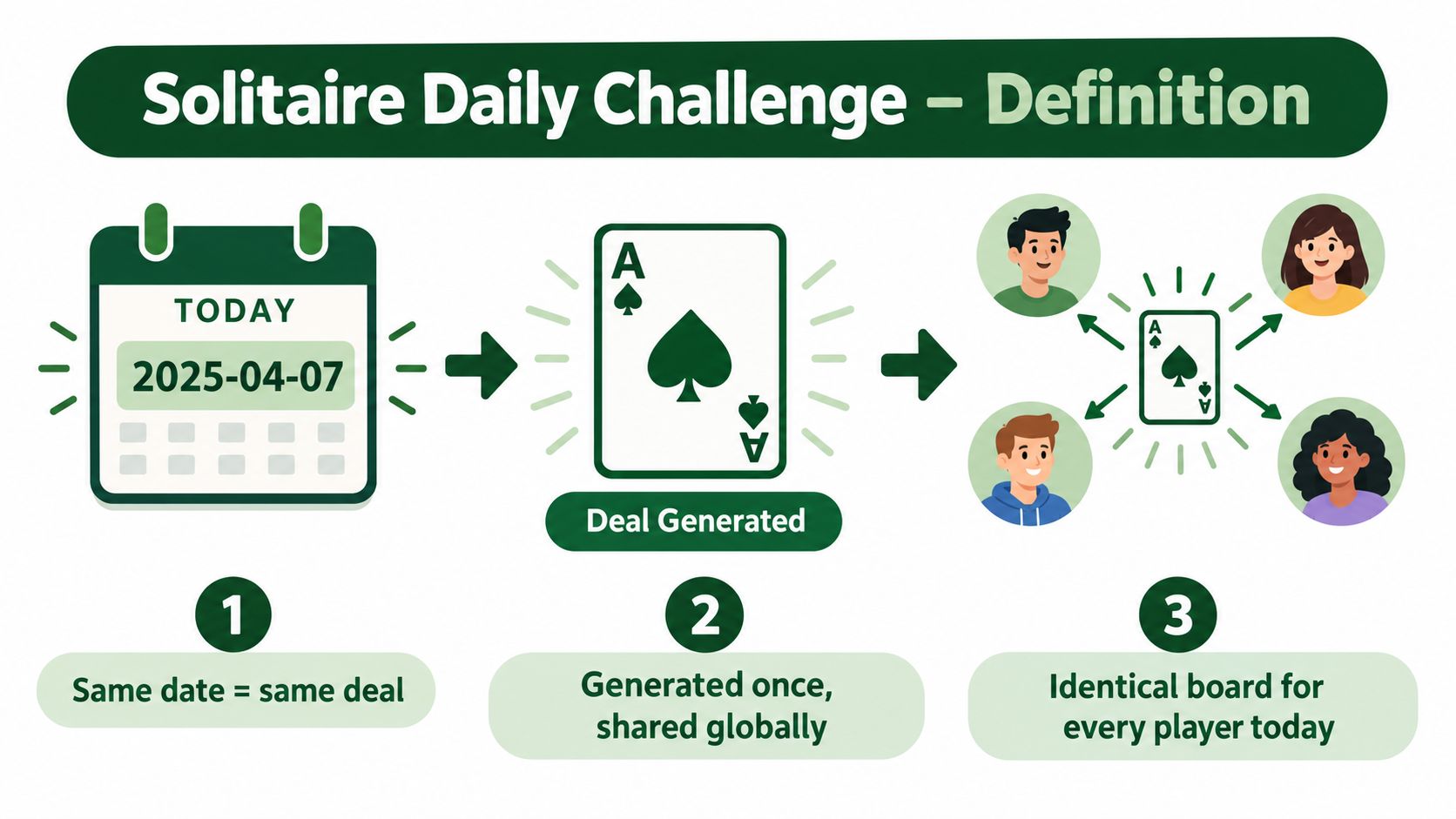
A Solitaire Daily Challenge is generally a date-linked deal. The date selects the board, and players opening the same product for that date receive the same starting layout. One service describes its daily deal as generated at midnight and identical worldwide, which makes the experience comparable across players using that service. Solitaire Online's explanation of the daily deal describes this shared-date model directly.
The easiest analogy is a shared crossword. Everyone receives the same clues, but each person chooses different answers, makes different mistakes, and finishes at a different pace. In solitaire, the cards and their starting order may match, while your moves, pauses, hints, undos, and completion time remain your own.
The date chooses the deal
A daily system typically feeds the date into a deterministic deal generator. You don't select a random seed manually. The product uses the calendar to produce a repeatable board, so two devices using the same daily service can begin from the same card arrangement.
The game variant can rotate. A service might feature Klondike on one day and another variant on a different day, although the exact schedule belongs to the product. “Daily” describes the schedule, not a universal rule that every platform must use the same game each day.
Shared board, separate performance
The shared deal doesn't mean shared results. One player may expose hidden cards early, while another may spend the stock too quickly. One product may allow generous undo use, while another may count undos as part of the result.
Most daily systems offer one live attempt for a date. Reopening the same challenge usually doesn't create a new daily board or erase an existing result. If you don't play, the calendar advances to the next seed. Whether you can replay the missed board later, and whether that replay affects a live streak, varies by product.
That is the first important boundary: the deal may be standardized, but the surrounding rules aren't.
How Scoring, Streaks, and Leaderboards Work
A daily score often combines several ideas, but no universal scoring formula governs every solitaire product. One game may reward a win, another may emphasize speed, and another may present completion and streaks without exposing a detailed calculation.
The safest way to read your result is to separate outcome, efficiency, and continuity. Your outcome says whether you completed the board. Efficiency may include time, moves, hints, or undos. Continuity describes whether you played the issued challenge on successive calendar days.
Read the result screen first
Look for these labels after a game ends:
- Completion: The board was solved and the daily record was submitted.
- Score: The product's own calculation, which may combine several factors.
- Time: How long the active run took, sometimes excluding pauses.
- Moves: The actions the product counts, which may include stock redeals or undo-related activity.
- Streak: The number of consecutive issued challenges credited to your account.
A streak is not the same as a win-rate statistic. You might complete a difficult board slowly and extend the streak, while a fast practice replay may improve your technique without counting toward the live calendar.
A comparison without invented math
The table below describes common scoring components as concepts, not as a promise that every platform uses all of them.
| Component | How It Adds Up |
|---|---|
| Win reward | A completed deal may receive the main completion value. |
| Time factor | Faster completion may influence ranking where the product uses timed scoring. |
| Move factor | Efficient play may matter when the platform tracks move economy. |
| Hint or undo treatment | The product may count, limit, or ignore assistance. |
| Streak credit | Completing the issued daily may extend continuity separately from points. |
A leaderboard can also change the meaning of a score. A global board compares you with a broad player pool. A friends-only list measures a smaller social group. A weekly or date-based board may refresh independently of an all-time record. Because these boards use different comparison groups and reset rules, the same raw result can occupy different positions.
A score answers “How did I play this board?” A streak answers “Did I show up for the scheduled boards?”
Don't assume that a zero on the streak display means you played badly. It may mean the challenge wasn't completed, the account wasn't signed in, the day changed before submission, or the platform's calendar treats the attempt differently. For a wider explanation of move values and common scoring ideas, see this solitaire scoring guide.
Playing Today's Challenge on Play Solitaire Gaming
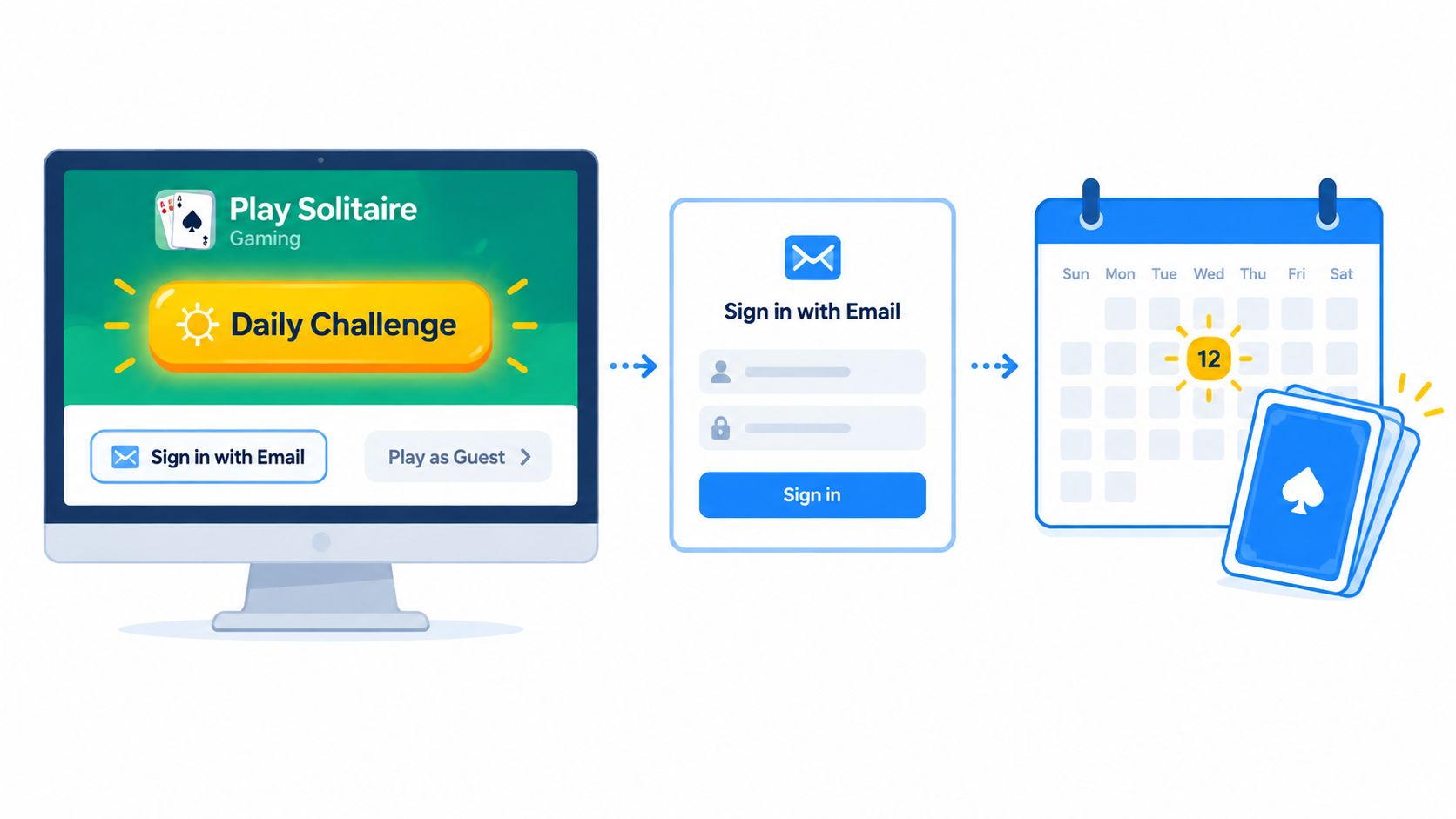
On Play Solitaire Gaming, start from the homepage and look for the Daily Challenge hero card or the Daily button in the game interface. Select it rather than opening a standard random deal. The daily entry is the route to the date-specific board.
The site supports play without a signup, while optional account access can provide a way to keep activity associated with the same player profile. If the page offers email or guest play, choose the option that matches your priority. Guest play is convenient for a quick session. Signing in is more useful if you want account-linked continuity across devices.
Load the board carefully
After you choose today's challenge, select the featured variant shown by the page. The exact rotation belongs to the site, so read the label rather than assuming every day is Klondike. Once the board loads, the deal is fixed for that daily session.
The toolbar gives you practical controls while you think:
- Hint can point toward a possible action when the board feels quiet.
- Undo lets you revisit a decision and compare the result of another line.
- Redeal or stock actions may count as moves according to the game's rules.
- Pause can stop the active timer where the interface supports timed play.
Use a hint to learn, not to surrender your decision-making. Before clicking it, scan the tableau and ask which hidden card, empty space, or foundation move you're trying to reach.
Know what each ending means
A win completes the challenge and normally advances the daily record. An active board you abandon is different from a completed loss. If the product marks unfinished play as missed, closing the page doesn't preserve your place as a successful daily result. Sign-in may preserve state or stats across desktop and mobile, but you should confirm the account is the same before switching devices.
The practical routine is simple. Open the Daily Challenge, verify the date and variant, make sure your account state is correct if you rely on sync, and submit the result before leaving the board.
Strategy That Lifts Your Win Rate
A daily board rewards disciplined reading more than frantic clicking. In Klondike, the underlying solvability problem is computationally hard, yet research summarized in a solvability thesis estimates that at least 81.9% of draw-1 deals are solvable, leaving about 18.1% unsolvable. The Klondike solvability thesis also reports that only 2.24 percentage points of those unsolvable deals were detected by the recursive method tested.
That doesn't mean you should expect to lose every fifth daily board. The estimate concerns a particular draw-1 Klondike model, while products may use different rules, generators, and validation methods. It does mean that a lost board isn't automatically proof that you made a mistake.
Read before committing
Start by locating blocked aces, twos, and low cards. A low card can open a foundation or create a useful tableau move, but moving a card because it is legal may remove the flexibility you need later.
Count buried cards before clearing a column. If a move exposes a face-down card, it may be more valuable than a neat-looking foundation push. Empty columns deserve similar care because they can receive Kings and create room for longer sequences.
Use assistance as feedback
Undo is most helpful when it answers a question. Did moving that red sequence block a black card? Did drawing from the stock too early remove your only access to a needed rank? Reverse the move, test the alternative, and remember the result.
Undo becomes a crutch when you click without observing. Give yourself a short period of deliberate play before reversing a move, and note what changed. That turns the tool into a training record rather than a way to erase every uncomfortable decision.
Avoid pushing middle cards to the foundation just because they fit. An 8 or 9 may still be needed in the tableau to build around a buried card. Preserve flexible sequences until you know the move opens something important.
Before the first move, ask:
- Which face-down card can I expose first?
- Which legal move creates the most future choices?
- Is an empty column available, and which King could use it?
- Am I building a foundation because it helps, or because it looks tidy?
- What does the next stock pass need to accomplish?
For additional practice ideas, use these expert solitaire strategy tips. Consistency matters more than forcing a win on a board that offers no workable path.
Midnight, Time Zones, and Calendar Archives
You finish a daily board while traveling, then a friend says the challenge ended hours ago. Both of you may be correct. “Today's challenge” sounds like one shared board, yet each product chooses its reset clock, archive rules, and streak policy.
A standardized daily challenge usually starts with a date-seeded deal. Players receiving that same issued date can face the same arrangement, which makes results easier to compare. The surrounding rules still vary widely. A product may reset at local midnight or at 00:00 UTC, offer old boards in a calendar, count replays separately, or treat a missed day as a broken streak.
Microsoft Solitaire offers a useful example of a long-running daily-play system. Microsoft first bundled Solitaire with Windows 3.0 on May 22, 1990, and later reported about 35 million active monthly players and more than 100 million games played each day by the game's 30th anniversary in 2020. The Microsoft Solitaire history overview shows how daily challenges can grow from an established playing habit.
Three models to recognize
| Platform Type | Reset Clock | Archive Access | Streak Counting Rule |
|---|---|---|---|
| UTC-based global product | Changes at 00:00 UTC | Depends on the product | Usually tied to the issued UTC date |
| Local-midnight product | Uses the device or local calendar | Depends on the product | Usually follows the player's local day |
| Archive-enabled client | Live reset follows its own clock | Past boards may be replayable | Replays commonly remain separate from the live streak |
A UTC-based service changes for everyone at one instant. A local-midnight app can show a fresh board to one region while another region is still finishing yesterday's deal. An archive may let you practice an old board without granting current-day streak credit. Replay access and streak credit are separate settings, so check both.
Microsoft support material indicates that its challenge calendar displays only the current month's completed daily challenges, while challenge history is tied to the Microsoft account used to sign in. The Microsoft support discussion about retrieving daily challenges shows why the visible calendar and account record may not cover the same period.
Before a streak run: Check the product's reset clock, confirm which account is signed in, and submit the result before the clock changes.
Travel can turn one missed day into several possibilities: an absence, a timezone mismatch, a sign-in problem, or a board completed after the cutoff. Compare streaks only after confirming that both players use the same calendar model.
When a Deal Really Is Unwinnable
You can make sensible moves, uncover useful cards, and still reach a position with no legal route to a foundation. A lost daily hand is not automatic proof of poor play. The board itself may have created the trap.
Klondike deals start from a seeded arrangement. If important cards are buried in an unfavorable order, even strong decisions may not produce a winning path. The solvability research discussed earlier shows that a meaningful share of draw-1 deals cannot be won. Research on the percentage of winnable solitaire games helps separate an impossible layout from a mistake you could have avoided.
Separate board failure from decision failure
Study the blockage's shape:
- Buried access: A needed low card or King sits under cards that cannot be moved legally.
- Color imbalance: Red and black sequences fail to connect in a way that opens the tableau.
- Forced stock cycling: A useful card appears only after a stock order you cannot reach before the available options run out.
- Foundation timing: Moving a card upward too early removes the tableau support needed to expose another card.
- Blocked empty column: You have a King ready to move, but the column it would need remains occupied, so no useful sequence can shift into the space.
One sign does not prove mathematical impossibility. It shows that the board deserves examination rather than a race for speed. Rewind a key move, test the alternative, and check whether the same obstruction returns.
Before drawing again, scan for available red-black pairs and ask whether an empty column would improve access. Delaying a tableau build can sometimes make a stock cycle useful. Repeated passes, however, may only conceal a dead layout.
Product rules also affect the result. Restricted undos, different stock behavior, scoring caps, hints, and variant rules can make two similar-looking challenges play very differently. Judge a daily result by the rules of that product, not by a perfect-play standard from another version.
The useful question is, “Did my decisions create the blockage, or did the seeded board leave no legal route?” You may not always prove the answer, but making that distinction protects both your strategy and your enjoyment.
Troubleshooting Missed Days and Broken Streaks
A streak is easier to protect when it becomes a small daily appointment, not a test of endurance. Start by identifying the rule attached to your account, because products handle dates, sign-ins, replays, and continuity differently. A challenge archive may preserve an older board without restoring the live streak, while an account-linked history may follow your profile rather than the device you used.
If you forgot to play
Open the challenge page and check whether the missed board appears in a calendar archive. Use it for practice if available, but do not assume that replaying it repairs the current streak. Some products keep past challenges accessible while separating those completions from today's continuity.
A reminder tied to an existing routine can prevent the next miss. Try your first coffee, an evening wind-down, a home-screen shortcut, or a pinned browser tab. The goal is to remove the small amount of friction that turns “later” into a missed day.
If your device died mid-hand
Return to the same product before starting another game. If you were signed in, the service may restore your progress or record the account's current status. Guest play may not transfer the board to another device, even when the game looks identical.
Do not begin a replacement random deal and treat it as the daily challenge. Reopen the Daily Challenge, verify the date, and look for a resume option or result screen. A daily board is usually tied to its issued date, while a random game is a different deal.
If travel changed the day
Check whether the product resets at local midnight or at a global time. That difference can make the same board appear current on one device and past on another. Avoid waiting until the final moments before the expected cutoff, since the board can change while you are still playing it.
Choose a consistent personal play window instead. It is safer than calculating the boundary while moving between time zones.
If your sign-in disappeared
Confirm that the email or account method matches the one used when the streak began. A different login can create a separate history on the same phone. Verify the active profile before completing another board, especially if your statistics or calendar suddenly look empty.
If a bonus or special rule was active
Read the result screen and challenge notes. A bonus may change points without changing completion, while a special mode may change how hints, undos, or replays count. A leaderboard position alone cannot reveal which rule affected the result.
Build a streak that survives ordinary life
Use a simple maintenance plan:
- Choose one window: Play at a repeatable time when interruptions are unlikely.
- Keep a backup cue: Set a second reminder for later the same day.
- Verify sync: If you use multiple devices, confirm the same account is active before beginning.
- Limit retries: Study a failed board, but do not turn one missed day into an exhausting chase.
- Review calmly: Check recent results and decide whether the problem was timing, strategy, or platform behavior.
Challenge systems encourage repeat play, yet research on challenge and retention indicates that difficulty affects players differently. The cited study defines churn as 14 days of inactivity and reports that players may leave when the perceived challenge is too high or too low for their preference. The study of challenge and player retention points to a practical lesson: choose a routine and difficulty level that keep the daily goal engaging rather than punishing.
A broken streak is information, not a verdict. Record what happened, check the product's calendar rules, and begin the next issued board with a clearer routine.
Play Solitaire Gaming provides browser-based access to daily challenges across solitaire variants, with hints, undo controls, and account options for keeping statistics connected across devices. Visit Play Solitaire Gaming to open a board, check its timing rules, and start a streak you can maintain comfortably.
Ready to play?