Canfield Solitaire Rules: The Complete Guide to Winning
By Rajat Agarwal, Founder of Play Solitaire Gaming
Master the canfield solitaire rules with our complete guide. Learn setup, strategy, scoring, and win rates to conquer one of the hardest solitaire games.
Canfield solitaire is one of the hardest classic card games, with a win rate of only about 8%, and learning the rules starts with a 52-card deck, a 13-card reserve, four tableau cards, and foundations that grow from a single starting rank instead of the usual aces. If you're staring at a Canfield layout and wondering why it feels so much harsher than Klondike, the answer is built into the structure of the game itself.
A lot of players arrive at Canfield the same way. They know Klondike, they expect a familiar rhythm, and within a few turns they feel trapped. Cards seem locked away, empty spaces don't behave the way they expect, and the stock never quite gives the rescue they want. That confusion is normal.
The good news is that Canfield makes sense once you stop treating it like “hard Klondike” and start treating it like its own system. The canfield solitaire rules are strict, but they're also logical. Once you understand how the reserve, tableau, stock, waste, and foundations work together, the game becomes less mysterious, even when it stays difficult.
Table of Contents
- The Challenge of Canfield Solitaire
- Setting Up the Table
- Understanding Legal Moves and Flow
- Variations in Stock and Reserve Rules
- Strategy and Win Probability
- Playing Canfield Online
The Challenge of Canfield Solitaire
You turn over a few cards, make the moves that would feel sensible in Klondike, and still hit a dead end almost immediately. In Canfield, that early wall is not unusual. It is part of the design.
Canfield feels harder because it gives you less freedom from the start and asks more of each decision. Klondike often lets you test ideas and recover from a weak move. Canfield is stricter. A blocked card tends to stay blocked longer, and one careless transfer can close off the small amount of working space you had.
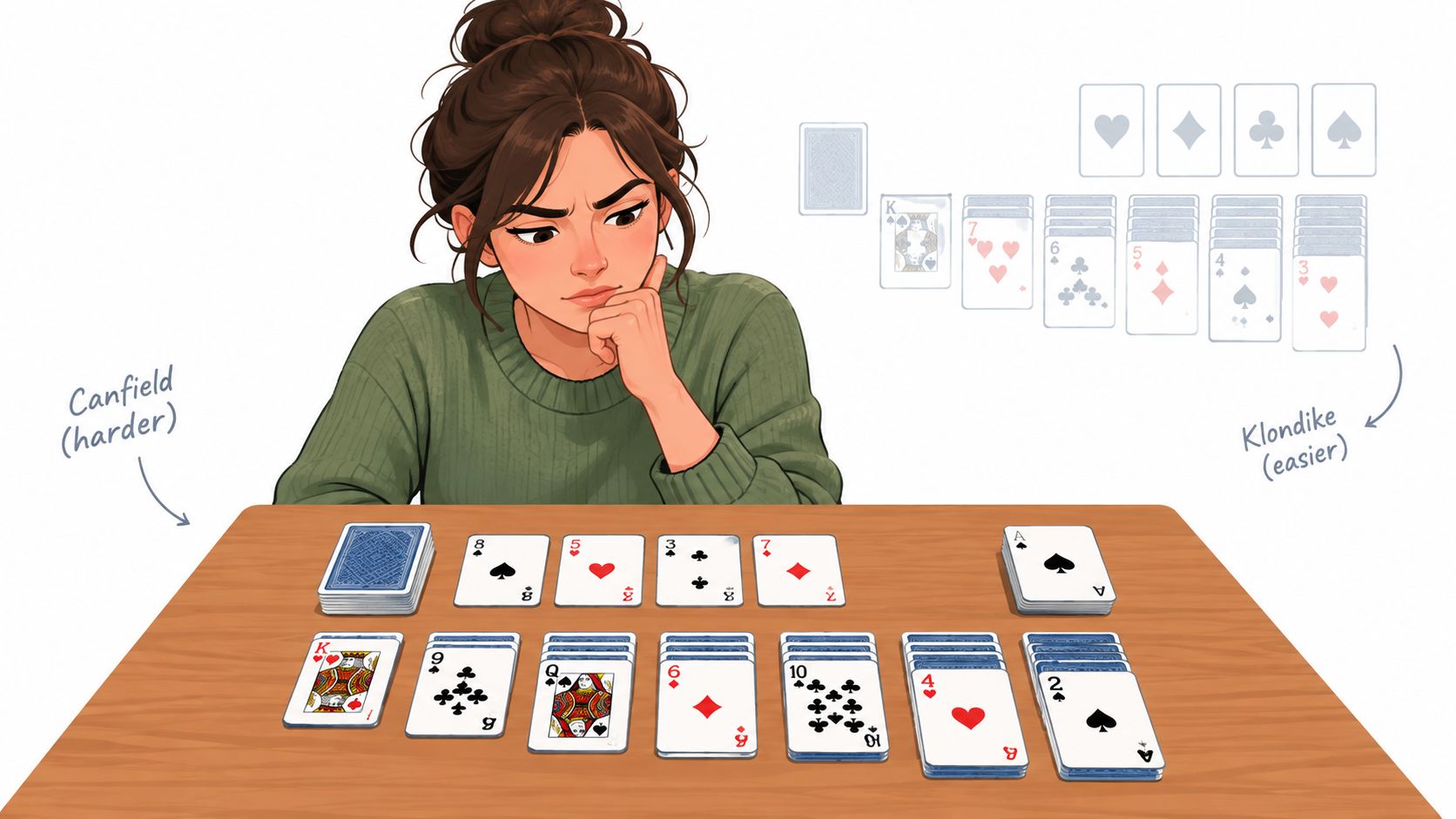
Why it feels harsher than Klondike
The difficulty is structural, not just emotional. Canfield is built around restrictions that pile up early.
- The reserve limits access: A reserve pile works like a waiting line with only the front person visible. If the card you need is third or fourth down, you cannot dig for it.
- The tableau gives you less room to rearrange: With only a few active spaces, each pile has to do more work.
- The foundation start can be awkward: The base rank decides where all foundations begin, so your first goal is not always the familiar race to the aces.
Those rules create a different kind of pressure. In Klondike, a move can be merely decent and still help. In Canfield, a move often needs to improve access, preserve space, or set up another move soon after. If it does none of those, it may make the position worse.
That is why the low win rate matters as a guide to strategy, not as trivia. Published summaries of Canfield commonly describe it as a single-digit-win game, which is a useful expectation to carry into your first sessions. You are not playing badly just because a deal collapses. You are learning a game where many deals begin with tight constraints and stay tight.
Standard rules versus variation rules
New players also get confused because "Canfield" does not always mean one exact ruleset. Some versions change how many cards you draw from the stock. Others change whether reserve cards refill spaces automatically or how many passes through the stock are allowed.
That detail matters. A rule change that sounds minor can make the game noticeably easier or harder. If you want to judge your decisions fairly, first identify whether you are playing standard Canfield or a house variation. The later sections on stock and reserve rules will make those differences clear.
A helpful comparison is the contrast in FreeCell vs solitaire differences. FreeCell gives you visible information and extra control. Canfield withholds both, which is a large part of its reputation.
A better mindset for learning
Treat Canfield like a traffic problem, not a speed contest.
Your job is to keep cards moving through narrow lanes without blocking the next useful route. That mindset helps because strong play in Canfield is less about making every legal move and more about protecting access to the few cards that can change the position.
Setting Up the Table
A correct setup removes half the confusion. Many rule disputes come from players learning a digital version that labels piles clearly, then trying to recreate it with real cards and putting one area in the wrong place.
The standard physical layout uses one 52-card deck, with 13 cards in the reserve pile, one face-up base card to begin the foundations, four face-up tableau cards, and the remaining cards as stock. That standard setup is described in the Spruce Crafts explanation of Canfield solitaire.
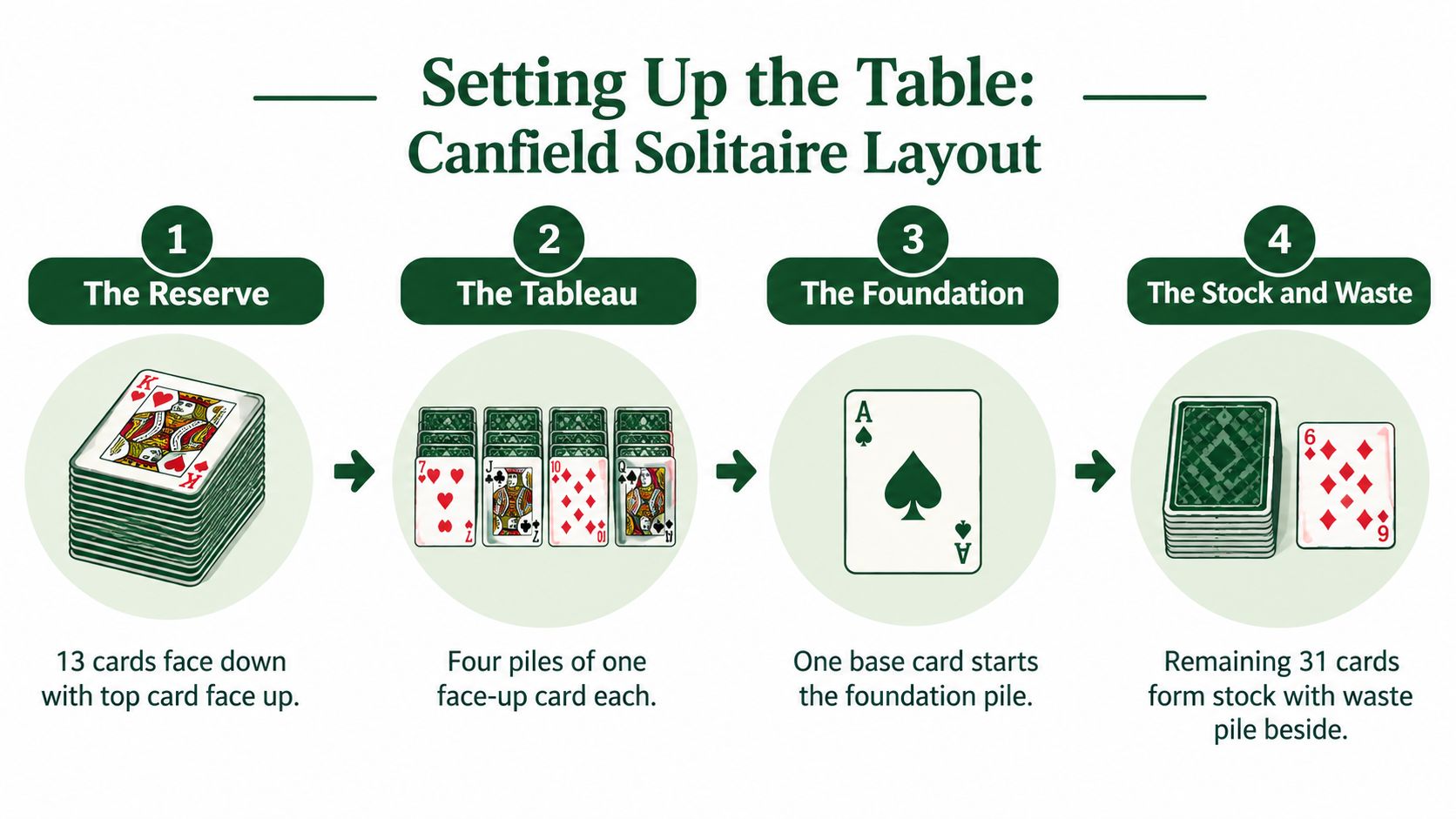
The five areas on the table
Think of the layout as five zones, each with a different job.
-
Reserve pile
Deal 13 cards into a single pile. In the usual form, only the top card is exposed and playable. -
Base card and foundations
Deal one face-up card to begin the first foundation. Its rank decides how all foundation piles will build. -
Tableau
Deal four face-up cards, each forming its own tableau pile. -
Stock
The remaining cards become the stock pile. -
Waste
This starts empty and receives cards drawn from the stock.
Where players often get mixed up
The base card is the part that throws off players trained by Klondike. In Klondike, foundations begin with aces. In Canfield, the first foundation card sets the rank for every suit.
If the base card is a king, the foundations start from kings. If it's a lower rank, the foundation sequence wraps around after king and continues at ace until the full suit is completed. That's why many players remember the rule as “building from kings rather than aces.” The deeper truth is that you build from the starting rank, not from a fixed ace-only opening.
Practical rule: Before making your first tableau move, look at the base card and mentally note what rank each foundation needs next.
A simple table helps:
| Area | What you place there | Why it matters |
|---|---|---|
| Reserve | 13 cards | Creates the game's main bottleneck |
| Foundation start | 1 face-up base card | Sets the rank sequence |
| Tableau | 4 face-up cards | Your working area |
| Stock | Remaining cards | Supplies future options |
| Waste | Drawn cards | Only top waste card is usually playable |
A quick visual walkthrough can make the setup easier to memorize:
Understanding Legal Moves and Flow
A Canfield turn often feels harder than it looks. In Klondike, a legal move usually opens another obvious move. In Canfield, legal moves exist inside a tighter structure, so the question is not just "Can I move this card?" but "What does that move free?"
Start with the two building systems, because they pull in opposite directions.
In the tableau, cards build down by rank and alternate colors. A red 8 can take a black 7. A black 10 can take a red 9. If you already know Klondike, this part will feel familiar.
The foundations follow a different logic. They build up by suit from the base rank set earlier, and the sequence wraps after king. So if the base card is a king, the next card for that suit is ace, then 2, then 3, and so on. Players often stumble here because the tableau uses descending order while the foundations use ascending order from a custom starting point.
Your playable cards usually come from only three exposed spots:
- the top reserve card
- the top card of each tableau pile
- the top waste card after a draw
That limited access is one of the structural reasons Canfield is harder than Klondike. More cards are present, but fewer are available. A buried reserve card may matter a lot, yet you cannot treat it as part of your current plan until the cards above it move.
The reserve controls the pace of the whole game.
It works like a traffic bottleneck. When the top reserve card has a legal move, the next card appears and your position may loosen. When it does not, the reserve can stall everything behind it. Because of that, a move that releases the reserve is often stronger than a move that only tidies the tableau.
Empty tableau spaces cause another common mistake. In standard Canfield rules, if a tableau pile becomes empty while the reserve still has cards, that space is usually filled from the reserve, not from any card you choose. This is a major difference from looser solitaire habits. An empty space is not automatically a storage spot you can use however you like.
The stock and waste add another layer of restriction. Standard rule sets commonly turn over three cards at a time from stock to waste, rather than one by one, as described in the Semicolon Canfield rules reference. That rule matters because card order starts working against you. A useful card may be present in the waste cycle but still remain out of reach because other cards sit on top of it.
That is a good way to read Canfield's low win rate. It is not hard only because the rules look unusual. It is hard because the game limits access at several points at once: the reserve reveals one card, the waste may reveal cards in clumps, and foundation timing depends on the base rank. Once you see that structure, your decisions become clearer.
If you want a useful contrast, how Spider Solitaire works shows a different kind of difficulty. Spider gives you more visible cards, while Canfield often hides the cards that matter most.
Variations in Stock and Reserve Rules
Canfield becomes much less frustrating once you realize that not every version uses the same stock and reserve rules. Two people can both say they're playing Canfield and still be playing meaningfully different games.
That matters because a “bad” game might be a mismatch between the rules you expect and the rules your app, website, or rulebook uses.
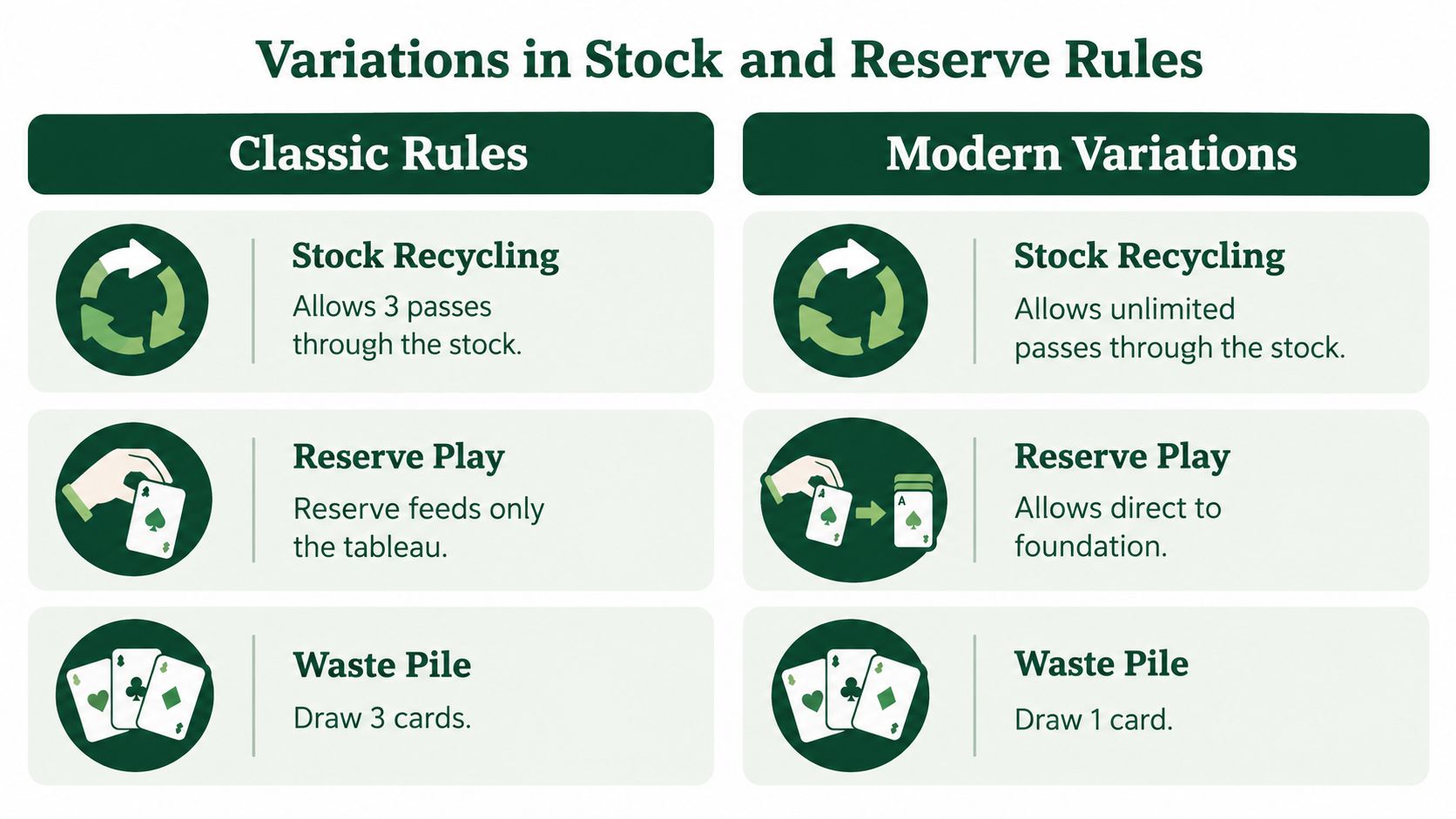
Standard rules and common alternatives
One widely used rule set turns over three cards at a time from the stock to the waste, and some versions allow the waste to be recycled indefinitely by turning it back into a new stock when the hand is exhausted. That variation is described in the Semicolon Canfield rules reference.
The biggest differences usually fall into two categories:
| Rule area | Stricter version | More forgiving version |
|---|---|---|
| Stock | Draw three to waste | Draw style may be easier |
| Redeals | Limited or less generous | Waste may be recycled repeatedly |
| Reserve access | Top card only | Some house rules reveal reserve more openly |
Why these variations matter in practice
A three-card stock draw makes planning harder because access arrives in chunks. You may know a needed card is somewhere in the waste cycle but still be unable to reach it at the right moment.
Reserve rules also change the personality of the game. If only the top reserve card is playable, every blocked reserve card creates pressure. If a variant exposes reserve cards more generously, the game starts to feel less like a lockbox and more like a constrained puzzle.
A simple way to protect yourself from confusion is to check these points before your first move:
- Stock draw rule: Are cards drawn one at a time or three at a time?
- Redeal rule: Can you recycle the waste, and if so, how?
- Reserve rule: Is only the top reserve card available?
A fair amount of Canfield frustration comes from silent rule changes, not poor play.
When you learn the canfield solitaire rules, always identify the exact version in front of you first. Strategy only makes sense after that.
Strategy and Win Probability
You make three or four legal moves, the layout looks cleaner, and then the game suddenly tightens. The reserve is still clogged, the waste card you need is out of reach, and a foundation move that felt safe has removed a card you needed for maneuvering. That pattern explains why Canfield frustrates strong Klondike players. The game gives you fewer recovery routes.
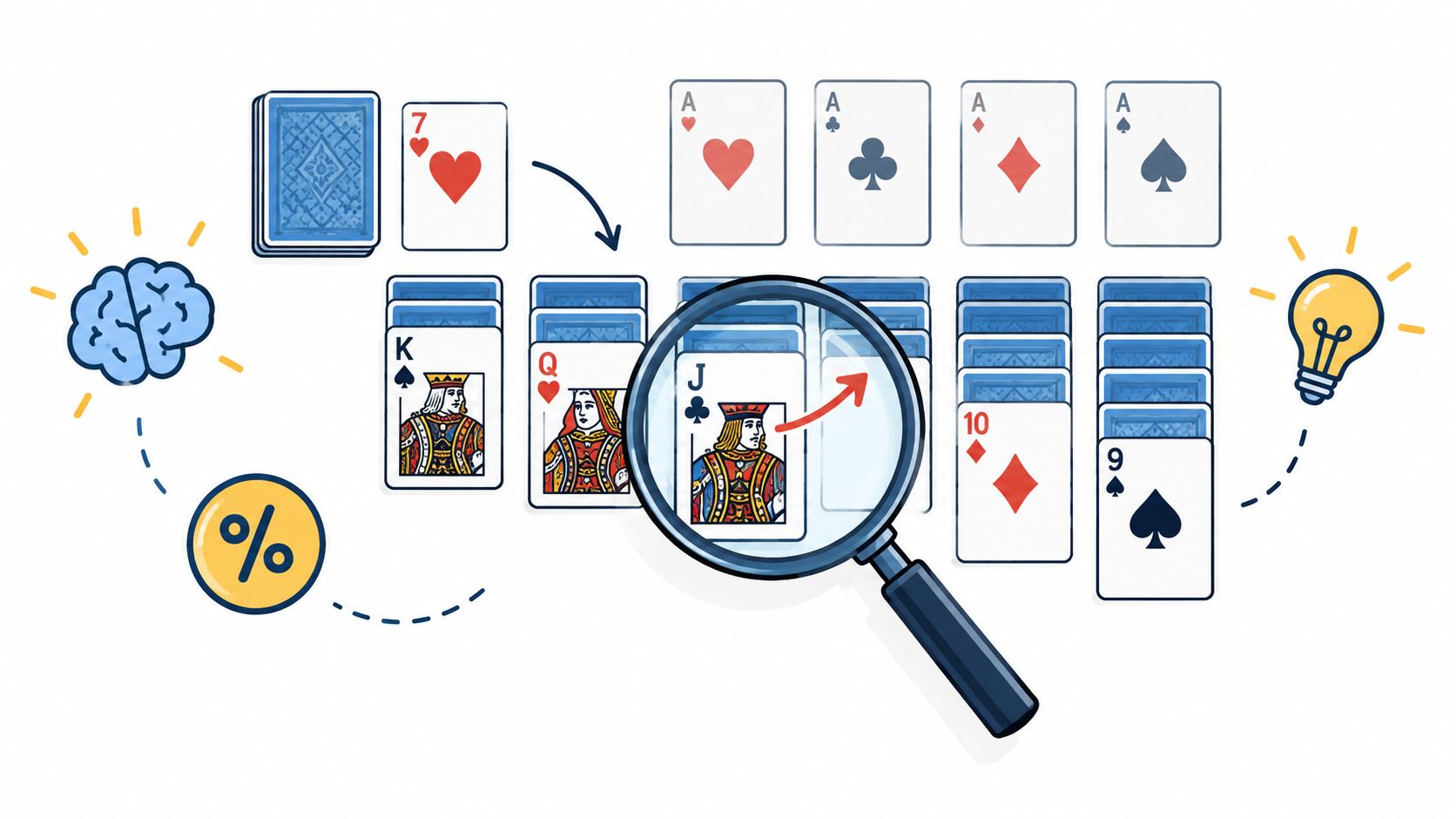
A low win rate matters here because it sets the right goal. You are rarely trying to "solve" every deal. You are trying to preserve access for as long as possible, because Canfield is structurally stingier than Klondike. The reserve starts as a backlog, the stock often limits timing, and one legal move can shut off two future moves.
That is the main strategic lesson: access matters more than tidiness.
In Klondike, you can often clean up the tableau and trust that new chances will appear. In Canfield, the layout works more like a narrow hallway. If you place the wrong card in that hallway, traffic jams form quickly. Players who treat Canfield like a faster Klondike usually lose for a simple reason. They improve the look of the table without improving access to buried cards.
Practical priorities
Use these priorities as a checklist during play:
- Free reserve cards early when the move does not create a worse block: Every reserve card you release gives you another chance to find a useful rank or color.
- Pause before building to the foundations: A card that is safe on a foundation in theory may still be doing work in the tableau.
- Protect flexible cards: Middle ranks often act like connectors. If you send them away too soon, entire chains stop moving.
- Treat empty tableau spaces as tools, not trophies: In some rule sets, a gap is immediately filled from the reserve. That can help, but it can also force a card into play before you have a place for it.
- Use the stock to improve timing, not just to consume turns: Draw only after checking whether a tableau or reserve move opens more possibilities first.
A good test for any move is simple. Does it reveal a new card, create a new landing spot, or preserve a useful connector? If it does none of those things, it may be legal but weak.
Here is where newer players often get trapped. They see a card that can go to the foundation and assume progress is always good. In Canfield, progress can be premature. A black 6 might belong on a foundation eventually, but if it is currently the only landing place for a red 5, moving it too soon can freeze part of the tableau. The move was legal. The timing was wrong.
So use the low win rate as a planning guide, not as trivia. It tells you the game is built around scarcity. Cards, spaces, and timing all matter more than they do in Klondike. If you want a broader comparison of how difficult different variants are in practice, this overview of solitaire win rates across variants gives useful context for where Canfield fits.
Playing Canfield Online
Digital Canfield removes some of the friction that makes the paper version intimidating. You don't have to worry about misdealing the stock, forgetting a variation rule, or accidentally moving a card into an illegal spot.
That's especially helpful in a game this strict. Undo lets you test a line of play and back up when you realize a legal move was still a bad move. Hints can also teach the movement logic, though they won't always explain why one legal play is strategically stronger than another.
What to check before you start a digital game
Online versions can look similar while using different assumptions. Before you settle into a session, check:
- Rule settings: Look for draw style, redeals, and reserve behavior.
- Move assistance: Auto-foundation can be risky in a game where tableau timing matters.
- Undo depth: Unlimited undo is useful for studying mistakes rather than just correcting them.
One browser-based option is Play Solitaire Gaming, which offers classic solitaire variants with hints and unlimited undo in a no-download format. If you want a broader guide to learning digital card games comfortably, this article on how to play solitaire online is a practical starting point.
The best use of online Canfield isn't just convenience. It's repetition. Because the game is structurally difficult, you learn faster when you can restart quickly, compare rule sets, and notice which choices consistently improve access to your reserve and waste.
If you want a clean place to practice what you've learned, Play Solitaire Gaming offers ad-free browser play, smart hints, unlimited undo, and clear guides for classic solitaire variants. It's a useful way to sharpen sequencing, compare games like Klondike, Spider, and FreeCell, and build the planning habits that make hard rule sets like Canfield easier to understand.
Ready to play?