Who Invented the Card Game Solitaire Origins Explained
By Rajat Agarwal, Founder of Play Solitaire Gaming
Who invented the card game solitaire? Discover why no single inventor exists, earliest evidence, and how solitaire evolved to today.
No single person invented solitaire, and the strongest historical consensus places its origin in anonymous Northern Europe in the late 18th century, with the earliest written German references appearing around 1783. That answer disappoints anyone hoping for one neat name, but it fits the evidence far better than the familiar legends.
Table of Contents
- Introduction Why the Search for One Inventor Misleads
- Why Solitaire Has No Single Inventor
- Earliest Evidence and Where Solitaire Really Began
- How Major Solitaire Variants Evolved From One Family
- From Rule Books to Digital Screens How Solitaire Became Global
- Playing Solitaire Today With History in Mind
- What to Remember About Solitaire Origins and Next Steps
Introduction Why the Search for One Inventor Misleads
The usual answer people want is a name. The better answer is a timeline. Who invented the card game solitaire is a trick question in disguise, because the game doesn't appear to begin with a signed invention, it emerges like a folk song, shaped by many players, many tables, and many local habits.
That's why quick answers so often feel thin. They pick a dramatic story, usually one with a prison cell or a royal court, and skip the harder part, which is proving it. A game like solitaire is closer to a spoken tradition than a patent filing, passed along, altered, and eventually written down in rule books.
The historical trail points to late 18th-century Northern Europe, not a single mastermind. Later, the game spread into France, then Britain and America, and finally into the digital world where many players now meet it as a browser game rather than a deck on a table. That long path matters because it changes the question from “who was the inventor?” to “how did this pastime become the version we know now?”
Practical rule: if a solitaire origin story names one hero but gives no documentary trail, treat it as a legend until the evidence says otherwise.
The rest of the story becomes much clearer once you stop looking for one creator and start following the game family, the rule books, and the spread across countries. By the end, you'll be able to explain why the Bastille tale persists, what the earliest evidence shows, and how modern digital play still carries the shape of those early patience games.
Why Solitaire Has No Single Inventor
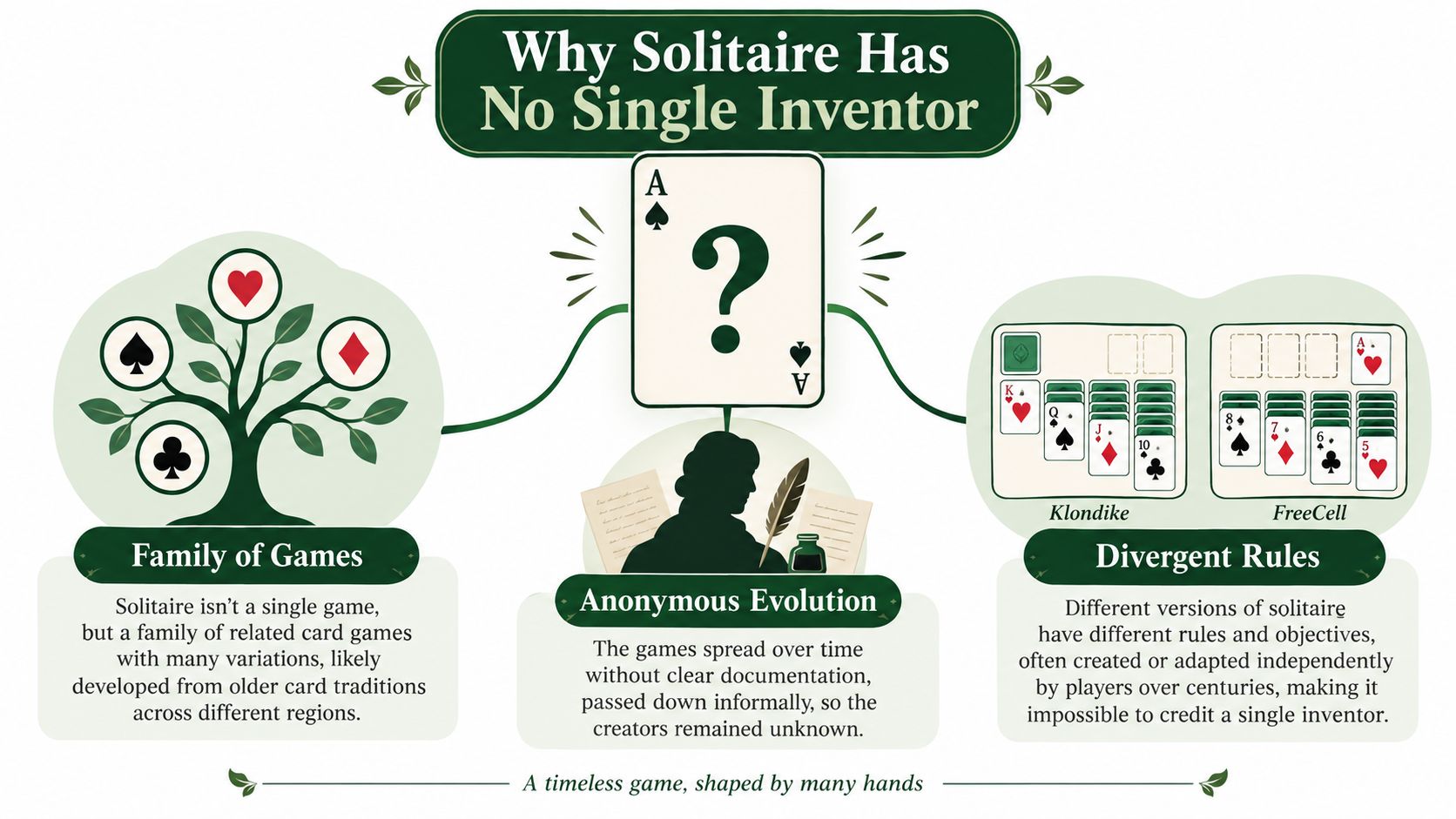
Solitaire is best understood as a family of patience games, not a single locked invention. That difference matters because families branch over time, while a single invention usually points to one clear creator. The historical record for solitaire looks like the first case.
Early versions were not standardized. They varied in layout, move rules, and even purpose, since some forms were tied to fortune-telling while others were solo pastimes. Once a game exists in that kind of variation, assigning it to one inventor becomes shaky, because the evidence describes a changing set of practices rather than one fixed design.
Invention versus evolution
Solitaire developed through gradual adjustment in different places, much like a dialect does. No one person decides a dialect into existence. People change pronunciation, word choice, and grammar over time, and the result is a recognizable but fluid form. Solitaire followed a similar path, with local variants taking shape before anyone tried to write them down in a rule book.
That is also why Klondike causes confusion. Klondike is one specific variant, and it became the version many players know best, but that does not make it the invention of solitaire itself. A popular branch is still only one branch.
Key distinction: the history of solitaire is broader than the history of any one version you play on a screen today.
A variant overview can help clarify the split between families and versions. Use this simple guide:
- Family first: solitaire began as a cluster of related patience games.
- Rules came later: written rule collections helped freeze some versions into more stable forms.
- Variants are separate: a named variant can have its own history without being the birth of solitaire.
A game that moved through many hands and many places does not fit a neat inventor story. The better question is how it changed, where it spread, and why later players kept attaching fresh names to old habits.
Earliest Evidence and Where Solitaire Really Began
The most careful answer starts in the late 18th century. Historical summaries place card solitaires in the Baltic region at the end of that century, and written references appear in German-language sources around 1783 and 1788. That's the earliest verifiable trail surfaced in the sources here, and it's why historians stay cautious about naming one country with total confidence.
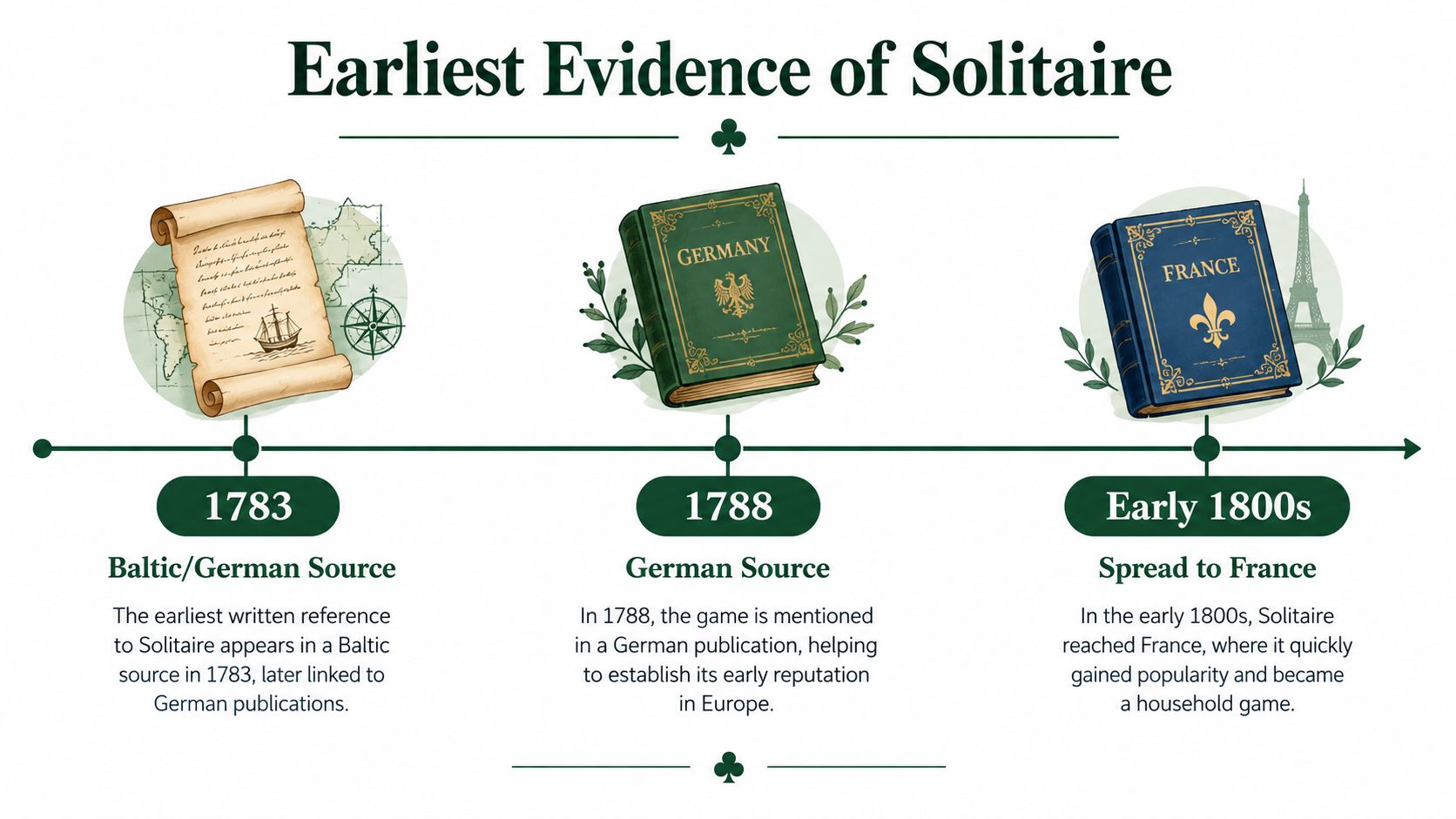
The gap before 1783 matters. The documentary trail is thin, so any claim that solitaire clearly began in one place before then runs ahead of the evidence. That's why modern histories describe the origin as anonymous and multi-country, rather than attaching the game to a single inventor or a single national birthplace.
What counts as evidence
A useful way to separate history from storytelling is to ask whether a claim can be tied to an early written source. The first documented references matter more than later, dramatic retellings because they show the game already existed in some recognizable form. In solitaire's case, those early sources point to Northern Europe, then to a wider spread.
From there, the game moved into France in the early 19th century, then into Britain and America in the latter half of that century. That spread didn't create the game, it carried it into new social settings and new printed collections. Later histories also note Lady Adelaide Cadogan's Illustrated Games of Patience, published around 1870, as one of the first major English-language collections to help standardize the rules for a wider audience.
The famous French aristocrat in the Bastille story doesn't hold up under this evidence. The sources surfaced here describe it as an unsupported legend, not a documented origin. If a version of the story can't be tied to surviving historical evidence, it belongs in the category of folklore, not fact.
For readers who like to follow the trail themselves, a compact history note at Play Solitaire Gaming's history page helps place the early references in context. The main takeaway is that solitaire's birth looks messy because it really was messy. It was written down after it had already begun moving between regions and rule traditions.
How Major Solitaire Variants Evolved From One Family
Once solitaire is understood as a family tree instead of a single invention, the modern variants stop looking random. Each branch keeps the same solo-card puzzle, but each one solves a different problem. Some versions emphasize clearing stacks, some reward open information, and some focus on suit sequencing. That is why players often switch between them based on the kind of thinking they want, not loyalty to one format.
The main branches
Klondike is the version many picture first. It centers on building foundations from a tableau with hidden cards, so the appeal comes from patience, basic planning, and reading what is not yet visible.
Spider moves the challenge toward multi-suit sequencing. FreeCell exposes more of the board, so the game shifts toward planning several moves ahead instead of waiting for luck to change the layout.
Pyramid uses a different rhythm altogether. You pair cards to clear the layout, which makes it feel closer to matching patterns under pressure. Yukon keeps the tableau highly active, Golf focuses on quick removal choices, TriPeaks rewards chain reactions, and Forty Thieves asks for careful deck management and longer-range sequencing.
A simple way to sort them is by how much information the player can see at once. The more visible the board, the more the game rewards planning. The more hidden the board, the more it rewards patience and recovery after a bad deal.
Practical insight: If you want a calmer game, choose a version with simpler movement. If you want more planning, choose one with more exposed information.
For a broader comparison of the families and branches, this variant guide is useful. It helps show why the names differ even when the games still belong to the same historical line.
| Variant | Core Mechanic | Best For |
|---|---|---|
| Klondike | Build foundations from a tableau with hidden cards | Familiar, classic play |
| Spider | Complete descending sequences, often across suits | Deep planning and longer sessions |
| FreeCell | Use open cells to rearrange the tableau | Strategic thinking |
| Pyramid | Remove paired cards that add to a target | Fast pattern recognition |
| Yukon | Move larger card groups within the tableau | Flexible sequencing |
| Golf | Clear cards by one-rank moves | Short, brisk rounds |
| TriPeaks | Chain adjacent ranks to clear peaks | Relaxed momentum play |
| Forty Thieves | Manage two decks with careful tableau building | Higher complexity |
The important point is simple. Klondike, Spider, and the others are later expressions of one tradition, not separate proof of a single inventor.
From Rule Books to Digital Screens How Solitaire Became Global
Solitaire became widely recognizable when rule collections turned scattered play into something people could learn consistently. A major milestone is Lady Adelaide Cadogan's Illustrated Games of Patience, published around 1870, which helped standardize solitaire rules for English-speaking readers and made the game easier to teach across households and clubs. That kind of publication matters because it gives a loose tradition a shared vocabulary.
Later, printed collections kept shaping what players expected solitaire to look like. Once a specific version gets repeated in books often enough, it starts to feel like “the” version, even if the older family tree is still underneath it. That's how Klondike came to dominate public imagination, even though it's only one branch of the broader patience tradition.
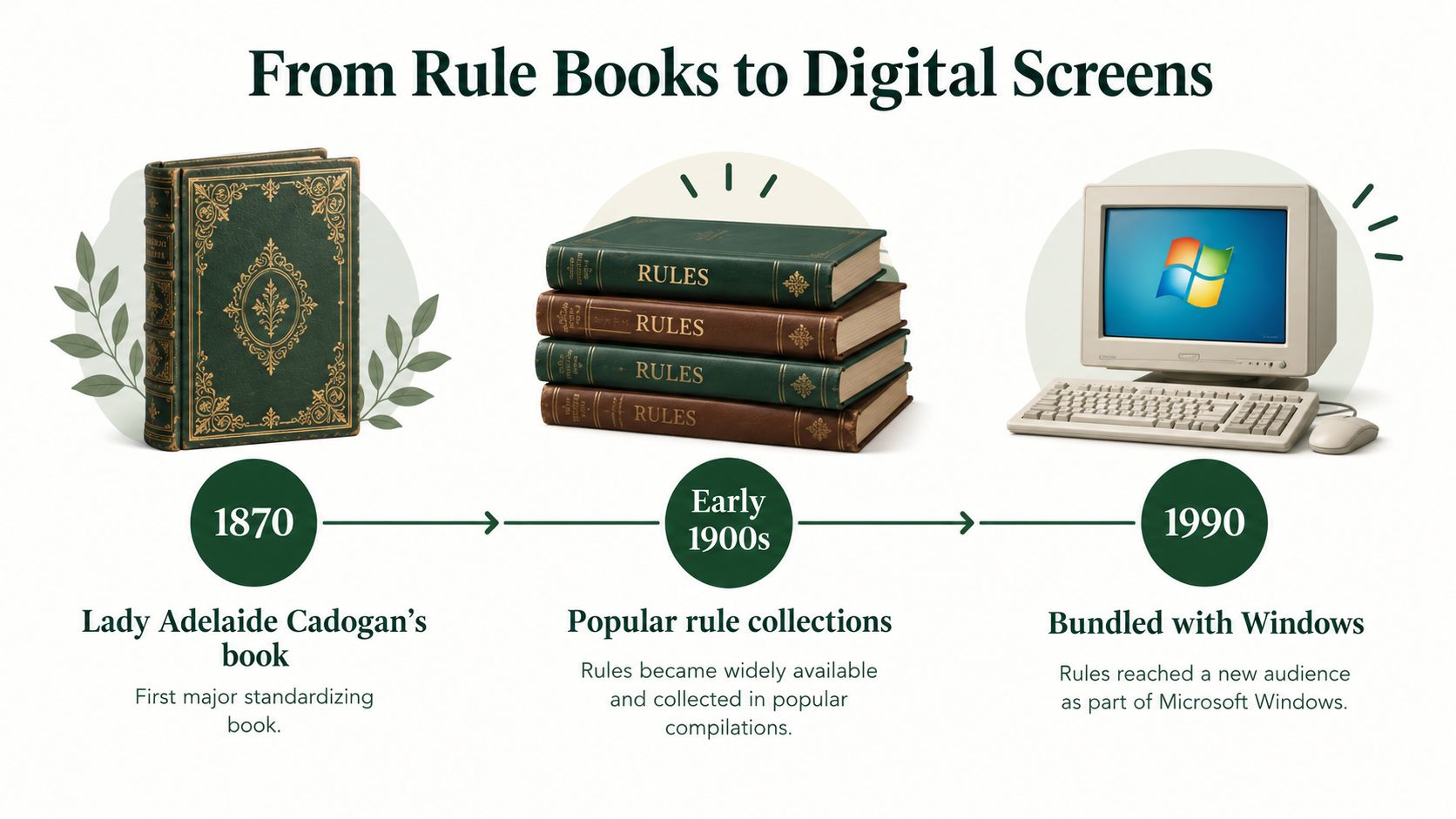
The digital jump changed access, not the core puzzle. Once a computer could deal, track, and reset the cards instantly, solitaire moved from a quiet tabletop habit into a default screen pastime. A modern browser version carries the same basic logic, but removes the friction of shuffling, setup, and manual cleanup.
Why the digital version feels so familiar
That familiarity comes from standardization. A player who learns one digital version can often recognize the same move logic in another, because the rule set has become more stable than it was in the early, anonymous years. The game also gained a new kind of portability, since a single click can now replace a physical deck.
For readers who like to see how the web version fits into that history, this browser solitaire article connects the older rule tradition to modern play habits. The point isn't that the computer invented solitaire. It's that computers helped normalize one version of it for millions of people.
Standardization made solitaire easier to recognize. Digital distribution made it easier to keep playing.
That's why so many people today think of solitaire as one fixed game. In reality, the game was canonized gradually, first in print and then on screens. The everyday version people open now is the product of that long process.
Playing Solitaire Today With History in Mind
Knowing the history changes how you choose a game. If you want the closest thing to the classic public image, start with Klondike. If you want more open planning, try FreeCell. If you want a faster, more reactive puzzle, TriPeaks or Golf makes the pace feel lighter.
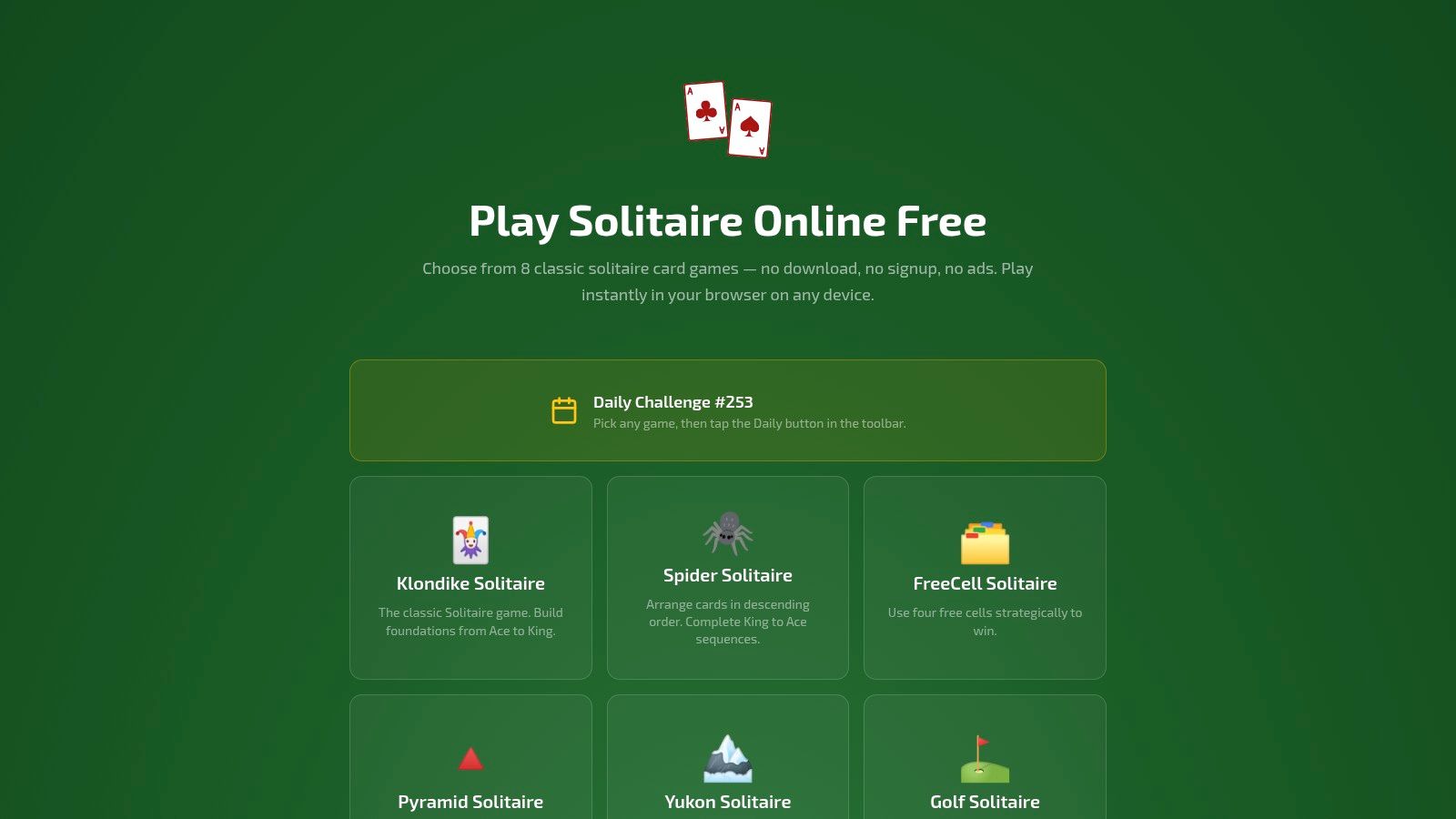
A browser platform like Play Solitaire Gaming packages those choices into one place. It offers eight variants, smooth drag-and-drop controls, smart hints, unlimited undo and redo, Daily challenges, global leaderboards, and optional cloud sync for tracking stats across devices. The practical value here is simple, it lets you move between the old patience tradition and modern convenience without installing anything.
How to use the history while you play
Start by matching the variant to your mood. If you're learning, pick a game with forgiving undo and clear move feedback. If you want rhythm, choose a version that rewards quick clearing. If you want a longer mental workout, choose one with more exposed information and deeper sequencing.
Practical rule: the more hidden information a variant has, the more it leans on patience. The more open it is, the more it leans on planning.
The same logic helps with improvement. A player who understands that solitaire grew through distinct rule traditions won't expect every version to feel identical. Instead, they'll notice which games reward memory, which ones reward pattern recognition, and which ones reward careful sequencing.
If you're new to the game or helping someone else learn it, this beginner's guide is a good companion piece. It keeps the focus on how the cards move, which is the part that matters once the origin myths fall away.
What to Remember About Solitaire Origins and Next Steps
The strongest historical answer is still the simplest one. Solitaire has no single confirmed inventor, and the best evidence points to anonymous emergence in Northern Europe in the late 18th century, with the earliest written German references around 1783. The Bastille story is a legend, not a documented origin, and the later variants are branches of a much older family of patience games.
That framing makes the game more interesting, not less. It shows how a quiet solo pastime can travel through regions, get codified in books, and then become a digital habit without ever losing its basic appeal. It also helps separate the origin of solitaire itself from the later history of Klondike and other variants.
If you remember only three things, make them these:
- No single inventor: the evidence points to a diffuse, anonymous beginning.
- No Bastille proof: the prison legend survives because it's catchy, not because it's supported.
- Variants came later: the modern versions people play now were formalized after the game was already circulating.
That's a more accurate story, and it's easier to share confidently. Try a variant you haven't played before, then notice how its rules reflect the long evolution behind the deck. The history gives the game more texture, and it makes every win feel a little more connected to the tradition behind it.
Try a new variant with that history in mind at Play Solitaire Gaming. It offers quick browser play, clear controls, and several classic solitaire versions in one place, so you can test the old patience tradition in a modern format. If you've ever wondered how the game's origins shape the way it feels today, this is a practical place to see that lineage in action.
Ready to play?