Solitaire for Beginners How to Play Klondike and Win More
By Rajat Agarwal, Founder of Play Solitaire Gaming
Solitaire for beginners made simple. Learn Klondike rules, step-by-step play, variants, mistakes to avoid and easy tips to win more on Play Solitaire Gaming.
You've opened a solitaire game, spotted an Ace, and moved it to a foundation. Then you're left staring at seven columns, a stock pile, and several face-down cards with no idea what matters next. That first-game confusion is normal. Solitaire looks simple because you move cards one at a time, but each move changes what you can do later.
This guide treats solitaire for beginners as a decision system, not a list of lucky moves. You'll learn how to read a Klondike table, choose moves that uncover hidden cards, protect useful empty spaces, and avoid sending cards to the foundations too early. You'll also see how hints, undo, and Daily challenges can become practice drills rather than buttons you press at random.
Table of Contents
- Welcome to Solitaire and What You Will Learn Quickly
- Understanding the Klondike Table and Essential Rules
- How to Play Your First Game Without Getting Stuck
- Popular Solitaire Variants Worth Trying After Klondike
- Common Beginner Mistakes and Simple Fixes That Win More
- Practice Smarter and Keep Improving on Play Solitaire Gaming
Welcome to Solitaire and What You Will Learn Quickly
Klondike is the version many players mean when they say “Solitaire.” Your first game may begin with an obvious move, such as placing a red six on a black seven. The difficult part comes after that move, when two legal choices appear and only one of them reveals a face-down card or keeps a future sequence available.
The table feels busy because it combines several kinds of information. Some cards are visible, some are hidden, the stock offers new possibilities, and the foundations reward progress while sometimes removing cards you still need in the tableau. You aren't failing because you haven't memorized a secret pattern. You're learning to balance immediate moves against future access.

Solitaire has stayed approachable for a remarkably long time. Written references place its earliest known history around 1783 in Germany, followed by its spread through France under the name “patience” in the late 18th century. Historical timelines therefore make the game roughly 240 years old, with beginner-friendly rules later standardized in printed rule books during the 1890s, as described in this history of patience and solitaire.
By the end of your first focused session, you should be able to:
- Name each pile: Recognize the tableau, stock, waste, and foundations.
- Check legal moves: Understand descending alternate-color tableau play and suit-based foundation building.
- Choose with purpose: Prefer moves that expose hidden cards or preserve mobility.
- Recover calmly: Use undo to test an idea instead of restarting at the first setback.
- Finish a winnable game: Follow a repeatable process rather than guessing.
For a second beginner-friendly explanation, keep this solitaire beginners guide nearby while you play.
Key takeaway: You learn solitaire by playing a few thoughtful games, not by trying to memorize every possible layout before touching a card.
Understanding the Klondike Table and Essential Rules
A card can be legal yet unhelpful. Before moving anything, identify the four parts of the Klondike table and ask what each move gives you: a hidden card, an open column, or more room to build.
The four areas on the table
- Tableau: Seven working columns run across the table. Klondike deals 1, 2, 3, 4, 5, 6, and 7 cards from left to right. Only the top card in each column starts face up.
- Stock: The face-down pile contains 24 cards after the tableau is dealt. Draw from it when the columns offer no useful move.
- Waste: Stock cards turn face up here. The visible waste card may be playable, depending on the draw mode.
- Foundations: Four spaces collect cards by suit, starting with an Ace and rising to a King.
You can review the complete setup in these Klondike Solitaire rules, or compare the same sequence with this Klondike Solitaire rules guide.
What can move where
Tableau cards build downward in alternating colors. A black eight can receive a red seven, and that red seven can receive a black six. You may move one exposed card or a connected descending sequence, provided the receiving card has the correct color and rank.
Foundations follow a separate pattern. Each space accepts one suit and rises from Ace to King. The two of hearts belongs on the hearts Ace, not on an Ace from another suit. Moving a card to a foundation can advance a suit, but pause if that card is still useful for rearranging the tableau.
An empty tableau column accepts only a King or a sequence that begins with a King in standard Klondike. The space therefore works like a parking bay for a King-led sequence. Creating one can let you shift a blocked group and reveal the face-down card beneath it, so preserve open columns until the placement serves a clear purpose.
Draw 1 is the clearest learning mode
Klondike commonly uses Draw 1 or Draw 3. Draw 1 turns one stock card at a time, making each choice easier to trace. Draw 3 reveals more cards per pass and requires you to remember which waste cards remain reachable.
For a first game, choose Draw 1. Use hints to identify a legal option, then decide whether it uncovers a card or preserves space before accepting it. Use undo as a practice drill: reverse the move, try a different order, and compare the resulting access. Daily challenges can provide another controlled layout for testing the same decisions. Try Draw 3 after the basic rhythm feels natural.
How to Play Your First Game Without Getting Stuck
Start with a scan, not a move. Look across all seven tableau columns and note every visible Ace, every card that can uncover a face-down card, and any move that could create a useful empty column. Your first question shouldn't be “What can I move?” It should be “Which legal move gives me the most access?”
Follow the access-first rhythm
- Move available Aces when they don't interfere with a reveal. An Ace has nowhere useful to go in the tableau, so placing it in its foundation usually opens a path for the next card of that suit.
- Uncover face-down cards. If one move exposes a hidden card and another rearranges visible cards, choose the revealing move unless the rearrangement creates important mobility.
- Build tableau sequences carefully. Alternate colors and descend by rank. A red ten can receive a black nine, but a red nine can't receive another red ten.
- Use the stock deliberately. Draw when the tableau offers no productive move, then inspect the waste card before moving it. Don't click through the stock without checking what each draw changes.
- Protect empty columns. An open column gives you room to shift a King sequence. Avoid filling it immediately unless the placement uncovers a card or improves your next choices.
- Delay foundation moves that remove useful tableau cards. A foundation move is good when it advances a suit without taking away a card needed to build another sequence.
You can see this decision order in action in the following video:
Consider a blocked King. Suppose a face-up King sits beneath several cards, but every tableau column is occupied. You can't move that King into a foundation, and moving unrelated cards may not help. Your useful objective becomes creating an empty column by moving a complete sequence elsewhere, then placing the King-led sequence into the open space. If no King can reach an empty column, keep developing other columns and use the stock rather than forcing an illegal move.
Now consider two possible moves. A red six can go onto either a black seven in one column or a black seven in another. One choice might expose a face-down card immediately, while the other leaves the red six sitting in a harmless but unhelpful sequence. Choose the reveal. If both choices expose something, prefer the one that leaves more varied cards available for later moves.
Undo turns these comparisons into a lesson. Make a move, inspect what it reveals, and reverse it if the result closes your options. Hints can serve the same purpose. Before accepting a hint, predict why the suggested move matters. Is it exposing a hidden card, making room for a King, or advancing a foundation without blocking the tableau?
A strong Draw-1 benchmark for beginners is a win rate around 10% to 20%, while applying core principles and forward planning can often move performance into the 15% to 25% range, according to solitaire statistics guidance. Treat those figures as learning benchmarks, not a promise for every deal. The useful shift is strategic: stop making only obvious moves, uncover hidden cards, preserve empty columns, and postpone foundation moves when they limit sequencing.
When the stock reveals no helpful card and the tableau has no productive rearrangement, undo the last few moves and inspect earlier choices. If the same position remains blocked after you've tested reasonable alternatives, restarting is a sensible learning decision, not a failure.
Popular Solitaire Variants Worth Trying After Klondike
Klondike rewards access and timing. Other variants change the central question, so choose your next game based on the kind of thinking you enjoy.
| Variant | How It Differs From Klondike | Best For Beginners Who Want |
|---|---|---|
| FreeCell | Most cards are visible, and four free cells provide temporary storage. | Open information and deliberate planning |
| Spider | Multiple decks create longer tableau sequences, with same-suit runs carrying special importance. | Building and clearing extended runs |
| Pyramid | Players remove card pairs whose ranks combine to the target total. | Quick pattern recognition |
| Yukon | Tableau movement is less like standard Klondike, with larger exposed groups to manage. | More freedom when moving sequences |
| Golf | Cards are cleared by selecting adjacent ranks from a waste pile. | Short, fast decisions |
| TriPeaks | Three connected peaks create a focused clearing puzzle. | Casual play with visible targets |
| Forty Thieves | Strict building rules make sequencing and stock management demanding. | A tougher planning challenge |
FreeCell changes the feel of the table immediately. An empty tableau column can receive any single card, rather than only a King-led sequence, which creates more room for temporary storage and rearrangement, as explained in these FreeCell rules. The tradeoff is that visible information doesn't make every move obvious. You need to map what a move will reveal several turns later.
Spider asks you to think in terms of completed runs. It uses two standard 52-card decks and deals 54 cards across ten tableau columns, with the first four columns receiving six cards and the remaining six receiving five. Only the top card of each column begins face up, according to the Spider setup rules. Cards can be moved individually in descending order regardless of suit, but only a same-suit descending sequence can move together. A completed King-to-Ace same-suit run leaves play, and clearing all eight such runs wins the game, as detailed in these Spider Solitaire rules.
Read this broader guide to solitaire game types when you want to compare the full range without abandoning Klondike as your practice base. FreeCell suits planners, Spider suits sequence builders, and Golf or TriPeaks suit players who prefer a quicker visual loop.
Common Beginner Mistakes and Simple Fixes That Win More
Most early losses don't come from misunderstanding how cards descend. They come from choosing a legal move that removes a future option.
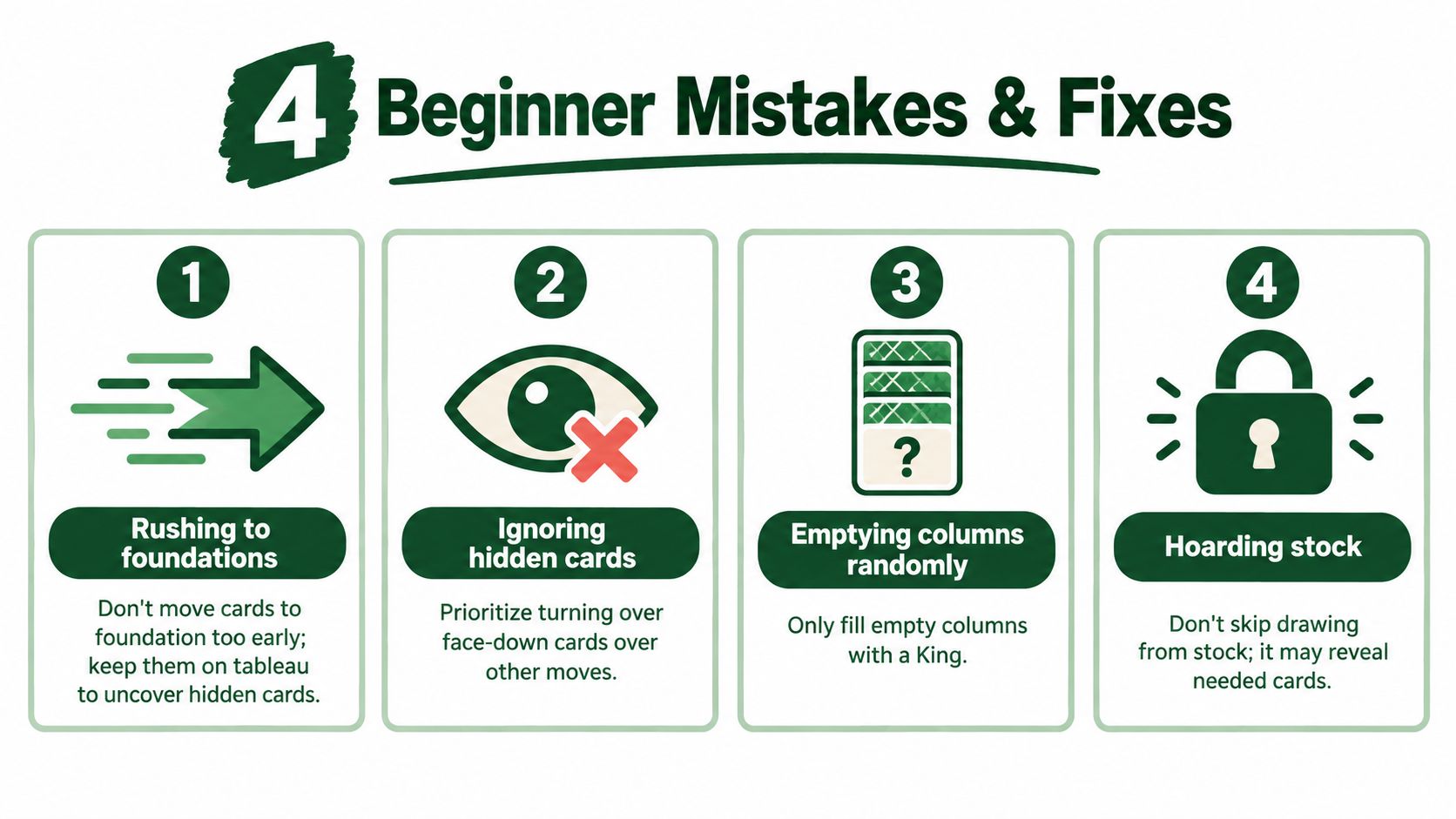
Four corrections to practice
- Rushing to foundations: Don't move a card upward just because it can go. Keep a tableau card available when it helps uncover a hidden card or support a descending sequence.
- Ignoring hidden cards: Prioritize a move that turns over a face-down card. For example, moving a red seven onto a black eight may be more valuable than extending an already visible run.
- Filling columns randomly: An empty column belongs to a King-led sequence. If you fill it without improving access, you may lose the workspace needed for a blocked King.
- Hoarding the stock: Drawing isn't a sign that you have run out of skill. The stock exists to reveal new options, so use it when the tableau has no productive move.
Before every move, pause for a compact check:
- Can this move uncover a hidden card?
- Does it create or preserve an empty column?
- Will moving this card to a foundation remove a card needed for tableau sequencing?
- Is there another legal move with a better reveal?
FreeCell exposes a related mistake in a different form. Almost 99.998881% to 99.999% of FreeCell deals are solvable with optimal play, so an ordinary loss usually reflects execution rather than an impossible layout, according to this FreeCell solvability analysis. Casual players typically win 40% to 60% of games, intermediate players 70% to 80%, and advanced players 80% to 90% or more, based on the same source. Beginners often move one card in a cascade without mapping the next several consequences, especially when empty columns and tableau order restrict future choices.
Three habits matter most: uncover hidden cards, preserve working space, and ask what your move makes possible next.
For more examples of these corrections, use this guide to common solitaire mistakes.
Practice Smarter and Keep Improving on Play Solitaire Gaming
Turn each game into a small experiment. Start with Klondike Draw 1, use a hint only after predicting its purpose, and use unlimited undo and redo to compare two choices. A useful session isn't just a win. It's a game where you notice why one move exposed a card, why another trapped a sequence, or why a foundation decision had to wait.
Try two short drills:
- Uncover-first drill: For one session, prioritize face-down reveals whenever the alternatives are otherwise comparable. After each move, name the card or space it opened.
- Empty-column drill: Before filling a vacant column, identify the King-led sequence you're placing there and the next move you expect that space to support.
Daily challenges add variety without changing your core decision process. Stats, streaks, and leaderboards can make progress visible, while optional cloud sync lets your results follow you between phone, tablet, and desktop. Move to FreeCell when you want open information and deeper planning, or try Spider when you want to practice building same-suit runs.
Solitaire's history reaches back to references around 1783, and the game is roughly 240 years old, yet the most useful beginner skill remains wonderfully modern: pause, compare, and choose the move that preserves future options. The cards don't need to be rushed. Your reasoning gets stronger through repeated, focused decisions.
Visit Play Solitaire Gaming to play Klondike instantly in your browser, with smart hints and unlimited undo and redo for practical training. Start with a Draw-1 game, complete a Daily challenge when you're ready, and use the available stats to track how your decision-making improves.
Ready to play?