Eight Off Solitaire: Rules, Strategy, and How to Play
By Rajat Agarwal, Founder of Play Solitaire Gaming
Learn eight off solitaire with clear rules, setup steps, strategy tips, and ways to play online with hints and undo for a smoother game.
If you open Eight Off solitaire and see eight columns beside a row of reserve cells, the setup may look familiar, but the first moves feel tighter than they seem. Every card you place affects how much you can move next.
Beginners often settle in once that tension makes sense. The game rewards patience more than luck, and it starts to click when you treat it as a capacity-management puzzle, not just a card-stacking game. The question is not only what you can move now, but what move leaves you more room later.
Table of Contents
- What Eight Off Solitaire Feels Like
- A Short History of Eight Off and the FreeCell Family
- Setup, Deal, and the Four Foundations
- How a Turn Works in Eight Off
- Strategy Built Around the Move-Math
- Eight Off Compared to FreeCell and Other Variants
- Troubleshooting Games That Will Not Move
- Playing Eight Off Solitaire Online
What Eight Off Solitaire Feels Like
The first deal can feel familiar. You see the eight tableau columns and the separate strip of reserve cells, and it is easy to expect a looser version of Klondike. Eight Off plays differently. The pace is quieter, more deliberate, and more technical, because the reserve is part of the board from the start.
That changes the feel of every decision. With Klondike, you may rely on trial and error more often. In Eight Off, each reserve cell is part of your working space, and spending one too early can narrow your options later. FreeCell has a similar sense of planning, but Eight Off adds more friction because the reserve cells are always visible and always tempting you to use them.
The mental hook that matters most
Practical rule: Every open reserve cell gives you exactly one more unit of move power, so spending a cell is never just a convenience, it changes your future options.
That idea explains why Eight Off appeals to players who like planning ahead. You are not only uncovering cards, you are managing space. A move that looks harmless can leave you with less room for longer sequences later, while a quieter move can set up a much stronger position a turn or two ahead.
Capacity is the puzzle. Empty cells work like parking spaces on a narrow street, the more you have open, the more easily the rest of the board can shift. That is the move-math behind Eight Off, and it is the part beginners usually miss at first.
If you stay with it, the game starts to make a specific kind of sense. Good planning beats lucky deals, and Eight Off usually gives you enough room to see that for yourself.
A Short History of Eight Off and the FreeCell Family
Eight Off sits in a family tree that long predates modern browser solitaire. Martin Gardner discussed the related Baker's Game in a June 1968 Scientific American column, and FreeCell was later created in 1978 by Paul Alfille. That lineage matters, because Eight Off borrowed the reserve-cell idea from that earlier tradition while keeping the stricter tableau rule that makes suit management so important. The historical path is why many players treat Eight Off as part of the FreeCell family, not a standalone modern invention, and that family connection is described in the game history notes from the Solitaire Association.

Why the family split matters
Baker's Game kept the suit-building idea, then FreeCell changed the tableau rule to alternating colors. Eight Off stayed closer to the suit-first tradition, so it feels more structured and, for many players, more restrictive. That's also why the game often seems harder than the looser FreeCell style even though it gives you more reserve space.
The important beginner takeaway is simple. Baker's Game, Eight Off, and FreeCell are related, but they don't solve the same way. Baker's Game is the strictest because every tableau build stays in suit. Eight Off keeps that same-suit demand while adding eight reserve cells. FreeCell relaxes the tableau rule and uses only four reserve cells, which changes the whole rhythm of play.
A useful way to think about the history
Eight Off is older in design spirit than FreeCell, even if FreeCell became more famous in the public imagination. It's not a newer spin-off that loosened rules for convenience. It's the other way around. The stricter suit-building tradition came first, and Eight Off preserved it while giving players a larger reserve to work with.
That combination helps explain its modern appeal. The game belongs to the classic patience lineage, but it still feels fresh on browser portals and older shareware collections because it asks for careful planning rather than fast clicking. If you've ever wanted a solitaire variant that feels like a logic puzzle with cards, that's the lane Eight Off lives in.
Setup, Deal, and the Four Foundations
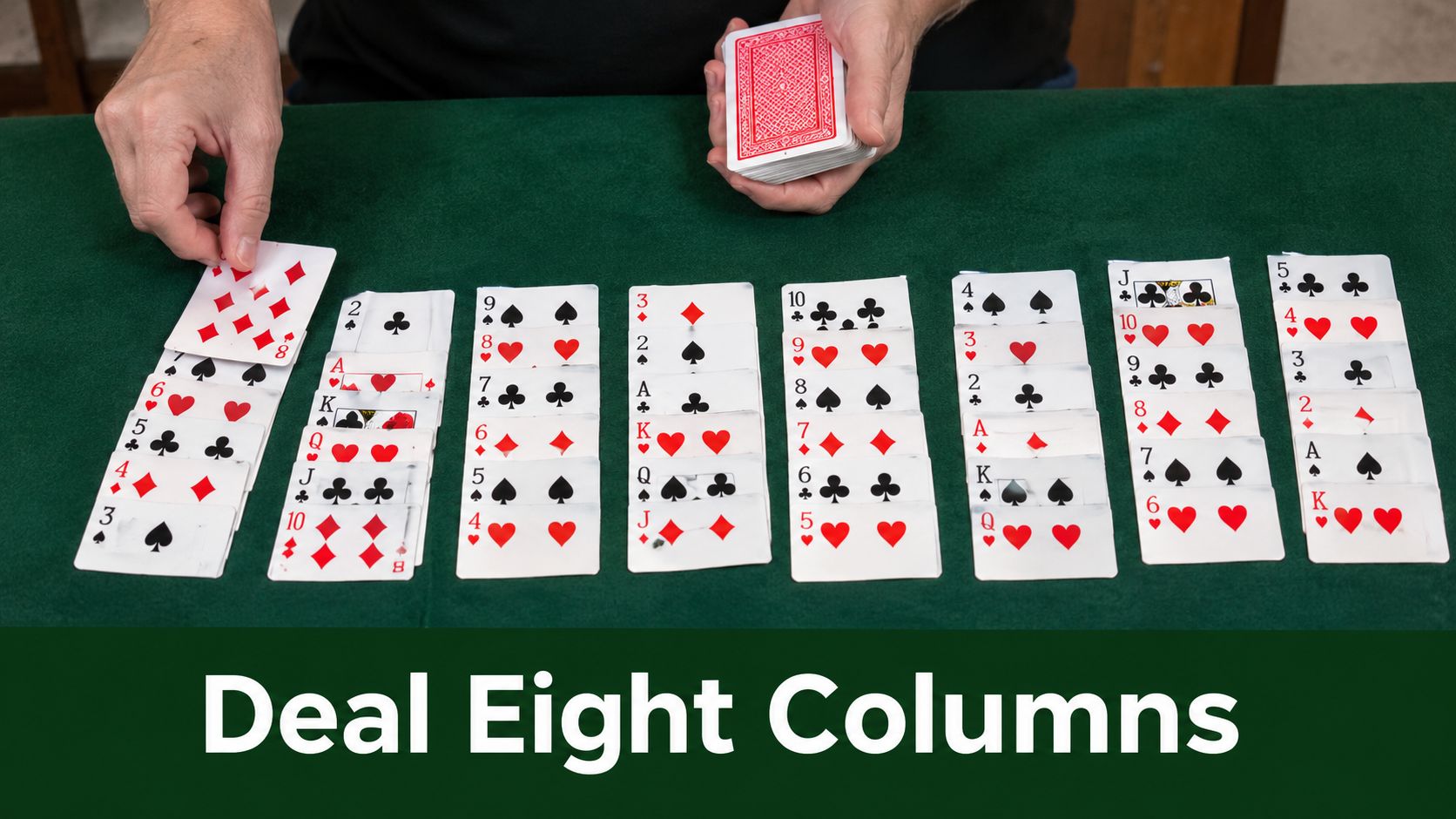
To start a real game, use a standard 52-card deck and shuffle thoroughly. Then deal 48 cards face up into eight tableau columns, with six cards in each column. The remaining four cards begin the four foundation piles, one for each suit where possible, with the lowest available card of each suit serving as the base when an Ace isn't present at the start, according to the standard layout used in Eight Off references such as the Eight Off rules summary.
The reserve is the part many newcomers miss. Eight Off gives you eight single-card reserve cells, and they start completely empty. Think of them as small waiting spots beside the main board, not as extra tableau columns and not as a stockpile you can stack up.
The building rules in plain language
Tableau columns build downward in rank and must stay in suit. That means a 9 of hearts can go on an 8 of hearts, but not on an 8 of spades. Foundations build upward by suit, starting from Ace and ending at King.
That's the rule that shapes nearly every move. A card in the tableau isn't just a card, it's part of a suit-specific ladder. If you move it too early, you may strand something underneath it. If you wait too long, you may run out of space to move the run you need.
A quick setup check
Before you play, verify three counts.
- 48 cards in the tableau, six per column
- 4 starting foundation cards or bases
- 8 empty reserve cells
If those numbers don't match, stop and re-deal. A clean setup matters because a misdeal makes later strategy impossible to judge fairly. Beginners often blame themselves for a game that was set up wrong, when the core issue was just a sloppy deal.
The layout can look busy, but the counts are easy once you've seen them once. You're not building from a huge stock pile. You're working with a fully visible table, a few spare spaces, and a lot of planning.
A note on what the layout is really telling you
The deal already gives you the first strategic clue. The columns with the most buried low cards deserve attention early, because those cards are the ones most likely to advance progress in the foundations. The reserve cells are there to help you reach them, not to become a permanent parking lot.
How a Turn Works in Eight Off
A legal turn in Eight Off starts with a few clear move types. You can move one card at a time between tableau columns, park a card in an empty reserve cell, move a card out of a reserve cell and back onto the tableau, or send a card to a foundation when the suit and rank line up correctly. The tableau also allows ordered descending runs in the same suit, so a move can carry more than one card if the board has enough open space to support it.
The empty-cell-plus-one rule
Beginners usually need this rule in plain view, because it is the engine behind long moves. With one empty reserve cell, you can move a sequence of two cards. With two empties, you can move three cards. With all four empties, you can move five cards.
The reserve cell is move power, not just a parking place. Every filled cell reduces the next move you can make, while every open cell gives the board more room to breathe. More open cells mean longer shifts, and longer shifts mean better control over the tableau.
Empty tableau columns matter too, but only in a narrow way. They are not general storage. Only Kings or King-led sequences may fill them, so an empty column is powerful and limited at the same time.
A short turn, broken down
A good turn often starts with a buried card, because buried cards are where progress hides. If a blocking card sits on top of something useful, check whether that blocker can create a better chain somewhere else first. If it cannot, ask whether moving it will free a column or just move the problem around.
A reserve cell helps when it creates a clearer board, like setting one chair aside so the rest of the table can be rearranged. Park the blocker, expose the card underneath, then look again at the whole column. The best move is often the one that opens a second move right after it.
Look at the deepest accessible card first, not the most obvious top card. Check whether it can advance a foundation or extend a same-suit run. Then decide whether spending one of your open cells gives you more room than you lose by filling it.
What beginners usually feel in the first few turns
The opening often feels cramped until one move suddenly frees two others. That is normal. Eight Off rewards small, practical moves that create space for a cleaner transfer later. If the board after your turn leaves you with more options than before, you are reading the position well.
Strategy Built Around the Move-Math
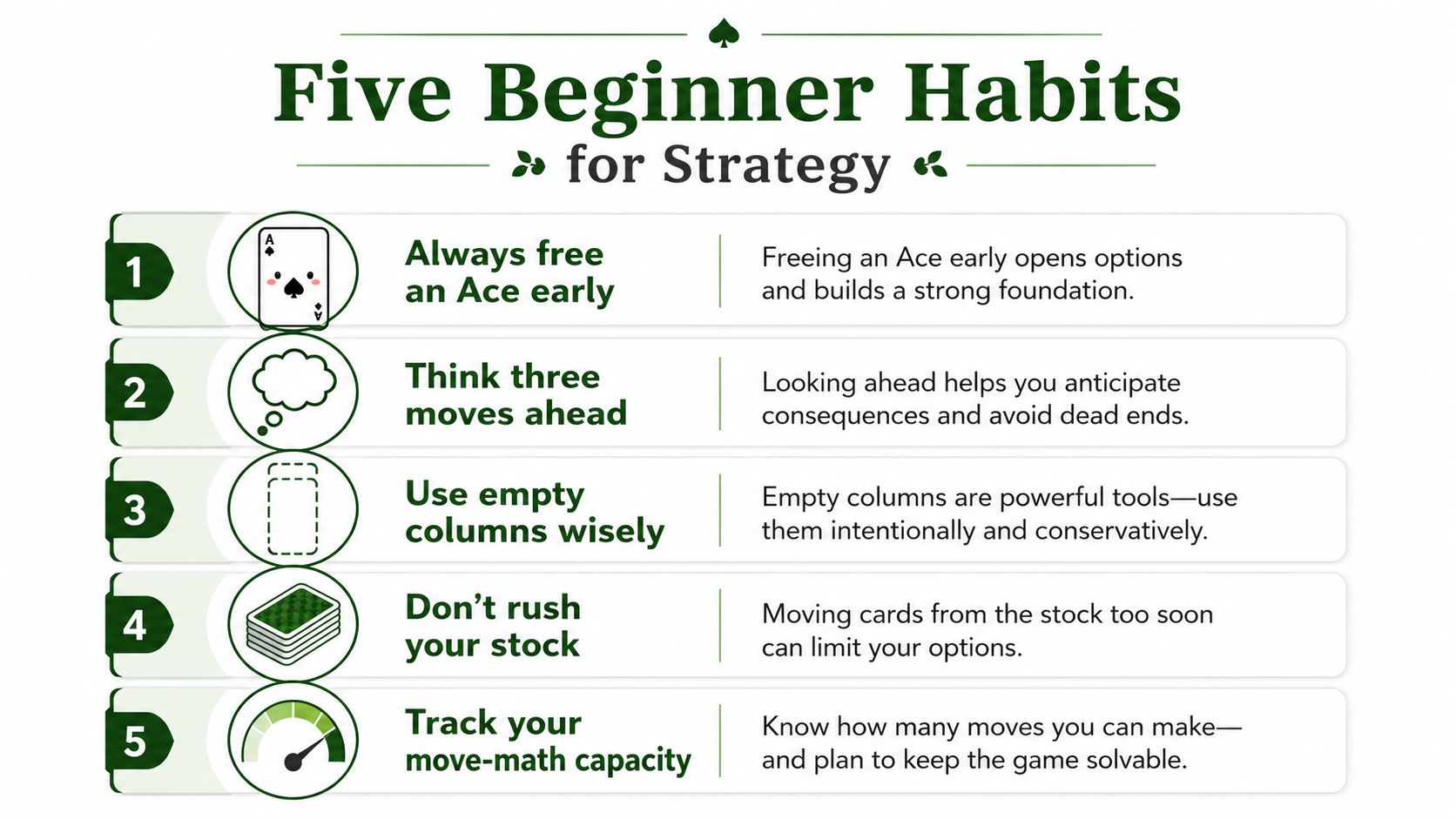
Eight Off becomes much easier when you stop thinking in terms of “good card” and “bad card” and start thinking in terms of capacity. Every reserve cell you fill lowers what you can move next, and every column you clear raises what the board can do for you. That's the heart of the game.
Five habits that change your results
- Always leave room early: Don't rush to fill all four reserve cells. Keeping at least one open means a single-card column can still be moved when you need it most.
- Dig in the most blocked column first: If one column hides a useful low card, it usually deserves attention before you tidy easy-looking runs elsewhere.
- Treat foundations with restraint: Move a card up only when it won't strand something you'll need for a longer same-suit sequence.
- Look for column-clearing chances: An empty tableau column is the best temporary landing spot for a long ordered sequence, because it can let you reshuffle the board without freezing it.
- Count before you click: Ask how many empties will remain after the move, not just whether the move is legal.
The cleanest decisions usually come from simple questions. Does this move free a column? If yes, it's often worth strong consideration. Does it only rearrange cards without opening space? Then it can wait. Is the card ready for a foundation, but also acting as a connector for a useful future shift? That's the moment to pause.
Why foundations can be a trap
New players often race cards upward because foundation moves feel productive. Sometimes they are. Sometimes they remove the very card that would have helped pull a buried sequence free. The safest foundation move is the one that doesn't cut off your next useful transfer.
Decision rule: If a move gives you more mobility, it deserves a close look. If it only makes the board look cleaner, it may be too early.
If you like thinking in this kind of structured way, a deeper look at the logic behind card movement is useful. A practical discussion of the math behind solitaire planning is available in the mathematics of solitaire, and it fits Eight Off especially well because the game is so sensitive to spare space.
The result is a slower, smarter rhythm. You're not trying to “get rid of” cards as fast as possible. You're trying to move the right card in the right order so the table keeps opening up instead of locking down.
Eight Off Compared to FreeCell and Other Variants
A Eight Off board can feel like a middle ground for a reason. The game uses one deck, eight tableau columns, eight reserve cells, and four foundations, so every move is a small capacity choice. You are not only moving cards, you are deciding where the board has room to breathe.
Modern solvability research has estimated a 99.8805% ± 0.002% win rate across 5 × 10^7 simulated deals, with 49,940,034 winnable games and 59,966 unwinnable games in that sample, while an earlier odds table reported 36.8% from 2,514 random games (odds of winning solitaire research). Those figures point in different directions because methodology and rule interpretation matter so much in solitaire analysis.
| Variant | Tableau Columns | Reserve Cells | Sequence Rule | Difficulty |
|---|---|---|---|---|
| Eight Off | 8 | 8 | Same-suit descending in tableau | Moderate to strict |
| FreeCell | 8 | 4 | Alternating colors in tableau | Flexible, but tighter reserve space |
| Baker's Game | 8 | 4 | Same-suit descending in tableau | Stricter |
| Seahaven | 10 | 4 | Same-suit descending in tableau | More planning depth |
Picking the right feel
Baker's Game is the sternest of the four, because it keeps the same-suit rule and gives you less reserve space to work with. FreeCell feels looser because alternating colors makes more tableau moves legal, even though the reserve is smaller. Seahaven spreads the game across more tableau columns, which changes the planning problem rather than just making it easier.
Eight Off sits in the middle. It gives you more reserve space than FreeCell, but it still asks you to build clean same-suit sequences. That combination suits players who want planning, yet do not want every position to feel compressed from the start.
For a broader comparison of related solitaire styles, FreeCell versus solitaire variants helps show why Eight Off feels familiar, but not identical.
If you want the plain practical takeaway, Eight Off is often the better entry point for learning capacity-based solitaire. It is stricter than the loosest games, but it leaves enough room for recovery when you count empty cells carefully.
Troubleshooting Games That Will Not Move
When an Eight Off game stalls, the problem is usually not that the deal is impossible to solve. It's that the board has lost useful capacity somewhere. The good news is that most stuck positions fit a few recognizable patterns, and each one has a recovery habit attached to it.
The trapped low-card problem
This happens when a needed 5 or 6 sits under same-suit blockers and can't reach the foundation path. The right response is often to park the blocking card in a free cell instead of trying to build onto it immediately. That gives you a temporary opening without breaking the suit chain you may need later.
The dead-end reserve pattern
Sometimes every reserve cell is full, and each card in the reserve is blocking the next useful sequence. That feels like the game has frozen, but the fix is usually to stop hoarding and start consolidating. Count the empties against the empty-cell-plus-one rule, then rebuild one sequence in the tableau so you can empty a reserve slot again.
The premature foundation drain
This is the classic beginner mistake. You move low cards up too quickly, then discover that the mid-rank cards underneath them have nowhere to go. If that happens, shift attention away from the foundation and rebuild the movable spot first. In some layouts, the card you advanced needs to be left alone until the board can support it again.
A simple recovery sequence
If the game feels jammed, check three things in order.
- How many reserve cells are still open?
- Can one column be freed with a small detour?
- Did a foundation move remove the card that was holding your run together?
If the answer to the second question is yes, take that path. If the answer to the third is yes, back out of the premature foundation move and restore a more flexible position. The goal isn't just to keep playing, it's to recover mobility without restarting the deal.
A stalled board usually looks worse than it is. Once you start tracking capacity instead of staring at the blocked card, the next move becomes easier to spot.
Playing Eight Off Solitaire Online
Open an Eight Off table in your browser and the layout usually does the teaching for you. You see eight tableau columns across the top, four free cells at one side, and four foundation piles on the other. Many online versions deal the tableau face up, so you can study the board before making a single move.
The controls are usually simple. Drag cards, click to select them, and in many versions double-click to send a legal card to the foundation. Useful browser tools often include undo, move hints, highlighted legal targets, a move counter, and a restart button, which let beginners test a line of play without paying for one careless click.
The interface matters because Eight Off rewards careful checking, not speed. Undo lets you test whether a foundation move was too early or whether a reserve cell should have stayed open. Hints can show a legal move, but they do not tell you whether that move improves the board or only shifts the problem somewhere else.
A clean table helps more than it first appears. When the screen is not crowded, it is easier to see which cells are open, which columns are blocked, and which move preserves future options. That matters most in Eight Off, where the mistake is often quiet rather than obvious.
If you want a broader walkthrough of browser play, the basics in how to play solitaire online carry over well here, because the same controls, undo habits, and legality checks still apply.
Eight Off online works best when you treat each turn as a small planning problem. The board should make that easier, not noisier.
If you want to keep building your Eight Off skills, try a few deals online, watch how often an empty cell changes your options, and pause before each foundation move. The browser table gives you a simple place to practice that habit.
Ready to play?