8 Challenging Solitaire Games to Master
By Rajat Agarwal, Founder of Play Solitaire Gaming
Compare 8 challenging solitaire games, from Spider to Forty Thieves, with rules, difficulty ratings, strategy tips, drills, and competitive play ideas.
Most advice about challenging solitaire games starts and ends with win rate. That's too narrow. A low win rate tells you a game is hard to finish, but it doesn't tell you why it's hard, or what skill you're training when you play it.
Some games squeeze you with hidden information and stock timing. Others make every card visible but punish sloppy sequencing. Some are hard because suit restrictions lock the board. Others are hard because you have to make fast, reversible choices before the layout closes up. That difference matters if you're trying to improve instead of just suffer through tougher deals.
A better way to choose your next solitaire test is to match the game to the skill it demands. The eight variants below use the same framework throughout: core rules, primary challenge, who it suits, practical strategy, a short practice drill, and a simple way to track progress over time.
That also makes browser play more useful. On Play Solitaire Gaming, you can try these variants without downloads, use hints and unlimited undo/redo while learning, then switch to Daily challenges or leaderboard goals when you want structure. That's a better progression than jumping straight into the statistically hardest deal and calling yourself stuck.
Here's the list, starting with the variant many players treat as the standard test of long-form solitaire planning.
Table of Contents
- 1. Spider Solitaire
- 2. FreeCell Solitaire
- 3. Pyramid Solitaire
- 4. Klondike Solitaire
- 5. Forty Thieves Solitaire
- 6. Golf Solitaire
- 7. TriPeaks Solitaire
- 8. Yukon Solitaire
- Challenging Solitaire: 8-Game Comparison
- Turn Difficulty Into a Practice Plan
1. Spider Solitaire
Spider feels fair right up until it traps you. Nearly every move looks productive at first, which is why players underestimate it. The test is not whether you can reveal cards. It is whether you can build a board that still works five moves later.
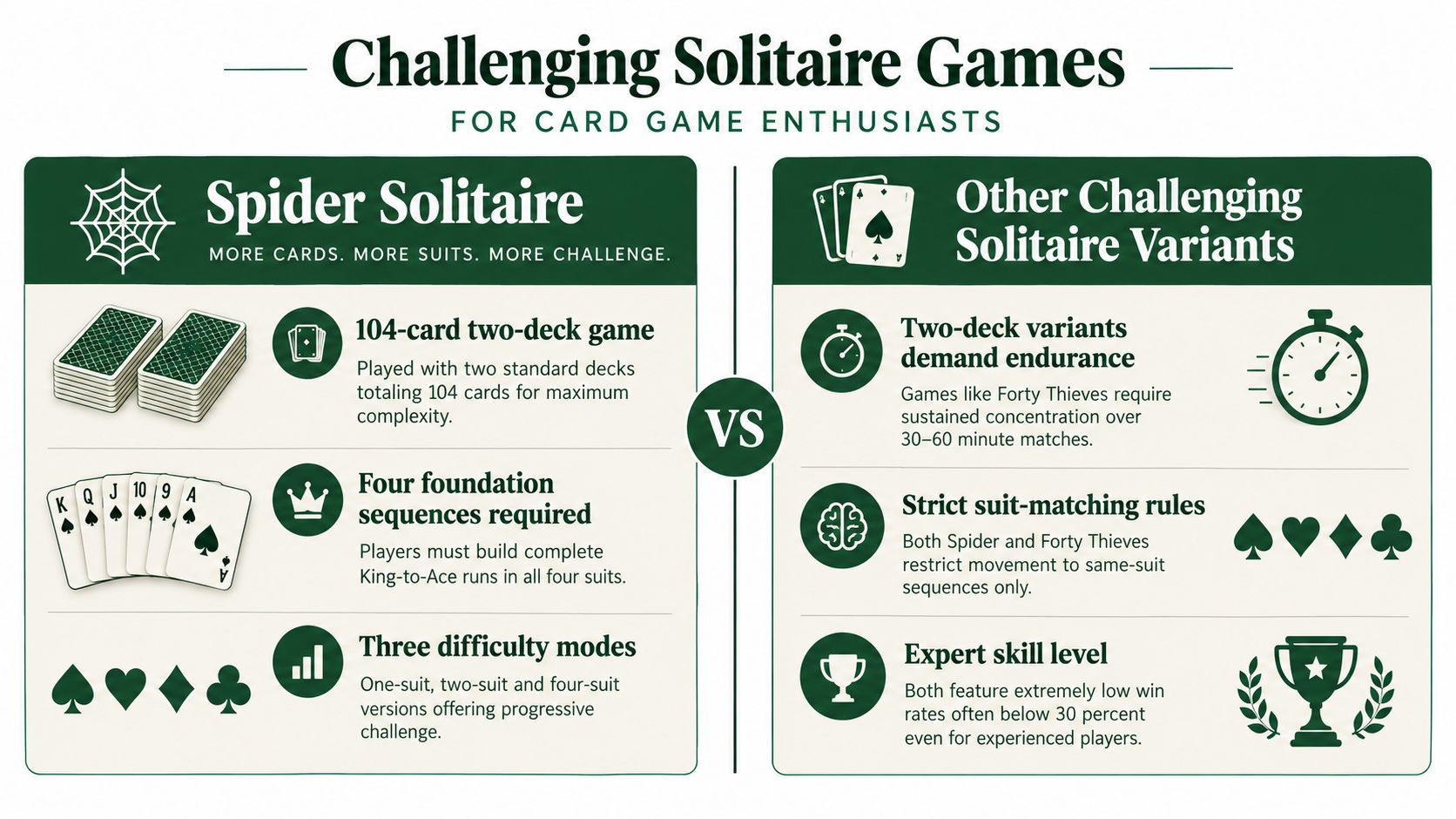
Spider uses 104 cards across 10 tableau columns, and you win by completing 8 same-suit runs from King down to Ace, based on the standard Spider Solitaire rules. Any face-up card can go on a face-up card one rank higher, even across suits. But only same-suit sequences move cleanly as a unit and clear from the board as finished runs.
That rule is the whole puzzle.
A mixed stack works like a box filled with items from different rooms. You can carry the box for a while, but when you need one specific item, the mess slows everything down. In Spider, mixed sequences help with short-term reveals, then later block the long moves that solve the deal.
Here's a quick visual comparison before the strategy gets more specific.
What Spider tests
Spider mainly tests sequencing and spatial planning. Sequencing matters because the strongest boards preserve same-suit order instead of piling cards together just because the rank fits. Spatial planning matters because empty columns are not just nice to have. They are working space for reorganizing long stacks.
Suit count changes the skill mix. One-suit Spider is a good training version because it teaches movement and column management with fewer penalties for messy choices. Two-suit Spider starts asking for real suit discipline. Four-suit Spider is where every casual shortcut becomes expensive, because a harmless-looking mixed pile can freeze an entire side of the board.
A practical rule helps here. If two moves reveal a card, prefer the one that keeps or creates a same-suit chain.
Consider a common position. You can place a 9 on a 10 of another suit to expose a hidden card now, or wait and attach that 9 to a 10 of the same suit a little later. Newer players often chase the instant reveal. Stronger players check what that reveal costs. If the first move creates a tangled column that cannot travel later, the short-term gain is smaller than it looks.
Another point causes confusion. Dealing new cards from the stock is not neutral. It changes every column at once, so it often helps to clear clutter and open a column before taking the next deal. If your tableau is already cramped, adding a full new row can bury the little flexibility you still had.
Practice drill and progress tracking
Match Spider to the skill you want to train. Use one-suit deals to practice sequencing, two-suit deals to practice suit discipline, and four-suit deals to practice full-board planning under pressure.
Try this drill for a short session. Play three games where you make one rule for yourself: every time you have a choice, rank same-suit building above simple card exposure unless the exposure creates an empty column. After each loss, use undo and find the first moment where a mixed stack became hard to move. That review matters because Spider mistakes often happen earlier than the collapse.
Play Solitaire Gaming fits this kind of practice well. Hints can show you candidate moves, but the more useful tool is unlimited undo/redo, because it lets you compare two move orders from the same position and see which one preserves mobility. If you want a rules refresher with tactical examples, its guide on how to play Spider and improve your strategy is a helpful companion. Daily challenges give you a repeatable test, and stats or leaderboard goals can show whether your cleaner sequencing is turning into more consistent finishes in the tougher suit modes.
A short walkthrough can also help you see how experienced players preserve mobility mid-game.
2. FreeCell Solitaire
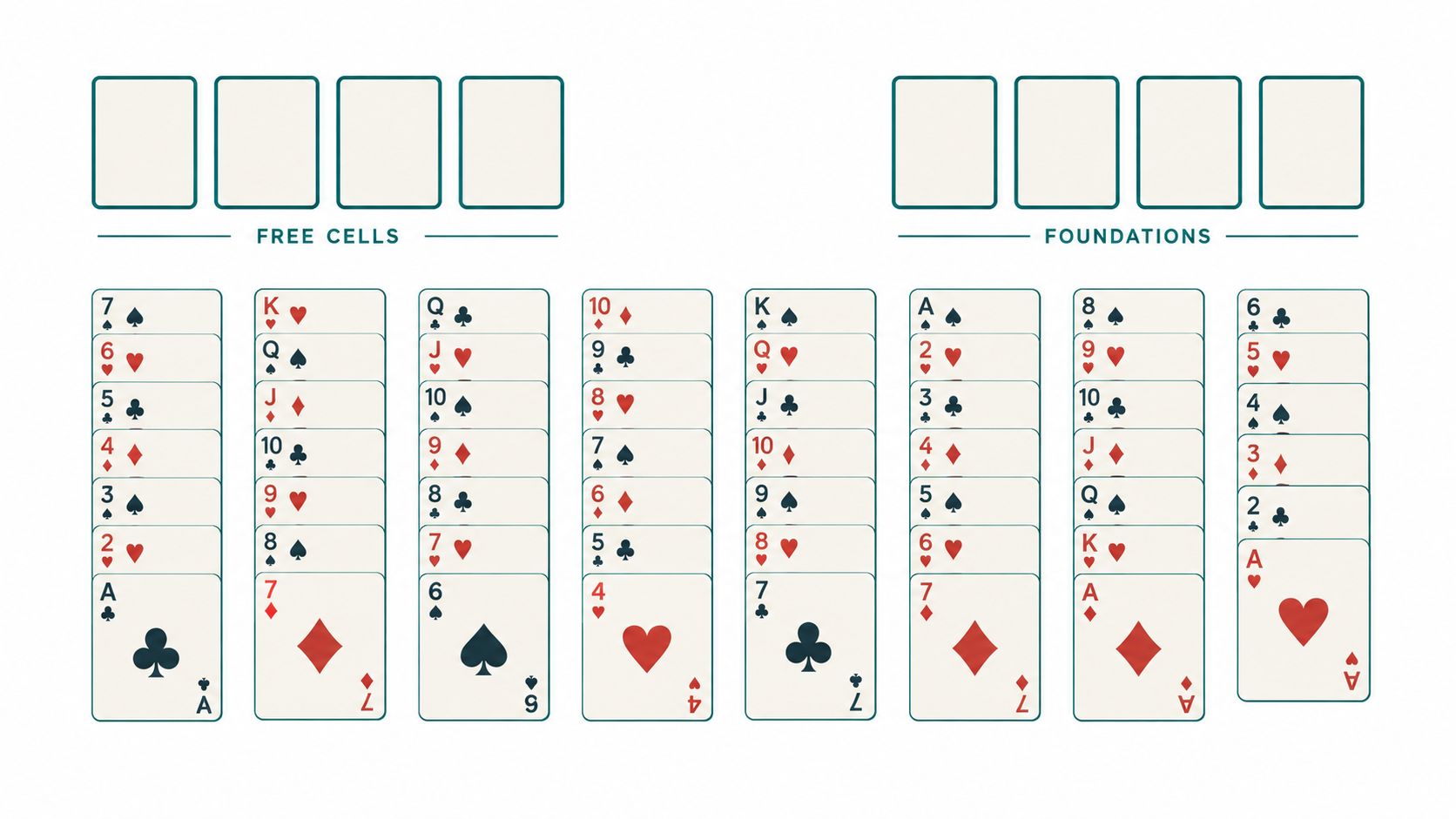
FreeCell feels different the moment you start because almost everything is visible. There's less mystery and more accountability. If you lose, it usually feels like a planning error, not a hidden-card ambush.
That's why FreeCell is one of the best challenging solitaire games for players who want to build methodical skill. In the same large Solitaired dataset noted earlier, FreeCell recorded a 40.9% win rate from 296,733 games. That's not easy, but it's high enough that improvement feels tangible rather than random.
The rule that changes everything
FreeCell's key mechanic is move capacity. The maximum number of cards you can move as a group is (empty free cells + 1) × 2^(empty tableau columns), according to the FreeCell rules explanation at StillDeck. There's also an important exception. If you're moving a sequence into an empty column, that destination column doesn't count as a helper in the calculation.
That means board space is not just convenient. It is your move engine. Fill every free cell and every column carelessly, and your options collapse.
Keep at least one free cell or one empty column available unless you know exactly what the next release move is.
Skill focus, drill, and how to measure progress
FreeCell primarily tests spatial planning. You're not guessing what's in the deck. You're budgeting temporary space so you can move a buried sequence at the right time.
Try this drill for a week: before each move, say to yourself which space resource you are spending. A free cell, an empty column, or a sequence transfer. That simple habit slows down impulsive moves and teaches board accounting.
For real-world play, hints are especially educational. In FreeCell, a hint often reveals a sequencing idea you didn't spot. Play Solitaire Gaming also gives you unlimited undo, which makes it easy to compare two different opening plans on the same deal. If you want a deeper discussion of solvability and what makes certain deals feel brutal, read is FreeCell always winnable.
Track something stricter than wins alone. Undo count per win is a strong metric in FreeCell because it reflects how clearly you're seeing the board before committing.
3. Pyramid Solitaire
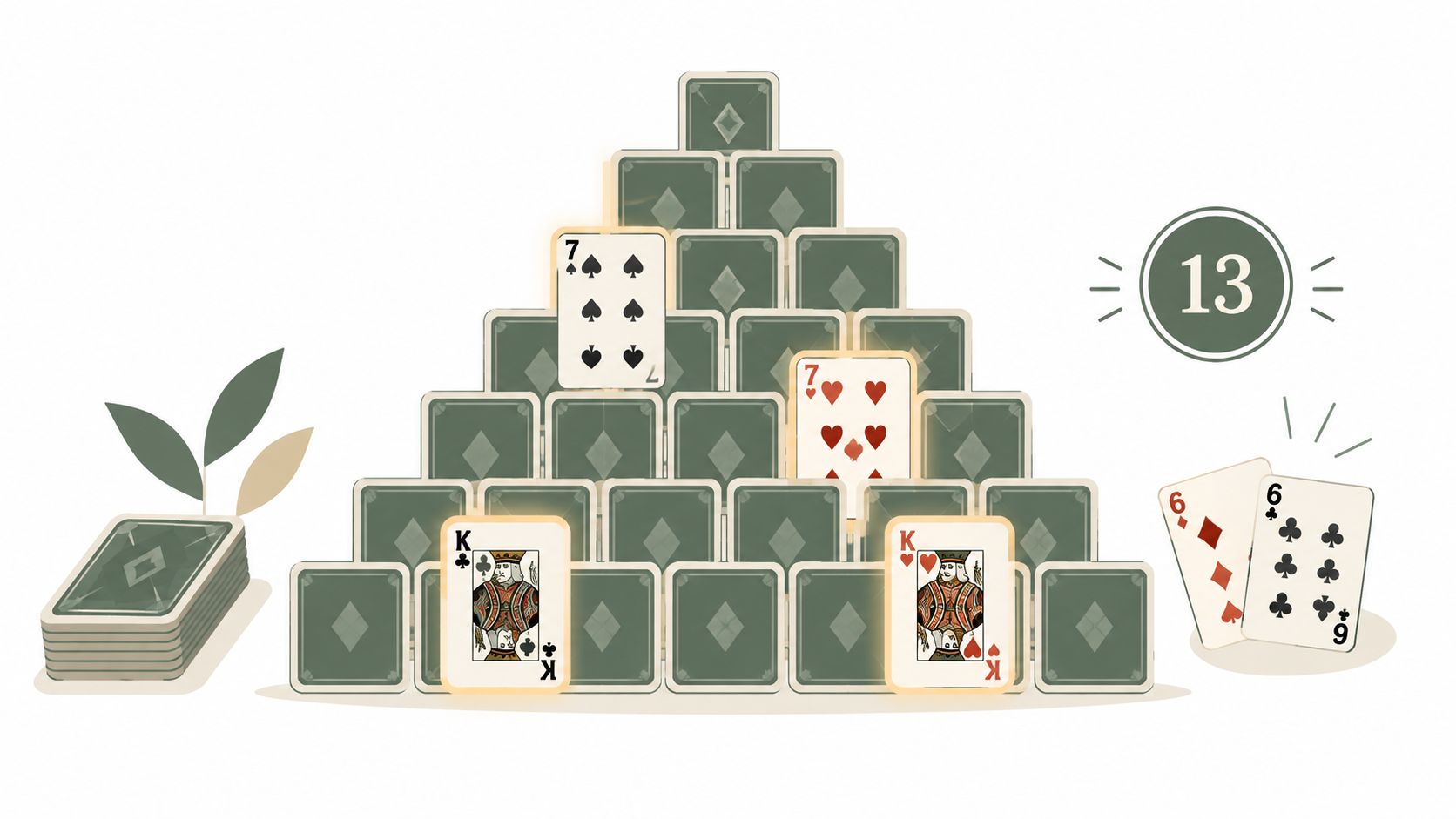
Pyramid looks gentle until you realize how many losing decisions happen early. The layout uses a layered pyramid where overlapped cards stay blocked until the cards above them are removed. You clear cards by pairing exposed cards that total 13. Kings clear alone, while other ranks need matching values.
That sounds simple, but Pyramid is a game of exposure order. A legal pair isn't always a good pair if it opens the wrong part of the structure or burns a card you needed from the waste.
Why the easy math becomes hard
Pyramid mainly tests probability judgment and exposure choices. You're asking two questions at once. Does this pair help now, and what does it make possible next?
A common scenario makes that clear. Suppose you can clear a 5 with an 8 from the waste, or clear a different 5 with an 8 from the pyramid itself. Both moves score the same immediate result. But the second choice may reveal two buried cards, while the first leaves the structure mostly unchanged.
Don't remove pairs just because they're available. Remove pairs that improve the shape of the board.
Practice drill and best use of tools
Run a focused drill where you pause on every turn with two or more pairing options and name which hidden cards each option could expose. If you can't tell, use undo after the fact and compare outcomes. Over time, you'll start seeing Pyramid less as arithmetic and more as controlled demolition.
This is also where accepting luck matters. Some shuffles leave too few productive pairing paths. Good play still matters, but not every loss means you missed a hidden masterpiece.
If you're using Play Solitaire Gaming, hints can help when you don't see an immediate pair, but undo is the stronger learning tool here because it lets you compare exposure paths directly. Its guide on how to win Pyramid Solitaire more consistently fits this variant well because the biggest leap comes from choosing better clears, not from moving faster.
4. Klondike Solitaire
Klondike gets mislabeled as the easy one because everyone recognizes it. That familiarity causes a different mistake. Players treat each legal move as progress, when the test is deciding which legal move keeps the game alive two or three turns later.
The rules look simple on paper. Build down in alternating colors in the tableau. Build up by suit on the foundations from Ace to King. Draw from the stock, then work with the waste card when it has a legal home, as explained in this draw-one versus draw-three rules guide. The hard part is not memorizing those rules. The hard part is seeing how one early move changes your future stock cycle and your available parking spots in the tableau.
What skill Klondike really tests
Klondike mainly tests stock management, with a second layer of sequencing. A useful comparison is a small workshop bench. Every time you move a card to the foundation, you clear one item away, but you may also lose a place where another card could have rested temporarily. Newer players often send low cards up as soon as possible. Stronger players ask a stricter question first: do I need this card down here to help reveal a face-down card or to rearrange a column?
Draw-one and draw-three sharpen different habits. Draw-one gives you more access, so it is better for learning how tableau choices create or waste opportunities. Draw-three makes memory and timing matter more because a playable card can disappear for a full stock cycle if you use the wrong move first. As noted earlier in the article, published win-rate comparisons show that turn-one Klondike is much more forgiving than turn-three.
A practical example of the tension
Suppose you can move a black 6 to a red 7 in one column, or move a low club to the foundation. The foundation move feels cleaner. The 6 move may be stronger if it reveals a face-down card or opens a column for a King later. Klondike keeps presenting that tradeoff: tidy the board now, or preserve mobility for the next sequence.
That is why the game frustrates skilled players. A move can be legal, sensible, and still wrong for this deal.
Practice drill and smart use of tools
Use a two-run drill. In the first game, delay foundation moves unless they reveal a hidden card or clearly improve a sequence. In the second game, play the opposite way and move safe foundation cards up quickly. Compare your results, especially in draw-three. You will start to see which cards function as support beams in the tableau and which ones are safe to remove.
Play Solitaire Gaming's Klondike Solitaire strategy guide fits that lesson well because it focuses on decision patterns instead of generic tips. On the site itself, undo and redo are most helpful after a stock pass. Replay the same position and test whether keeping a card in the tableau gave you a better waste order. Daily challenges work well for consistent practice because they give you one contained deal to examine instead of a blur of unrelated losses. Stats help too. Track whether your losses come more often from stalled stock cycles or from blocked face-down cards, then practice the weaker skill on purpose.
Luck still matters here. Some deals collapse because the hidden cards and stock order never cooperate. Klondike improves fastest when you separate those losses from the ones caused by rushing cards to the foundation or spending tableau space too early.
5. Forty Thieves Solitaire
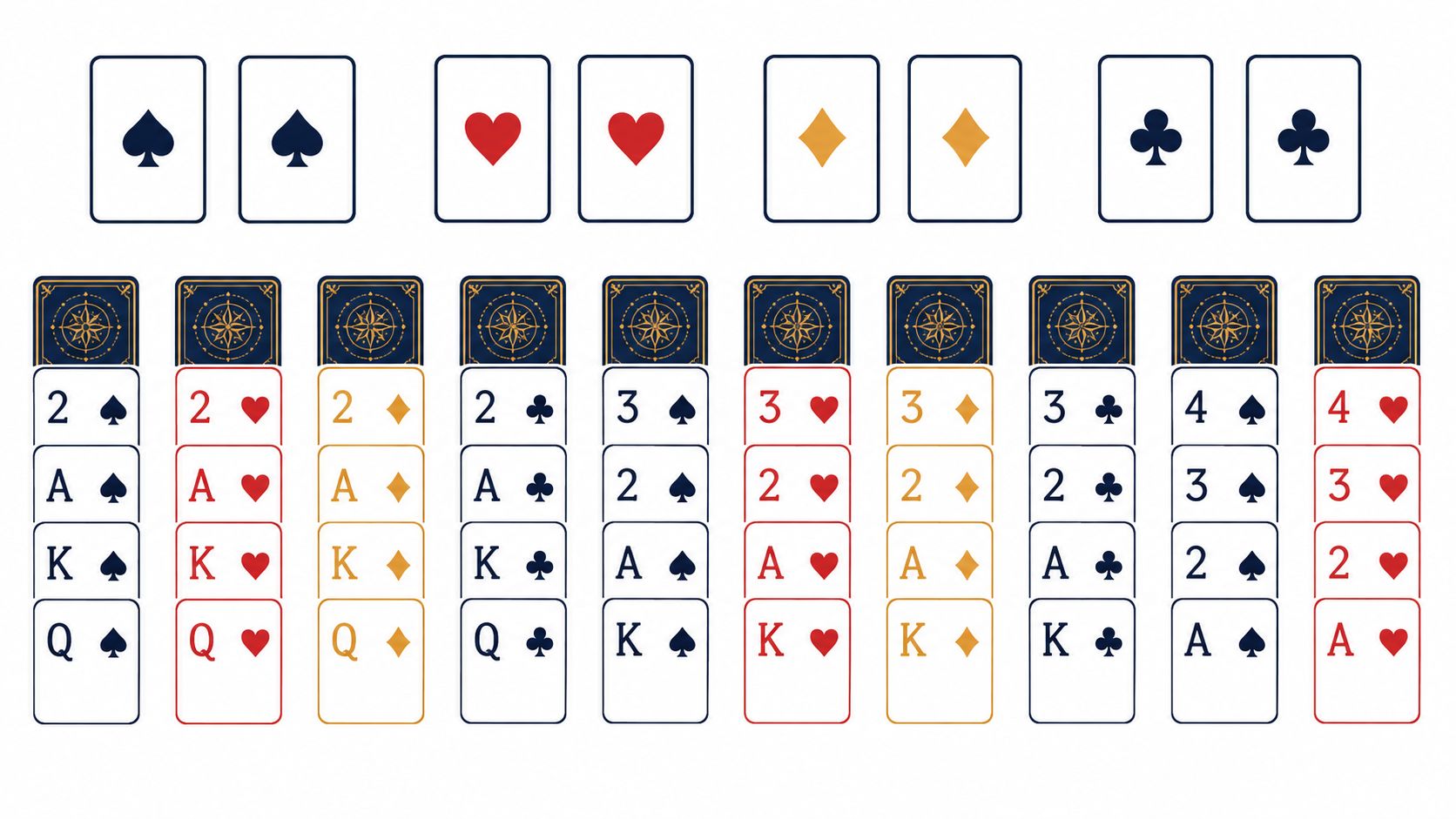
Forty Thieves is what happens when a solitaire game strips away generosity. It uses two decks and asks for clean suit-by-suit building with very little slack. If Klondike feels like a negotiation, Forty Thieves feels like a contract.
The challenge is mostly in the tableau rule. You don't build down by alternating color. You build down by suit. That sounds like a small change until you try to free a card trapped behind the wrong suit stack.
Why expert players keep coming back
Forty Thieves belongs in any discussion of challenging solitaire games because it punishes vague play. If you move a card “for now,” you often regret it later. Suit purity matters from the start, and empty spaces become precious because they can rescue a blocked run or strand one.
Independent difficulty rankings often place it among the tougher classic variants. One comparative source described Accordion as the hardest at about a 1% win rate, while Canfield, Spider 4-suit, and Forty Thieves cluster around 8 to 10%, according to the Solitaired overview of difficult solitaire games. That doesn't tell you how your next deal will play, but it does show the company Forty Thieves keeps.
Practice drill and platform features that help
The best drill here is a pre-move scan. Before your first move, identify every visible card that already has a same-suit destination or blocker. Then make your opening choice based on which move improves suit order, not just which move looks active.
A practical way to use Play Solitaire Gaming is to treat undo as a laboratory. Try one opening line that pushes foundations early and another that conserves tableau mobility. Over several sessions, check your private synced stats for a pattern in which approach produces better streaks or fewer dead-end boards.
This variant also rewards patience with Daily challenges. A seeded deal gives you a fixed puzzle to revisit mentally, which is useful in a game where one early suit mistake can shape the entire board.
6. Golf Solitaire
Golf is fast, but it isn't shallow. It replaces long-range stock management with immediate sequencing pressure. You clear exposed tableau cards by playing one rank up or down from the current card, and you can switch direction whenever the next move allows it.
That freedom is the trap. Because so many moves look playable, it's easy to spend a useful card on a short sequence and miss the longer chain that would have opened the board.
The skill behind the speed
Golf mainly tests rapid decisions and local pattern reading. You don't have much time to indulge a complicated plan because the stock is your finite rescue line. Once you draw, the sequence resets, and a promising branch can disappear.
A realistic mid-game choice might look like this. Your current card is a 7. You can clear a 6 that exposes two more cards, or clear an 8 that keeps a longer visible chain alive. Neither move is universally right. The better move depends on whether exposure or continuity is rarer on that specific board.
- Favor exposure early: If one move opens buried cards and the other only extends a surface chain, the exposure move often gives you more future outs.
- Save the stock: Don't draw just because the tableau path looks short. Check both up and down directions first.
- Review direction changes: Undo is valuable in Golf because a single up-then-down pivot can determine whether a whole row clears.
Practice drill and tracking idea
Play three quick games in a row with one focus only: before each move, count how many immediate follow-ups it creates. You're training yourself to prefer branches over isolated clears.
Golf fits Play Solitaire Gaming well because short rounds make repetition easy. Use Daily mode when you want a fixed target, and use leaderboard play when you want to practice making clean decisions under a little pressure. A useful metric here is average completion time only after your win rate becomes stable. Before that, decision quality matters more than speed.
7. TriPeaks Solitaire
TriPeaks sits between accessibility and planning. Like Golf, you remove cards one rank above or below the current card, and you can change direction as needed. Unlike Golf, the three overlapping peaks make exposure order much more visual. Clearing the wrong ridge can leave a more valuable lane blocked.
That makes TriPeaks a good bridge game. It teaches sequencing quickly, but it still rewards players who look beyond the next legal move.
What TriPeaks is really testing
TriPeaks tests rapid sequencing with board-shape awareness. You're not only extending runs. You're choosing which peak collapses first and which hidden cards become available next.
A simple example shows the difference. If two legal moves exist and one reveals a center card touching multiple blocked cards, that move often has more strategic value than a move that only peels an outer edge. Beginners tend to clear what's nearest. Better players clear what opens the most structure.
In TriPeaks, the strongest move often isn't the longest run. It's the move that opens the board for the next run.
Practice drill and useful features
Use a “center first” drill for several games. Whenever you have equal sequence options, choose the move that exposes the most connected hidden card, even if the immediate run is shorter. Then review with undo if the board later stalls. You'll start seeing the peaks as linked systems instead of three separate piles.
TriPeaks also pairs well with Daily challenges because the deals are short enough to replay mentally after a loss. If you sign in on Play Solitaire Gaming, private synced stats give you a clean way to compare streaks across desktop and mobile without changing the game itself. That consistency helps when you're training fast recognition rather than deep calculation.
8. Yukon Solitaire
Yukon is a great test for players who say they hate losing to hidden information. There's no stock pile to blame. Nearly all the complexity sits in movement rules and board vision.
Its identity comes from a distinctive twist. You can move tableau groups even when the card you want isn't fully exposed, as long as the sequence below it moves together legally. That means a partially buried card can become active long before a Klondike player would expect it.
Why Yukon feels strange at first
Yukon mainly tests visible-information planning and spatial reasoning. Since so much is on the table from the start, the hard part isn't discovering options. It's recognizing which apparent mess can be transformed into a legal chain.
That creates a very different mental load from Klondike. In Klondike, you often ask, “What will the next stock card give me?” In Yukon, you ask, “What sequence can I relocate if I first make one supporting move?” The board is open, but the geometry is tricky.
Practice drill and progress method
Start each game with a full-board scan before touching anything. Find one red-black descending chain that could travel if a single blocker moved. Then spend your opening turns trying to enable that transfer. This trains the exact pattern Yukon rewards.
Yukon also benefits from hints used sparingly. A hint can reveal a legal group move you didn't know to look for. Once you see enough of those, your eye gets better at spotting them unaided. Because Play Solitaire Gaming includes unlimited undo/redo, you can test a speculative multi-card move, then back out if it damages later mobility.
For players who like measuring improvement, Yukon works well with a “fewer restarts” goal. Since the full layout is visible early, better planning should reduce the urge to abandon a deal after only a handful of moves.
Challenging Solitaire: 8-Game Comparison
| Variant | 🔄 Complexity | ⚡ Resources | 📊 Expected outcomes | 💡 Ideal use cases | ⭐ Key advantages |
|---|---|---|---|---|---|
| Spider Solitaire | Very high, two-deck, 10-tableau suit sequencing; steep learning curve | 2 decks (104 cards); 15–60+ min per game | Builds deep planning/pattern skills; low win rates (≈15–30% at skilled levels) | Competitive/long strategy sessions; leaderboard play | Very high skill ceiling and replayability |
| FreeCell Solitaire | High, complex free-cell management but deterministic solvability | 1 deck; 15–30+ min; numbered deals enable replay | Strong logic/sequencing gains; almost all deals solvable with perfect play | Skill training, study of optimal play, practice sessions | Skill-dominant game with near-zero luck influence |
| Pyramid Solitaire | Medium, pair-to-13 mechanic with layered exposure constraints | 1 deck (28-card pyramid + stock); 5–10 min | Quick tactical decision-making; mixed luck/skill; variable winnability | Short casual play, quick tactical practice | Fast games, elegant layout, accessible rules |
| Klondike Solitaire | Medium, standard tableau + stock cycling (one- or three-card draw) | 1 deck; 5–30 min depending on draw rules | Good intro to solitaire strategy; moderate win rates (≈15–25%) | Beginners, casual play, learning core solitaire mechanics | Widely recognized; balanced difficulty and accessibility |
| Forty Thieves Solitaire | Very high, two-deck, suit-only descending sequences; very restrictive moves | 2 decks (104 cards); 30–60+ min per game | Develops advanced sequencing skills; extremely low win rates (<5%) | Expert players seeking ultimate challenge and long games | Deep strategic complexity and satisfying long-term goals |
| Golf Solitaire | Low–Medium, simple up/down sequencing with fast decision tempo | 1 deck; 2–5 min per game; small stock | Rapid decision-making practice; moderate win rates (≈30–40%) | Short breaks, mobile play, high-repeat casual sessions | Fast-paced, high replayability, easy to learn |
| TriPeaks Solitaire | Medium, three-peak layout with up/down sequencing and exposure planning | 1 deck; 5–10 min per game | Balanced mix of luck and planning; moderate win rates (≈30–35%) | Casual-to-intermediate players wanting visual strategy | Combines Pyramid aesthetics with Golf-like sequencing |
| Yukon Solitaire | High, all cards visible; complex multi-card moves and spatial tracking | 1 deck; 15–25+ min per game; no stock | Strong spatial reasoning and planning gains; skill-focused outcomes | Advanced players preferring minimal luck and full visibility | All-cards-visible play that emphasizes pure tactical skill |
Turn Difficulty Into a Practice Plan
The most useful way to approach challenging solitaire games is to stop asking which one is hardest in the abstract and start asking what each one trains. That shift turns frustration into feedback.
Use Klondike if you want to build the fundamentals of tableau judgment and stock timing. It teaches when to expose, when to hold, and when a legal move is strategically bad. If you want faster pattern work, pick Golf or TriPeaks. Both sharpen sequencing under light pressure, and both make it easy to fit several reps into a short session.
Pyramid is better for pairing logic and exposure choices. It rewards players who can look one move past the obvious match. FreeCell and Yukon belong together when your goal is visible-information planning. In those games, the cards are largely there to be read. Success comes from managing space, recognizing transfer opportunities, and staying organized when the board gets crowded.
Spider and Forty Thieves are the suit-discipline games. They teach restraint. In both, a move can look productive while damaging your future mobility. If you want a game that forces you to respect sequence quality, not just sequence length, those are the right tests.
A simple practice plan works better than bouncing randomly among variants. Pick one game for a week. Choose one metric you can repeat consistently, such as wins, streak length, completion time, or undo count. Then keep the goal narrow. In FreeCell, lower your undo count. In Spider, improve your ability to preserve same-suit chains. In Klondike, focus on exposing buried cards earlier. In Golf, track whether your decisions reduce forced stock draws.
Play Solitaire Gaming fits that kind of deliberate practice because the tools line up with different learning stages. Hints help when you don't yet see the move. Undo/redo helps when you want to compare two lines on the same deal. The Daily button gives you a fixed challenge, and private synced stats let you carry your progress across devices if you sign in. Global leaderboards add a competitive target when you're ready for one.
The point of a hard solitaire game isn't just to be beaten eventually. Its value is diagnostic. A challenging game becomes useful when its difficulty reveals a skill you can deliberately improve, then gives you enough repetition to improve it.
Play Solitaire Gaming gives you all eight of these variants in a fast browser format with no download barrier, plus hints, unlimited undo/redo, Daily challenges, and optional synced stats. If you want to turn challenging solitaire games into a real practice routine instead of a random habit, visit Play Solitaire Gaming and test one skill at a time.
Ready to play?